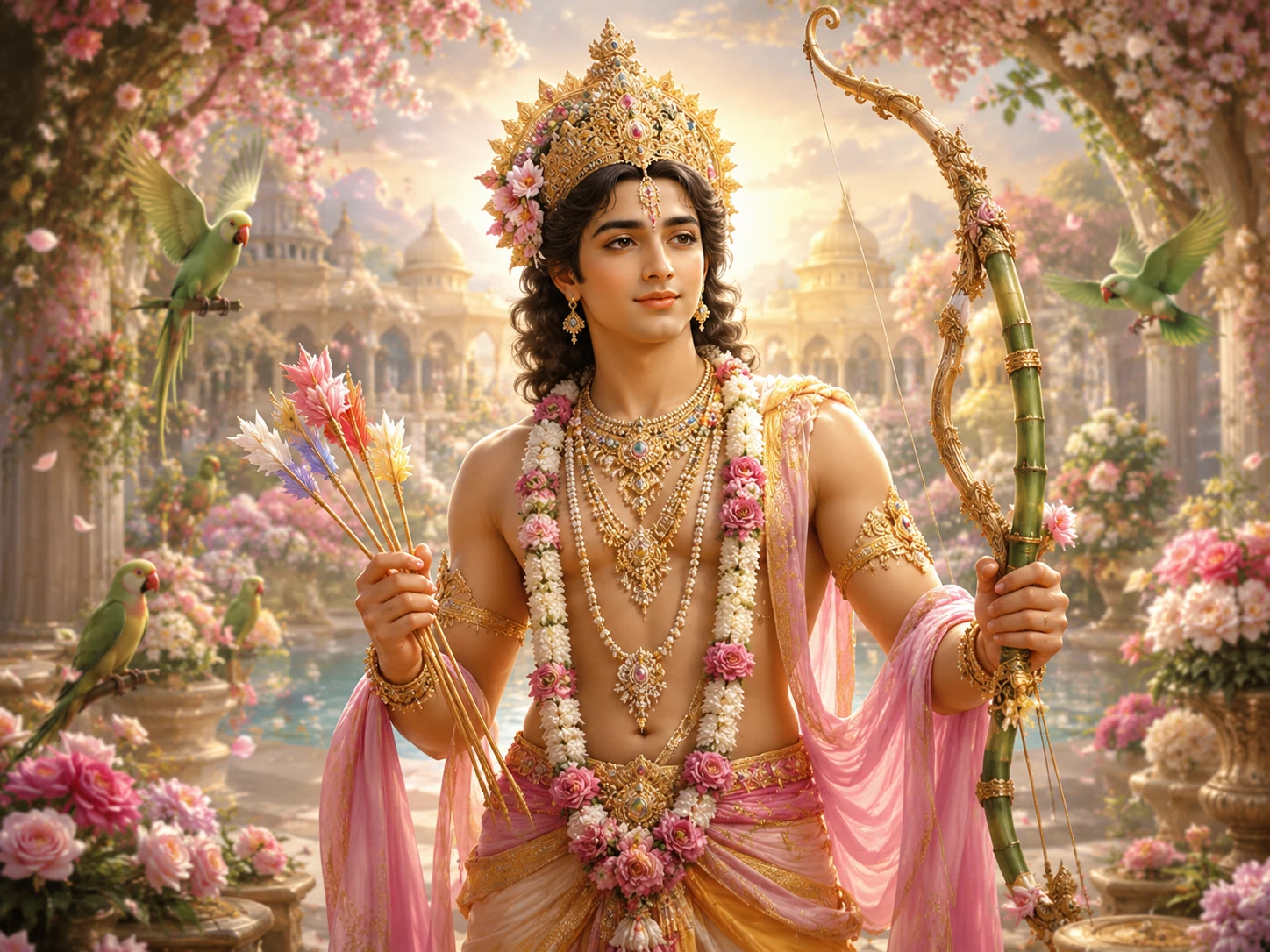
Kamadeva -- The God of Love
कामदेव -- प्रेम के देवता
Kamadeva is the Hindu god of love, romantic desire, and sexual attraction. His Sanskrit name combines kama (desire) and deva (god), and he is the deity invoked when a Hindu tradition wants to name the principle that causes humans to fall into attraction. His iconographic features are specific: a young, handsome, green-skinned or golden-skinned man riding a parrot, carrying a bow made of sugarcane strung with honeybees, and shooting five flower-tipped arrows -- lotus, ashoka, mango blossom, jasmine, and blue lotus -- each of which produces a specific emotional effect. His wife is Rati (pleasure), and his constant companion is the spring season Vasanta, who travels with him ensuring that wherever they go, flowers bloom and breezes turn sweet. He is also known as Manmatha (the churner of the mind), Madana (the intoxicator), Ananga (the bodiless), Pushpabana (he of flower-arrows), and Kandarpa (the inflamer). Each epithet names a different aspect of what falling in love feels like. Hindu poetic tradition, from Kalidasa in the fifth century to Jayadeva in the twelfth, has drawn continuously on Kamadeva's iconography to describe the experience of being struck by love. The arrow is not a metaphor. In Hindu aesthetic theory, falling in love is, at the theological level, being hit by Kamadeva's bow.
The central Kamadeva narrative in Hindu mythology is his burning by Shiva, retold across the Shiva Purana, the Matsya Purana, and most finely in Kalidasa's Kumarasambhava. The crisis began when the demon Tarakasura was granted the boon that he could only be killed by a son of Shiva. Shiva, after the death of his wife Sati, had withdrawn to Mount Kailash in deep meditation and showed no inclination toward marriage or children. The gods, fearing that Tarakasura would devastate the three worlds, sent Kamadeva to interrupt Shiva's meditation and awaken desire in him toward Parvati, Sati's reincarnation, who was performing tapas nearby. Kamadeva agreed, knowing the risk. He travelled to Kailash with Rati and Vasanta. He drew his bow and shot a flower-arrow at the meditating Shiva. Shiva felt the disturbance, opened his third eye, and with a single glance reduced Kamadeva to ash on the spot. Rati collapsed in grief. The gods retreated. But the arrow had struck its mark: Shiva, annoyed and momentarily distracted, noticed Parvati and, over time, consented to marry her. Skanda was conceived, eventually defeated Tarakasura, and the cosmic order was restored. Kamadeva had done his job by sacrificing his body. He is ananga -- the bodiless -- ever since.
ॐ कामदेवाय विद्महे पुष्पबाणाय धीमहि । तन्नो अनङ्गः प्रचोदयात् ॥
oṃ kāmadevāya vidmahe puṣpabāṇāya dhīmahi | tanno anaṅgaḥ pracodayāt ||
Om. Let us know Kamadeva. Let us meditate upon the one whose arrows are flowers. May the bodiless one (Ananga) kindle our insight.
— Kamadeva Gayatri Mantra (traditional Smarta and Vaishnava corpus)
Kalidasa's Kumarasambhava, one of the greatest works of classical Sanskrit literature, devotes its entire third canto (canto 3) to the Kamadeva-Shiva encounter. The poem was written probably in the fourth or fifth century CE and has been read continuously since then; it is still taught in Sanskrit departments at JNU, at Hyderabad Central University, and at Benaras Hindu University. Canto 3 describes Kamadeva's approach to Kailash with cinematic precision: the mountain under the early spring; Shiva seated in dhyana; Kamadeva approaching cautiously, Rati and Vasanta beside him; the slow drawing of the sugarcane bow; the moment Shiva opens his eye; the destruction. Kalidasa's Sanskrit is among the most musical in the language, and the verses describing Kamadeva's death are read in Indian literary tradition as one of the peak achievements of Sanskrit poetry. The fourth canto is Rati's lament, widely considered the most moving grief-poem in classical Indian literature. Rati wanders through the forest calling out to her absent husband, addressing trees and animals, describing their love in specific detail, asking the universe how it can continue in his absence. The poem is traditionally assigned as a memorization exercise in strict Sanskrit pedagogy because its verse-structure is perfect and its emotional register is transferable across contexts: any experience of loss in a student's life finds echo in Rati's grief.
Rati's lament leads to the resolution of the Kamadeva narrative. When her grief reached its peak, the other gods and the goddess Parvati intervened on her behalf. A compromise was arranged: Kamadeva could not be restored to his former physical form, because Shiva's decision was irrevocable, but his essence was preserved and promised a future embodiment. The promise was fulfilled in the Dvapara Yuga: Kamadeva was reborn as Pradyumna, the son of Krishna and Rukmini. Rati was reborn as Mayavati, the wife of the demon Shambara. The Bhagavata Purana (10.55) tells the full story of their reunion: the infant Pradyumna was stolen from Krishna's palace by Shambara, who knew of a prophecy that this child would kill him, and thrown into the ocean. A fish swallowed the child. A fisherman caught the fish and gave it to Shambara's kitchen. The cook found the living child inside and brought him to Mayavati, Shambara's wife, who raised him without knowing his true identity. When Pradyumna grew up, Mayavati (who was actually Rati) revealed his identity and her own. They fell in love again, Pradyumna killed Shambara, and they escaped to Dwaraka where Krishna welcomed them. The love-story that began in heaven as Kamadeva and Rati continued on earth as Pradyumna and Rati-Mayavati. The tradition treats this as evidence that divine love, once established, cannot be permanently undone -- even by Shiva's third eye.
Kamadeva's Five Flower-Arrows
| Arrow | Flower | Effect |
|---|---|---|
| Unmadana / उन्मादन | Lotus / कमल | Causes intoxication and infatuation. / उन्माद और मोह उत्पन्न करता है। |
| Tapana / तापन | Ashoka / अशोक | Causes heating of the body with desire. / इच्छा से शरीर में ताप उत्पन्न करता है। |
| Shoshana / शोषण | Mango blossom / आम्र-मंजरी | Causes the lover to waste away from longing. / प्रेमी को विरह से क्षीण कर देता है। |
| Stambhana / स्तम्भन | Jasmine / चमेली | Causes paralysis, the inability to act for love of the beloved. / स्तम्भन, प्रिय के प्रेम में कार्य करने की अक्षमता उत्पन्न करता है। |
| Sammohana / सम्मोहन | Blue lotus / नीलकमल | Causes total fascination, the loss of all will to resist. / पूर्ण मोह, प्रतिरोध की इच्छा का नाश उत्पन्न करता है। |
The five arrows correspond to the five stages of falling in love as described in classical Sanskrit rasa theory. The Natya Shastra (4th century CE) and later texts on kavya (poetry) and rasa treat these stages as the specific phenomenology of romantic love. Kalidasa's poetry uses each stage precisely.
The festival of Holi has a specific Kamadeva connection that is often forgotten in contemporary celebrations. In parts of South India, particularly in Andhra Pradesh, Karnataka, and Tamil Nadu, the festival of Kama Dahana or Holika Dahan on the full moon of Phalguna is understood to commemorate the burning of Kamadeva by Shiva. Communities light large bonfires on this night and, in some regions, an effigy representing Kamadeva is symbolically thrown into the flames along with the effigy of Holika. The following day, the colourful play of Holi is said to represent Rati's return and the celebration of restored desire. The North Indian Holi mostly retains only the Holika-Prahlad narrative and the colourful play; the Kamadeva layer has faded. But in Telugu and Kannada Shaiva traditions, the Kama Dahana observance is distinct and continues to be performed annually. Scholars of festival history, including Devdutt Pattanaik and Wendy Doniger, have documented this dual origin of Holi, with different regional communities emphasizing different layers. A Telugu family in Vijayawada celebrating Kama Dahana on Phalguna Purnima, and a Punjabi family in Amritsar celebrating Holi the next day with colour, are performing what is theologically a single festival in two related registers: the burning of desire and the return of desire.
Kamadeva shares cross-cultural family resemblance with Eros of Greek mythology and Cupid of Roman mythology, but the Indian deity is theologically more developed than his Mediterranean cousins. Eros in Hesiod is one of the primordial Greek gods; Cupid in Roman poetry is Venus's infant son with an arrow. Kamadeva's iconography of the archer with flower-arrows, his wife Rati (the Greek Psyche has some functional overlap but the genealogy is different), his parrot mount, his flower-draped bow -- all are elaborated over two millennia into a theologically complete system. Indologists including Wendy Doniger and Diana Eck have noted the structural parallel but cautioned against assuming direct transmission; the archer-of-love motif appears independently in several ancient Indo-European mythologies, and the specific Indian elaboration is distinct. The most useful comparative point is the shared theological recognition across cultures that love and desire are not merely personal emotional states but structural cosmic principles deserving of personification. A literature student at Delhi University reading the Metamorphoses of Ovid alongside the Kumarasambhava of Kalidasa is working in comparative poetics that Indian academic tradition has pursued since the nineteenth century. Kamadeva's cross-cultural kinship does not diminish his Indian specificity; it adds to it.
Anang Trayodashi, the thirteenth day of the waxing moon in Margashirsha (November-December), is a specific festival observance dedicated to Kamadeva in his bodiless form. The vow (vrata) is usually observed by married women seeking the welfare of their husbands and the continuation of their marital love. On this day, women fast, prepare a special meal of sweet milk-based dishes, and at the end of the day offer these dishes to their husbands while reciting traditional mantras to Kamadeva and Rati. The theological framework is that since Kamadeva became bodiless after Shiva's third eye, it is now Rati who holds the form of the couple's presence in the world; any woman preserving her husband's love is, at a symbolic level, continuing Rati's work. The festival is observed primarily in Bengal, Odisha, and in parts of Maharashtra and Gujarat. A second Kamadeva-specific observance is Madan Trayodashi in Chaitra (March-April), the spring equivalent, observed more widely across North India as a festival of renewed romantic energy between long-married couples. The festival is low-key compared to Holi or Diwali but is still kept by orthodox families. Contemporary commentators have noted that in an era of high divorce rates and declining marriage stability, the Anang Trayodashi observance can be understood as a traditional practice whose effectiveness does not require literal theological belief; the ritual attention to the marital relationship, performed once a year, has measurable effects on marital satisfaction.
Kamadeva's role in the Gaudiya Vaishnava tradition of Chaitanya is theologically specific and merits separate discussion. The Kama Gayatri in its Gaudiya formulation -- klim kamadevaya vidmahe pushpabanaya dhimahi tan no ananga prachodayat -- is held by Gaudiya theology to be a mantra that addresses Krishna himself, not a separate Kamadeva. The tradition teaches that Kamadeva is an aspect of Krishna, specifically the aspect that attracts the soul toward Krishna through the experience of love. The theological logic is that the very desire a devotee feels -- romantic, aesthetic, emotional -- is already Krishna operating under the name of Kamadeva. Srila Prabhupada, the founder of ISKCON, elaborated this teaching in his commentaries on the Chaitanya Charitamrita (Madhya Lila 21.125-129), arguing that the Kama Gayatri is one of the most potent mantras in the tradition and is given to advanced disciples for specific sadhana. The Gaudiya reading transforms what is, in popular perception, a mantra for romantic attraction into a mantra for absorption in Krishna-bhakti. This transformation is characteristic of how Vaishnava tradition has continuously redirected kama (desire) toward bhakti-kama (devotional desire), not denying desire but reorienting its object. A Gaudiya devotee in a Mumbai ISKCON temple chanting the Kama Gayatri is doing something theologically quite different from a popular practitioner in a small town who chants the same mantra for personal romantic success. The difference is in the intention, not the syllables.
Dedicated Kamadeva temples in India are few but notable. The Kameshwara Temple at Kanchipuram in Tamil Nadu honours Kamadeva directly and is mentioned in the Periya Puranam and other Tamil Shaiva texts. The Trivikrama-Kameshwara Temple in Kerala's Alappuzha district is another. The Kamdev Statue at the Konark Sun Temple in Odisha is carved on one of the temple's external panels and is considered one of the finest Kamadeva sculptures in Indian art, showing him with Rati, holding the sugarcane bow, with attendant maidens. Most Kamadeva worship in contemporary India, however, is not performed at dedicated temples but at Krishna temples, where Pradyumna is venerated as Krishna's son and Kamadeva's reincarnation. The annual Pradyumna Abhisheka at the Dwarkadhish Temple in Dwarka, Gujarat (falling in the lunar month of Shravana) is a major Kamadeva-adjacent festival. In the northeast, parts of Assam and Tripura, Kamadeva has a regional identity merged with local Kamakhya-tradition goddesses, and the Kamakhya Temple near Guwahati (one of the 51 Shakti Pithas) has a complex theological relationship with Kamadeva that scholars trace through Tantric textual traditions. A traveller visiting Kamakhya will find Kamadeva mentioned in the temple's origin narrative: the site is where Kamadeva regained a portion of his form through the goddess's grace.
Contemporary Indian society has a layered relationship with Kamadeva that deserves direct acknowledgment. The deity's theological association with romantic love has made him controversial in certain ways and relevant in others. Bollywood and the Hindi film industry draw on Kamadeva iconography continuously: the phrase 'Manmatha' or 'Madan' appears in hundreds of love-song lyrics; the visual of the flower-arrow is a cliché of film-poster design; film titles like Manmatha and Madanotsava are common. At the same time, conservative Hindu commentators have at times questioned whether Kamadeva should be worshipped as vigorously as other deities, given that his sphere -- kama -- is one of the four purusharthas (life-goals: dharma, artha, kama, moksha) but not the highest. The tradition's answer, from the Kama Sutra of Vatsyayana (compiled roughly fourth century CE) onward, has been that kama is legitimate and necessary within its proper sphere. The Kama Sutra is not, as its popular Western reception suggests, merely a text on sexual positions; it is a detailed guidebook to the cultivation of romantic and aesthetic life within the dharmic framework. It treats Kamadeva as the presiding deity of this cultivation and begins with invocations to him. Contemporary Valentine's Day controversies in India, in which right-wing groups have sometimes opposed public romantic celebration, occasionally prompt counter-arguments pointing to Kamadeva as the indigenous Hindu patron of precisely the same cultural territory.
The theological question of why Shiva burned Kamadeva has been extensively discussed in Shaiva and Vaishnava commentary, and the answers vary. One traditional reading is that Shiva's burning of Kamadeva was not anger but a teaching: desire that interrupts meditation must be consumed, and the consumption itself is a service to the devotee who is interrupted. A second reading is that the burning was necessary for the cosmic narrative: only a bodiless Kamadeva could represent love as a universal principle rather than a partial personal deity; his bodilessness after the burning made him functionally more effective, not less. A third reading, associated with the Shaivite tradition of Kashmir, is that the burning represents the initial stage of the soul's progression in the Shaiva path: the sadhaka must first lose the gross body of desire (Kamadeva's physical form) before progressing to the subtler identifications that lead to Shiva. Each of these readings is theologically available, and none is treated by the tradition as definitive. The Kamadeva narrative is explicitly held as one of the most productive in Hindu theology because it refuses to resolve in a single direction. Love can be an obstacle to meditation. Love can also be necessary for cosmic continuation. Love can be destroyed. Love can be reborn. The single story contains all these possibilities without privileging any. A contemporary Hindu thinking about their own relationship between desire and spiritual practice finds in the Kamadeva narrative a framework that does not simplify.
The Kamasutra of Vatsyayana, compiled roughly in the third to fifth century CE in north India, opens with invocations to Kamadeva and positions itself explicitly as a text in the dharmic tradition. The popular Western reception of the Kamasutra as a sex manual is a serious misunderstanding: the text has seven sections, of which only the second deals with specific physical positions. The first section establishes the philosophical grounding of kama within the four purusharthas. The third through seventh cover courtship, marriage, the conduct of married life, relations with courtesans, and the cultivation of attractiveness and aesthetic sensibility. Vatsyayana repeatedly emphasizes that kama must operate within dharma and must not harm others; his text is a guide to civilized romantic life, not a permission for exploitation. Kamadeva is the presiding deity of this entire framework. Modern Sanskrit scholars including Wendy Doniger and Alain Danielou have produced careful translations and commentaries that attempt to recover the text's original dharmic framing. A contemporary reader seeking to understand the Hindu tradition's actual position on sexuality would do better to read Vatsyayana and to understand Kamadeva's theological role than to depend on popular stereotypes. The Hindu tradition takes kama seriously both as something to be cultivated and as something to be restrained; Kamadeva is the specific deity through whom this balance is theorized.
For a contemporary Hindu who wants to begin a Kamadeva practice, the entry point is specific to the intention. If the practice is for deepening an existing romantic relationship, the recommended observance is Anang Trayodashi or Madan Trayodashi, performed as a couple or individually, with a small household puja that includes offerings of flowers, fruit, and a meal prepared together. If the practice is for finding a romantic partner, traditional advice is to recite the Kamadeva Gayatri 108 times daily for 40 days, starting on a Friday (Kamadeva's day in the traditional panchaka), while visualizing the specific qualities desired in a partner. If the practice is for spiritual deepening in the Vaishnava lineage -- understanding Kamadeva as an aspect of Krishna -- then the practice should be taken under guidance from an initiated teacher, as Gaudiya and other Vaishnava traditions hold the Kama Gayatri as an advanced mantra. For most practitioners, the simplest and most traditional observance is to keep a small image or picture of Kamadeva and Rati together on the household puja shelf during the two Trayodashi festivals, offer fresh flowers, recite the Kamadeva Gayatri three times, and reflect on the quality of love in one's own life. The deity is not demanding. He asks only that desire be acknowledged rather than denied, and honoured rather than exploited.
Recite the Kamadeva Gayatri on Anang Trayodashi
Chant the Kamadeva Gayatri 108 times on a mala on Anang Trayodashi (Margashirsha Shukla Trayodashi), on Madan Trayodashi (Chaitra Shukla Trayodashi), or on Fridays. It is traditionally recited for the deepening of marital love. It is not yet on Eternal Raga; the mantra library has related hymns.
Tags
Eternal Raga · शाश्वत राग
Institutional voice — scholarly articles on Sanatan Dharma
Deepen Your Understanding
अपनी समझ और गहरी करें
deities avatars
Who is Shiva?
He is the ash-smeared ascetic who is also the ideal husband. The destroyer of the universe who is called 'The Auspicious One.' The god of death who drank poison to save all life. He sits in meditation on a Himalayan peak, and simultaneously dances the cosmos into existence and annihilation. No deity in Hinduism contains more contradictions -- and no deity resolves them more completely. This is not a mythology explainer. This is an attempt to stand at the foot of the mountain and look up.
scriptural exegesis
Krishna's 16,108 Queens -- The Story Behind the Number
The number sounds absurd until you understand what it means. Krishna did not 'collect' 16,108 wives. He rescued 16,100 women from a demon's prison, and when no one in society would accept them back -- because they were 'tainted' -- he married every single one to restore their honour. Add 8 named queens (the Ashtabharya) married through love, valour, or diplomacy, and you get the most misunderstood number in Hindu mythology. This is not a harem story. It is the largest social rehabilitation programme in ancient literature.
deities avatars
Daksha's Yagna and Sati -- Why Daksha Hated Shiva
A father so offended by his son-in-law that he held a cosmic sacrifice and invited every god in the universe -- except Shiva. A wife so devastated by the insult that she walked into the sacred fire and burned herself alive. And a husband so enraged by her death that he created a warrior from his dreadlock who destroyed the entire ceremony and beheaded the father-in-law. The Daksha Yagna is not a domestic dispute. It is the origin story of the Shakti Peethas, the theology of Shiva's rage, and the reason Parvati exists.
deities avatars
Parvati -- Shakti, Wife, Mother, and the Woman Who Moved a Mountain God
She is the daughter of the Himalayas who performed tapas so intense that even Shiva -- the god who burned Kamadeva to ash for daring to disturb his meditation -- was compelled to open his eyes. Parvati is Hinduism's most complete feminine archetype: lover, mother, warrior, philosopher, and the literal other half of god.
deities avatars
Rukmini and Krishna -- The Princess Who Wrote First
Promised by her brother to another king, the princess of Vidarbha sent Krishna a letter of seven verses asking him to carry her away. The story of Rukmini, chief queen of Dwarka, revered as Lakshmi herself -- and why her letter is one of the great love poems of the Bhagavata.
deities avatars
Nine Forms of Shiva -- The Many Faces of Mahadeva
He is the silent teacher under a banyan tree and the screaming destroyer on a battlefield. He is half-woman and half-man. He drank the poison that would have ended the universe and his throat turned blue. Nine scripturally-attested forms of Shiva -- from Nataraja to Rudra -- and why each one exists.
tantra mantra yantra
Mahamrityunjaya Mantra -- Conquering Death
A 16-year-old boy clings to a Shiva Linga as the god of death throws a noose around his neck. Shiva emerges from the Linga, kicks Yama in the chest, and declares the boy immortal. That boy is Markandeya. That mantra is the Mahamrityunjaya. It appears in the Rig Veda, the Yajur Veda, and the Atharva Veda -- the only healing mantra attested in three of the four Vedas. It is chanted in ICU corridors, before surgeries, at bedsides, and in cremation grounds. This is not a mantra about avoiding death. It is a mantra about not being afraid of it.
Kamadeva shares cross-cultural family resemblance with Eros of Greek mythology and Cupid of Roman mythology, but the Indian deity is theologically more developed than his Mediterranean cousins. Eros in Hesiod is one of t…
More in Deities & Avatars
33 Koti Devata -- Why Hinduism Has 33 Types of Gods, Not 33 Crore
13 min read
Agni -- The Fire God
19 min read
Annapurna -- Goddess of Food
19 min readThe same translation error that turned '33 Koti' into '33 crore' in Hinduism also happened in Buddhism. The Chinese translation of Buddhist texts rendered 'Sapta Koti Buddha' (7 Supreme Buddhas) as '7 Crore Buddhas.' The…
Deities AvatarsCommunity Reflections
🕉️
Be the first to share your reflection.