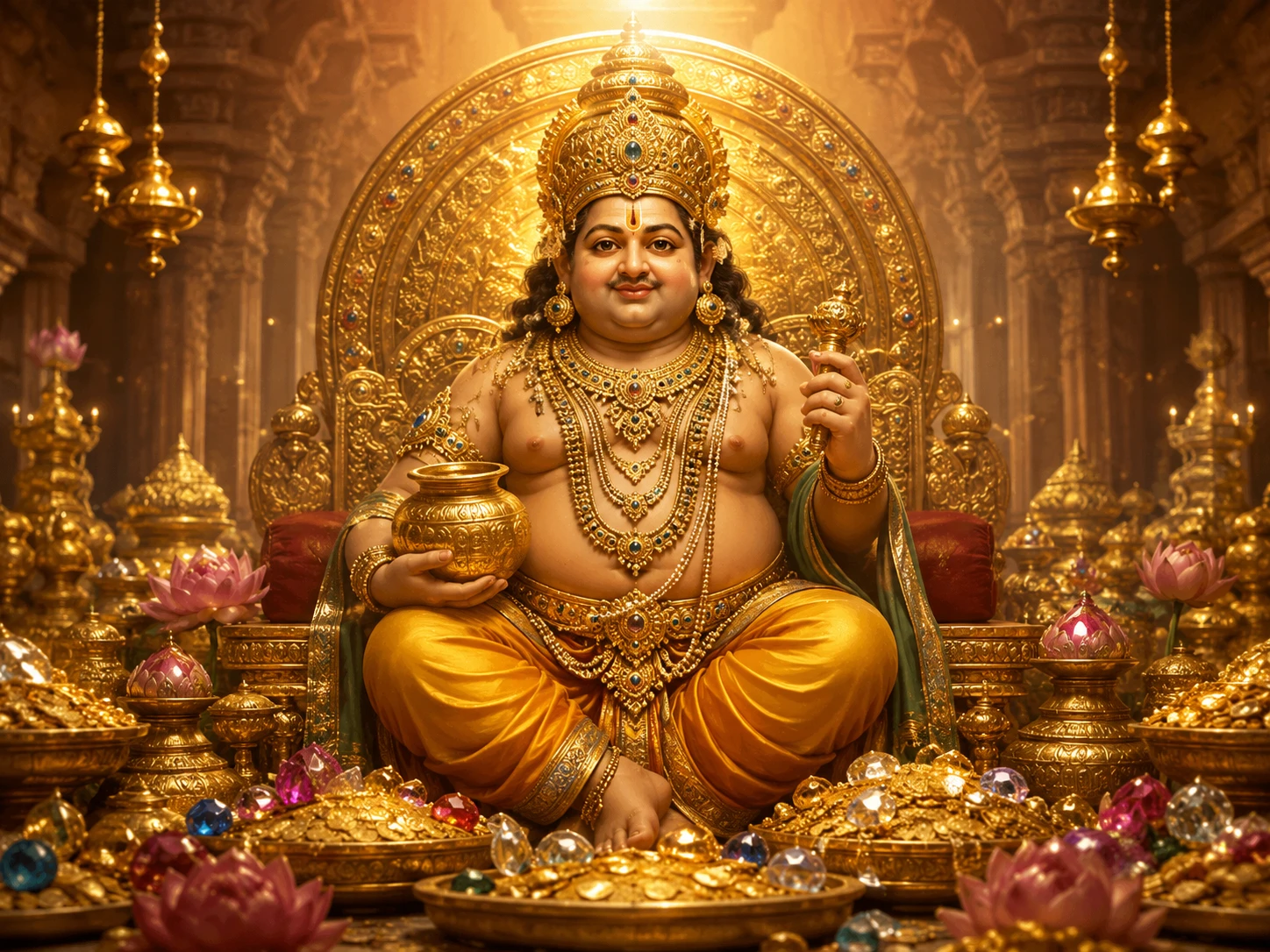
Kubera -- Lord of Wealth
कुबेर -- धन के देवता
Kubera is the Hindu god of wealth, the king of the yakshas (a class of nature spirits), and one of the four Lokapalas (guardians of the directions) who presides specifically over the north. He is one of the most practically invoked deities in Hindu civilization because his domain -- material prosperity -- intersects with the daily concerns of every household and business. Every Indian shopkeeper opening a new business performs a Kubera puja; every Diwali ritual at traders' establishments includes Kubera alongside Lakshmi; every account book in orthodox Marwari, Gujarati, and Chettiar business families opens with a Kubera invocation at the start of the new financial year. Unlike the philosophical or devotional deities whose worship is voluntary, Kubera-worship in Indian commercial life is functionally compulsory: a business that does not invoke him at festivals is treated as having overlooked something structurally important. The deity is specifically concerned with the accumulation, protection, and responsible distribution of wealth, not merely its generation. Hindu theology distinguishes these three aspects, and Kubera is the chief custodian of the first two. Lakshmi is more concerned with flow; Kubera is concerned with treasury. A wealth deity without Kubera would be incomplete in the Hindu theological scheme.
Kubera's origin and genealogy are laid out in the Mahabharata and elaborated in the Ramayana and several Puranas. He is the son of the sage Vishrava (hence one of his names, Vaishravana, 'the son of Vishrava'), and the grandson of the sage Pulastya, one of the seven great rishis. By this lineage, Kubera is a brahmin-born being, not a deva; this is theologically important because it establishes wealth as a domain that requires brahminical wisdom and restraint rather than kshatriya forcefulness or deva-ish power. Kubera's mother Ilavida bore him; Vishrava's second wife, Kaikasi, bore the rakshasa brothers Ravana, Kumbhakarna, and Vibhishana, which makes Kubera the half-brother of Ravana. This relationship drives a key narrative: Kubera originally ruled Lanka, which had been built for him by Vishvakarma, the divine architect. Ravana, after extensive tapas, received boons from Brahma that made him nearly invincible; he then expelled Kubera from Lanka and took the island-city for himself. Kubera retreated north to the Himalayas, where the gods built him a new capital, Alaka, on Mount Kailash. He has ruled from there ever since. When Rama eventually defeated Ravana and reclaimed Lanka, he offered the kingdom back to Vibhishana (Ravana's virtuous younger brother), not to Kubera. Kubera remained at Alaka. The transaction is theologically specific: wealth moves between lineages based on dharma, and Kubera's acceptance of displacement without bitterness is itself a teaching about what true wealth means.
ॐ यक्षराजाय विद्महे वैश्रवणाय धीमहि । तन्नो कुबेरः प्रचोदयात् ॥
oṃ yakṣarājāya vidmahe vaiśravaṇāya dhīmahi | tanno kuberaḥ pracodayāt ||
Om. Let us know the king of the yakshas. Let us meditate upon the son of Vishrava. May Kubera kindle our insight.
— Kubera Gayatri Mantra (traditional Smarta corpus; widely recited at Dhanteras and financial year-end observances)
Kubera's iconography is specific and unmistakable. He is shown as a short, pot-bellied figure, his body dwarfish in proportion, with a round abdomen that almost reaches his feet when he is seated. His skin is sometimes pale, sometimes golden. He wears heavy jewellery: a large gold crown, heavy earrings, a chain of precious stones around his neck, bracelets on his wrists, and rings on all his fingers. He is dressed in fine silk. In one hand he typically holds a money-bag (gada-like club sometimes), and in another a nakula -- a mongoose -- which is his specific vahana and symbolic companion. The mongoose in Kubera's iconography is not merely a mount; it vomits precious gems when squeezed, making it a functional symbol of the inexhaustible treasury. Kubera sits on a lotus or on his vahana a ram or an elephant depending on the regional tradition. His posture is sukhasana (easy sitting) rather than the heroic standing of a kshatriya deity; his face is plump and content rather than fierce or ascetic. The iconographic signature is dharmic prosperity in its fully material form, not renunciation. The contrast with Shiva, the archetypal ascetic, is deliberate: Kubera represents the opposite but equally valid pole of Hindu life, the grihastha ideal of prosperity properly enjoyed. Temple representations of the two deities side by side communicate the full dharmic range.
The concept of the Nava Nidhi, nine special treasures that Kubera specifically commands, is a distinctive feature of his theology. These treasures are not simply accumulations of wealth; each has specific attributes and domains. The nine are: Padma (lotus, associated with qualities of the heart), Mahapadma (great lotus, quality of mind), Makara (crocodile, associated with war and power), Kachhapa (tortoise, long-life and stability), Shankha (conch, knowledge), Mukunda (emerald, purity), Nanda (delight, joy-producing), Nila (sapphire, peace), and Kharva (dwarf, compact density of value). These are detailed in the Padma Purana and elaborated in later Tantric and Puranic commentaries. Each Nidhi is personified as a minor deity in Kubera's court and is itself an object of specific meditation and invocation for those seeking particular types of wealth. A business seeking commercial success may specifically invoke Mahapadma; a family seeking joyful prosperity may invoke Nanda. This differentiation of wealth into nine specific categories reflects a careful Hindu theology of prosperity that distinguishes material accumulation from the various qualitative conditions under which that accumulation is meaningful. Kubera is not just a treasurer; he is the master of a taxonomy of wealth, and different facets of his domain are suited to different devotional approaches.
Kubera and the Four Lokapala System
| Direction | Lokapala | Domain |
|---|---|---|
| East / पूर्व | Indra / इंद्र | Rain, thunder, devas; king of the gods. / वर्षा, गर्जन, देवता; देवताओं का राजा। |
| South / दक्षिण | Yama / यम | Death, dharma, judgment; lord of the ancestors. / मृत्यु, धर्म, न्याय; पूर्वजों के स्वामी। |
| West / पश्चिम | Varuna / वरुण | Waters, oceans, cosmic law; guardian of rta. / जल, सागर, ब्रह्मांडीय नियम; ऋत के रक्षक। |
| North / उत्तर | Kubera / कुबेर | Wealth, yakshas, treasures; guardian of material prosperity. / धन, यक्ष, कोष; भौतिक समृद्धि के रक्षक। |
The expanded eight-direction system (Ashta-Dikpalas) adds Agni (southeast), Nirriti (southwest), Vayu (northwest), and Ishana (northeast). Kubera's position in the north is consistently preserved across both the four-direction and eight-direction systems; the north is always the direction of wealth. This is why Vastu Shastra specifies the north as the direction for placing cash boxes, safes, and the family treasury in traditional Hindu architecture.
Dhanteras, the thirteenth day of the waning moon in Kartik (October-November), is the festival most directly dedicated to Kubera alongside Lakshmi. The name combines dhan (wealth) and teras (thirteenth), and the day falls two days before Diwali. The traditional observance involves purchasing something valuable -- historically gold, silver, or copper utensils, now often any new asset -- as an auspicious beginning of the financial festival season. Indian jewellery showrooms register enormous sales on this single day; the 2024 Dhanteras saw an estimated 60,000 crore rupees of gold and silver purchases across India in a 24-hour period. The theological framing is that what is brought home on Dhanteras begins its existence in the household as specifically Kubera-blessed, meaning that it will function auspiciously within the household economy. The household puja on Dhanteras involves lighting a diya at the entrance, placing the new purchase before images of Kubera and Lakshmi, offering flowers, reciting the Kubera Gayatri and Lakshmi mantras, and committing to right use of the purchase. Orthodox practice also includes placing a few coins in the prayer space to be kept year-round as Kubera-charged currency. The festival links to the Ayurvedic tradition of Dhanvantari Jayanti, also observed on this day; Dhanvantari is the deity of Ayurveda, and the double observance ties health to wealth in Hindu understanding of prosperity.
Kubera's capital Alaka, described in the Meghaduta of Kalidasa (5th century CE), is the most celebrated description of a wealthy city in classical Sanskrit literature. Kalidasa's lovesick yaksha, exiled from Alaka for a year by Kubera as punishment, sends a message home to his wife via a cloud, and in describing the route the poem gives a detailed picture of Alaka: a city of gem-covered towers, perpetual spring with flowers that never fade, lakes with golden lotuses, moonlight that mingles with the breath of perfumed women. The Meghaduta is a fixture of Sanskrit curricula in India, still taught at Delhi University, JNU, and classical Sanskrit pathashalas; generations of Indian students have memorized its opening verse describing the yaksha's separation from Alaka. The Alaka of Kalidasa's imagination became the template for how Hindu literature continues to describe divine or royal wealth: not mere quantity but specific qualities of sensory luxury, aesthetic refinement, and perpetual abundance. When Bollywood sets portray palace interiors or when contemporary Indian fiction describes aspirational wealth, the underlying reference remains Alaka, sometimes with explicit allusion. A literary scholar in Chennai working on Kalidasa's influence on modern Indian literature is tracing a lineage that runs from Kubera's capital through Mughal miniatures to the set design of Karan Johar films. The wealth deity's city has had unusual staying power in the cultural imagination.
The yakshas, of whom Kubera is king, are a class of supernatural beings in Hindu, Buddhist, and Jain traditions. They are nature spirits associated with trees, rivers, and underground wealth; the term yaksha covers a range of entities from benevolent protectors of specific places to fearsome guardians of treasure. Female yakshas (yakshinis) are often described as beautiful, fertile, and associated with trees. Yaksha sculpture is among the oldest religious art in India; the Parkham Yaksha, dating to approximately the third century BCE and now at the Mathura Museum, is one of the earliest free-standing stone sculptures in South Asia, predating most surviving Hindu temple sculpture by centuries. The yaksha cult was widely popular in the Mauryan period and contributed to the iconographic vocabulary of later Hindu sculpture: the plump, pot-bellied form that eventually became Kubera's signature derives from yaksha iconography, as does Ganesha's body type. The integration of yaksha worship into classical Hindu theology, with Kubera as king, happened gradually over the late Vedic to early Puranic period. Yakshas continue to appear in rural Hindu folk religion across India, where specific yakshas are associated with specific trees, springs, and boundary markers; a traveller in rural Kerala, Maharashtra, or West Bengal will encounter small shrines to local yakshas that predate and underlie the more visible classical Hindu pantheon.
The traditional Kubera Yantra, a geometric diagram used in Tantric wealth practice, is drawn as a 3-by-3 grid whose nine cells contain specific numbers arranged such that every row, column, and diagonal sums to 72 (the number traditionally associated with Kubera's attainment). The yantra is engraved on copper, silver, or gold plates and placed in the north corner of the home or business puja space. Vastu Shastra prescriptions additionally direct that the safe or cash box of the household should be placed in the north and should open toward the north, because wealth flows outward from that direction under Kubera's governance. These prescriptions are taken seriously across business-caste Hindu families: a Marwari merchant in Kolkata, a Gujarati jeweller in Ahmedabad, a Chettiar moneylender in Karaikudi will each consult a vastu expert before placing their business's cash-handling infrastructure. Contemporary vastu consultants operate across India as a multi-billion-rupee industry, combining classical Sanskrit text citations with modern interior design. Critics describe much of contemporary vastu practice as superstition; defenders point to the specifically Kubera-related prescriptions as among the oldest and most textually grounded elements of the system. The Kubera Yantra, whether believed in literally or observed as a traditional practice, continues to be an accepted component of Hindu commercial life.
The relationship between Kubera and Lakshmi in Hindu theology is specifically delineated and worth understanding. Lakshmi is the goddess of prosperity in its flowing, active sense: she is the energy that causes wealth to come to someone, that makes an investment grow, that turns effort into increase. Kubera is the god of wealth in its stored, stable sense: he is the principle that causes wealth to remain, to be protected, to accumulate rather than dissipate. A household or business that has Lakshmi but not Kubera may make money but fail to retain it. A household with Kubera but not Lakshmi may preserve whatever capital it has but see no growth. Traditional Hindu economic theology holds that both deities must be invoked for complete prosperity. This is why Diwali puja includes both: Lakshmi for the incoming financial year, Kubera for the continuing treasury. The two deities are often shown together in household puja images, not as husband and wife but as complementary principals of the wealth-economy. A contemporary commentary might describe the distinction in modern finance terms: Lakshmi is to return-on-investment what Kubera is to capital preservation. Both are needed for sustainable wealth. The ancient Hindu intuition that wealth has these two distinct aspects anticipates many contemporary financial teachings about the importance of both growth and preservation.
Kubera's position in Buddhist tradition provides an interesting cross-cultural reference point. As Buddhism spread out of India between the third century BCE and the first centuries CE, Kubera was absorbed into the emerging Buddhist pantheon under the name Vaishravana (retaining his Sanskrit epithet) or Jambhala, where he became one of the Four Heavenly Kings who guard the four cardinal directions in East Asian Buddhism. The Japanese name for Kubera-Vaishravana is Bishamonten; the Chinese name is Pishamen or Duowen Tianwang; the Tibetan name is Namtose. In all these traditions, Kubera's core attributes -- wealth, guardianship of the north, command of the yakshas (rendered as the yaksha or kumbhanda hordes in Buddhist cosmology), pot-bellied iconography, carrying a mongoose or money-sack -- are preserved with local variation. Bishamonten is one of the Seven Lucky Gods of Japan and is invoked at New Year celebrations across Japan; a Japanese salaryman visiting the Asakusa Shrine in Tokyo at Shogatsu to invoke Bishamonten for business success is, at a theological level, invoking the same deity that his Indian counterpart is invoking at a Kubera Yantra in a Mumbai shop. The deity's cross-cultural staying power reflects his structural importance: wealth is a universal human concern, and a deity specifically focused on it is accepted by whatever tradition is doing the accepting. The Indian origin is preserved in the iconography; the functional role is adapted to each cultural context.
The ethical dimension of Kubera's theology is often overlooked in popular wealth-seeking observance but is central in classical sources. The Mahabharata's Shanti Parva and Anushasana Parva contain extended discussions of Kubera's teachings to Yudhishthira about the dharmic management of wealth, and the consistent position is that wealth earned or retained unethically is not truly Kubera's wealth; it is an imitation that will not sustain. Several Puranic narratives depict Kubera withdrawing his blessing from kings or merchants who have accumulated wealth through adharmic means -- excessive taxation, fraud, exploitation of the poor, deceitful trade. The wealth remains physically present but loses its auspicious quality; it becomes 'Alakshmi' (ill-omened wealth), which brings calamity rather than peace. This teaching is made very explicit in the commercial traditions of Jain merchants, Marwari business families, and Chettiar trader networks, all of whom carry specific ethical protocols around wealth accumulation that they explicitly trace to Kubera's teaching. A young Marwari entrepreneur in Delhi may be told by his grandfather that there are specific ways of doing business that will alienate Kubera even if they make money -- and that long-term family prosperity requires keeping the deity satisfied. This is not only pious sentiment; it is a practical understanding of reputational and relational capital that has sustained Indian business networks for centuries. Kubera's ethics are, in effect, the basis of a dharmic business school that has never required formal curriculum.
The number of significant Kubera-specific temples in India is smaller than for most other major deities, which itself carries theological information: Kubera's worship is embedded in household and commercial practice rather than concentrated at specific pilgrimage sites. The most important temple is the Kubera Bhandari Temple at Tilakwada in Gujarat's Narmada district, which draws significant pilgrim traffic particularly at Dhanteras and on financial year-end days. The Hoysaleswara Temple at Halebidu in Karnataka contains some of the finest twelfth-century Kubera sculpture on its outer walls. The Bhairav Mandir at Gokarna in Karnataka has a Kubera shrine within its precincts. In Tamil Nadu, the Kalyana Venkateswara temple at Srinivasa Mangapuram near Tirupati has a specifically venerated Kubera pillar that couples visit before marriage for prosperity blessings. The relative geographical dispersion of Kubera worship, rather than its concentration at one great pilgrimage site, reflects the deity's specific function: he is called upon wherever wealth is being stored or decisions about wealth are being made, which is everywhere a Hindu family or business operates. The north corner of millions of homes across India is, in functional religious-geography terms, a Kubera shrine, even when no image is installed. The direction itself carries the deity.
For a contemporary Hindu who wants to begin a Kubera practice, the entry point is specificity about the kind of prosperity sought. If the concern is starting a business or launching a new financial venture, the traditional recommendation is a Kubera-Lakshmi puja on a Friday (Kubera's particular day in some traditions), with a specific sankalpa (intention) about the venture. Keep a small Kubera Yantra in the north of the workspace, recite the Kubera Gayatri daily for 21 days, and maintain attention on the ethical dimensions of the venture throughout. If the concern is the preservation of existing wealth through a difficult period, the recommended practice is an annual Dhanteras observance with full attention: the new purchase placed before Kubera, the recitation of his mantras, the visible placement of coins or gold in the puja space. If the concern is general household prosperity, the minimal daily practice is a brief bow at the family Kubera image (if one is kept) and a moment of gratitude for what already exists before any financial decision of the day. The deity does not respond well to greed-based invocation; the consistent theological position is that Kubera blesses those who are already grateful and contributes additionally, rather than responding to demands from those who feel entitled. This is the main practical teaching. Gratitude-before-request is the Kubera discipline. The deity responds to consistent acknowledgment, not to dramatic petition.
Recite the Kubera Gayatri on Dhanteras
Chant the Kubera Gayatri 108 times on a mala on Dhanteras (Kartik Krishna Trayodashi), at the start of a business venture, and on Fridays for prosperity. It is traditionally paired with placing a Kubera Yantra in the north of the home or workplace. The Kubera Stotram is on Eternal Raga with its meaning.
Tags
Eternal Raga · शाश्वत राग
Institutional voice — scholarly articles on Sanatan Dharma
Deepen Your Understanding
अपनी समझ और गहरी करें
deities avatars
Yama -- The God of Death and Dharma
Yama rides a buffalo, carries a noose, and keeps perfect records of every action in every lifetime. He is not the villain of Hindu mythology. He is the judge whose verdicts are based entirely on what a person has done. The Katha Upanishad's finest teaching comes from him, given to a nine-year-old boy who refused to leave without an answer. This is the god of death who is actually the god of dharma.
deities avatars
Indra -- King of the Devas
Once, Indra was the king of the Hindu pantheon. About 250 hymns of the Rig Veda -- more than for any other deity -- praise him. He slays the dragon Vritra, rides the white elephant Airavata, rules the heaven of Svarga. Then something happens in the Puranic period, and Indra recedes. This is the story of the Hindu god who used to be first.
deities avatars
Who is Shiva?
He is the ash-smeared ascetic who is also the ideal husband. The destroyer of the universe who is called 'The Auspicious One.' The god of death who drank poison to save all life. He sits in meditation on a Himalayan peak, and simultaneously dances the cosmos into existence and annihilation. No deity in Hinduism contains more contradictions -- and no deity resolves them more completely. This is not a mythology explainer. This is an attempt to stand at the foot of the mountain and look up.
deities avatars
Dashavatara -- Why Vishnu Comes Back Ten Times
Fish, tortoise, boar, half-lion, dwarf, axe-warrior, prince, cowherd, enlightened teacher, future horseman. The ten avatars of Vishnu are not random folklore. Read them in sequence and you get something startling -- a narrative that mirrors evolutionary biology, tracks the rise and fall of political systems, and argues that God does not sit above history but enters it, gets dirty, and does the work. The Dashavatara is Hinduism's answer to the question every civilisation asks: why does the world keep breaking, and who fixes it?
rituals traditions
Vrata -- What a Hindu Vow Really Means (It Is Not Just Fasting)
Your mother kept Karva Chauth without water for sixteen hours. Your grandmother observed Ekadashi every fortnight without fail. Your colleague skips lunch on Tuesdays 'for Hanuman.' The world sees Hindu fasting as dietary restriction. The tradition sees it as something far more radical: Vrata is a voluntary, time-bound act of self-imposed discipline that rewires the relationship between desire and willpower. Fasting is the most visible expression. But the real Vrata happens inside.
rituals traditions
Tirtha Yatra -- Why Hindus Travel to Get Closer to God
The word 'Tirtha' does not mean 'holy place.' It means 'crossing point' -- a ford where the river of worldly existence can be crossed to reach the far shore of liberation. Hindu pilgrimage is not tourism with a spiritual label. It is the deliberate journey to locations where the boundary between the material and the divine is believed to be thinnest -- where the crossing is easiest. From Kashi to Kailash, from Char Dham to Kumbh Mela, the tradition maps a sacred geography onto the physical landscape of the subcontinent, turning the act of travel itself into a spiritual practice.
scriptural exegesis
Samudra Manthan -- When Gods and Demons Ran a Joint Venture and the Universe Almost Died
A cosmic ocean. A mountain for a churning rod. A serpent king for a rope. Gods on one end, demons on the other. And out came 14 treasures -- including wealth, beauty, medicine, immortality, and one poison so lethal it could end creation itself. The Samudra Manthan is not mythology. It is the original playbook for collaboration, crisis management, and how to handle it when your joint venture partner tries to cheat you.
Kubera's capital Alaka, described in the Meghaduta of Kalidasa (5th century CE), is the most celebrated description of a wealthy city in classical Sanskrit literature. Kalidasa's lovesick yaksha, exiled from Alaka for a …
More in Deities & Avatars
33 Koti Devata -- Why Hinduism Has 33 Types of Gods, Not 33 Crore
13 min read
Agni -- The Fire God
19 min read
Annapurna -- Goddess of Food
19 min readThe same translation error that turned '33 Koti' into '33 crore' in Hinduism also happened in Buddhism. The Chinese translation of Buddhist texts rendered 'Sapta Koti Buddha' (7 Supreme Buddhas) as '7 Crore Buddhas.' The…
Deities AvatarsCommunity Reflections
🕉️
Be the first to share your reflection.