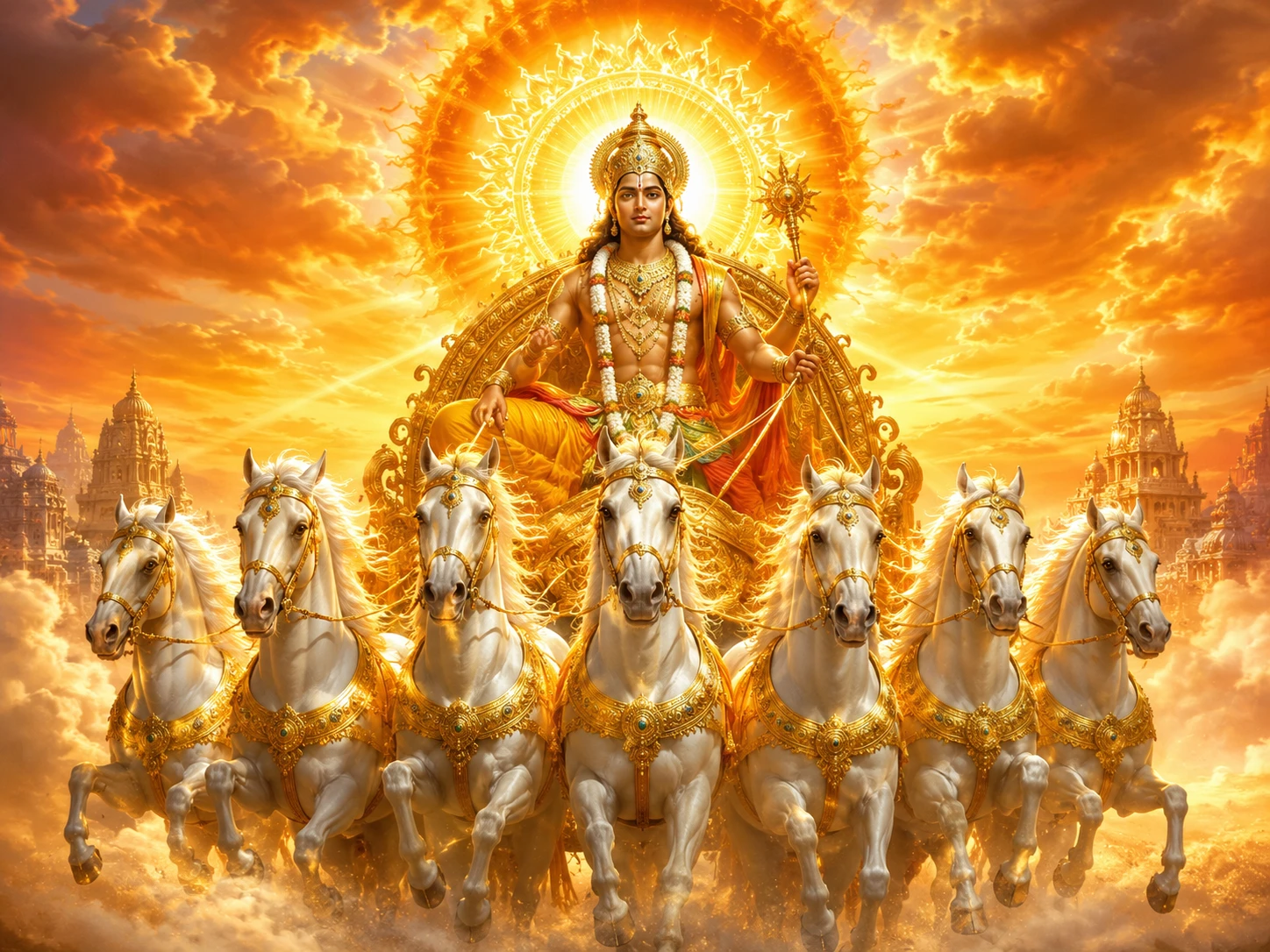
Surya -- The Sun God Who Drives a Seven-Horse Chariot Across the Sky Every Day
सूर्य देव -- सात अश्वों के रथ पर प्रतिदिन आकाश पार करने वाले देवता
Every religion on Earth has worshipped the sun. The Egyptians had Ra. The Greeks had Helios and Apollo. The Aztecs had Tonatiuh. The Japanese have Amaterasu. But no civilisation integrated sun worship as deeply into daily life, philosophy, architecture, and physical practice as Hindu India.
Surya -- the Sun God, also called Aditya, Savitr, Bhaskara, Ravi, and Arka -- is unique among Hindu deities because he is directly, physically visible. You cannot see Vishnu. You cannot see Shiva. But you can see Surya -- every single morning, rising over the horizon, illuminating the world, sustaining all life. He is the only deity whose existence requires no faith, no scripture, no priestly mediation. He is there. Look up.
The Rig Veda, the oldest text in Hinduism (composed approximately 1500-1200 BCE), contains more hymns to Surya and solar deities (Savitr, Mitra, Pushan, Vishnu in his solar aspect) than to almost any other divine figure. The Gayatri Mantra -- Om Bhur Bhuvah Svah, Tat Savitur Varenyam, Bhargo Devasya Dhimahi, Dhiyo Yo Nah Prachodayat -- is addressed to Savitr (the solar deity) and is considered the most important single verse in the entire Vedic corpus. Every Brahmin boy receives this mantra at his Upanayana (sacred thread ceremony) and is expected to chant it at sunrise and sunset for the rest of his life. The Gayatri has been chanted daily, without interruption, for approximately 3,000 years -- making it arguably the longest continuously recited prayer in human civilisation.
Surya is the progenitor of two of the most important lineages in Hindu mythology: the Suryavansha (Solar Dynasty), from which Rama descends, and through his son Shani (Saturn), the Navagraha (nine planetary deities) that govern Vedic astrology. His charioteer is Aruna (the personified dawn, brother of Garuda). His chariot has one wheel (the year) drawn by seven horses (the seven days of the week, or the seven metres of Vedic poetry, or the seven colours of visible light -- the tradition offers multiple symbolic readings). His wives are Sanjna (consciousness) and Chhaya (shadow).
For the NEET student who sets her alarm for 5 AM and sees the sunrise through her Kota hostel window before beginning twelve hours of study. For the software engineer who does Surya Namaskar at 6:30 AM in his Whitefield apartment before commuting to Manyata Tech Park. For the Bihar farmer's wife who stands waist-deep in the Ganges at dawn during Chhath Puja, offering arghya (water libation) to the rising and setting sun with a dedication that would put any Olympian's discipline to shame. Surya is not an abstract deity. He is the one you see first every morning, the one who makes all other seeing possible.
ॐ भूर्भुवः स्वः तत्सवितुर्वरेण्यं भर्गो देवस्य धीमहि धियो यो नः प्रचोदयात्॥
oṃ bhūr bhuvaḥ svaḥ tat savitur vareṇyaṃ bhargo devasya dhīmahi dhiyo yo naḥ pracodayāt ||
Om -- we meditate upon the supreme effulgence of that divine Savitr (the Sun, the creator) -- the most worthy of worship -- may he illuminate and inspire our intellect.
— Gayatri Mantra -- Rig Veda 3.62.10 (also Yajur Veda, Sama Veda)
The Konark Sun Temple in Odisha -- a UNESCO World Heritage Site built by King Narasimhadeva I of the Eastern Ganga dynasty in the 13th century CE -- is the most spectacular architectural tribute to Surya ever constructed. The entire temple is designed as a massive stone chariot of the Sun God, complete with twelve pairs of intricately carved wheels (representing the twelve months of the year), seven horses pulling the chariot (representing the seven days of the week), and elaborate erotic and mythological sculptural panels covering every surface.
The temple's engineering is remarkable. The main entrance was oriented so that the first rays of the rising sun would strike the deity's idol at the centre of the sanctum -- a feat of astronomical alignment that required precise knowledge of the sun's path across the sky at Konark's latitude. The wheels of the chariot function as sundials -- the shadow cast by the spokes accurately indicates the time of day, verified by modern measurement.
Chhath Puja -- the ancient Vedic sun worship festival celebrated primarily in Bihar, Jharkhand, eastern UP, and the Madheshi regions of Nepal -- is the most intense and physically demanding vrat (devotional fast) in Hinduism. Observed over four days, it involves 36 hours of fasting without water (nirjala vrat), standing waist-deep in rivers or ponds at dawn and dusk to offer arghya to the rising and setting sun, and preparing elaborate offerings of thekua (wheat-based sweet), fruits, and sugarcane. The festival honours both the setting and rising sun -- honouring the setting sun (Chhathi Maiya's consort) is theologically significant because it acknowledges the god in his moment of departure, not just arrival.
Chhath is remarkable for several reasons. It is one of the only Vedic rituals that has survived in continuous popular practice without Brahminical mediation -- there is no priest involved; the devotee (typically a woman) performs all rituals herself. It is also one of the most egalitarian Hindu festivals -- no caste distinctions apply during Chhath. And it is extraordinarily gruelling -- the 36-hour waterless fast followed by standing in cold water at dawn is physically comparable to an ultra-marathon.
Surya Namaskar -- the 12-pose yoga sequence performed facing the sun -- has become the most widely practised physical-spiritual routine in global yoga. Originally a devotional practice, it has been adopted by secular yoga studios worldwide, making Surya arguably the most worshipped Hindu deity globally, if you count everyone who does Sun Salutations. The International Day of Yoga (June 21, established by the UN in 2014 at India's proposal) falls on the summer solstice -- the longest day of the year, the day of maximum solar exposure -- making it, implicitly, a global Surya festival.
The Aditya Hridayam -- a hymn to Surya recited by the sage Agastya to Rama on the battlefield of Lanka, found in the Yuddha Kanda of Valmiki's Ramayana (Chapter 107) -- is considered one of the most powerful prayers in the Hindu tradition. Agastya teaches Rama to invoke Surya's power before his final battle with Ravana, and after chanting the Aditya Hridayam three times, Rama receives divine energy and defeats the demon king. The hymn is recited today for courage, health, and victory -- UPSC aspirants, athletes before competitions, and patients facing surgery are among those who recite it.
For the rooftop yogi who salutes the sun at dawn on a Mumbai terrace. For the Chhath devotee standing in the freezing Ganges at Patna in November. For the tourist at Konark who suddenly realises that the stone chariot wheel beneath her palm is also a working sundial. Surya is not an ancient memory. He is the most present deity in Hinduism -- the one who shows up, without fail, every single morning.
Surya in Daily Indian Life -- Where the Sun God Hides in Plain Sight
| Practice / Institution | Surya Connection | Who Participates |
|---|---|---|
| Gayatri Mantra (Sandhyavandanam) | Addressed to Savitr (Solar deity) -- chanted at sunrise/sunset | Every initiated Hindu (Upanayana); millions daily |
| Surya Namaskar (Yoga) | 12-pose sun salutation -- originally devotional, now global fitness | Estimated 300+ million yoga practitioners worldwide |
| Chhath Puja | Direct Vedic sun worship -- arghya to rising and setting sun | 50+ million primarily in Bihar, Jharkhand, eastern UP, Nepal |
| Konark Sun Temple | Entire temple shaped as Surya's chariot; UNESCO World Heritage | 2+ million annual visitors |
| Sunday (Ravivaar) | Named after Ravi (Surya) -- day of the Sun in Hindi | All Hindi-speaking Indians |
| Makar Sankranti / Pongal | Solar harvest festival marking sun's northward journey (Uttarayana) | Hundreds of millions across India |
| Surya Siddhanta | Ancient astronomical text -- basis of Vedic calendar calculation | Panchanga makers, astrologers, ISRO (for traditional calendar) |
| Aditya Hridayam | Recited for courage before battles, exams, surgeries | UPSC aspirants, athletes, patients, soldiers |
| ISRO's Aditya-L1 | India's first solar observatory mission (launched Sept 2023) | Named after Surya -- national space programme |
Surya may be the least 'worshipped' major Hindu deity in terms of dedicated temples, but he is the most practised -- embedded in daily mantras, physical routines, festival cycles, and even space missions.
Surya's family tree is one of the most consequential in all of Hindu mythology, because through his children, Surya's influence extends to virtually every major narrative in the tradition.
Surya's primary wife is Sanjna (also called Saranyu), the daughter of the divine architect Vishwakarma. Unable to bear Surya's blinding radiance, Sanjna creates a shadow-double of herself called Chhaya (literally 'Shadow') and retreats to perform tapas in a forest, disguised as a mare. Surya, upon discovering the deception, pursues her in the form of a horse. From this equine union are born the Ashwini Kumaras -- the divine twin horsemen who are the physicians of the gods and the ancestors of Ayurvedic medicine.
From Sanjna before her departure, Surya fathers Vaivasvata Manu (the progenitor of the current human race and the establisher of dharma -- making every human being, in this tradition, a descendant of the Sun), Yama (the god of death and dharma -- the first being to die, who then became the ruler of the realm of the dead), and Yamuna (the sacred river, personified as Yama's twin sister).
From Chhaya, Surya fathers Shani (Saturn -- the most feared planet in Vedic astrology, the god of karma and justice, whose gaze is said to bring suffering that leads to spiritual growth), Tapati (a river goddess), and Savarni Manu (the Manu of a future cosmic cycle).
The Suryavansha (Solar Dynasty) -- the royal lineage that descends from Surya through Vaivasvata Manu -- includes some of the most important figures in Hindu history: King Ikshvaku (the first king of the Solar Dynasty, who founded the kingdom of Ayodhya), Harishchandra (the king whose commitment to truth was tested by Vishwamitra), Sagara (whose 60,000 sons were burned by Sage Kapila's gaze, leading to the descent of the Ganges), Bhagiratha (who brought the Ganges to earth through centuries of tapas), Dilipa, Raghu, Dasharatha, and finally Rama -- the avatar of Vishnu, hero of the Ramayana, and the ideal king. The entire Ramayana is, in a sense, a Solar Dynasty family saga.
Shani's influence extends into every Indian horoscope. The period of Sade Sati (seven-and-a-half years of Saturn's transit through the twelfth, first, and second houses from the natal moon) is the most feared astrological period in Vedic astrology. Millions of Indians modify their behaviour, wear specific gemstones (blue sapphire or its substitutes), visit Shani temples (like Shani Shingnapur in Maharashtra, where houses traditionally have no doors because Shani's justice makes theft impossible), and recite the Shani Stotra during Sade Sati. All of this flows from one source: the Sun God's complicated relationship with his shadow-wife.
The irony that Surya -- the source of light and life -- fathered both Yama (death) and Shani (suffering) is not lost on Hindu theology. It is, in fact, the point. Light casts shadows. Life contains death. The source of all energy is also, inevitably, the source of all entropy. Surya's family tree is a cosmological statement: from the same source that gives you warmth, visibility, and growth come the inescapable realities of mortality, karma, and the slow, inexorable turning of time.
ISRO's Aditya-L1 -- India's first dedicated solar observation mission, launched in September 2023 -- is named after Surya (Aditya being one of his Vedic names). The spacecraft orbits the Sun-Earth L1 Lagrange point, studying solar corona, solar wind, and space weather. When ISRO scientists named the mission, they were continuing a tradition of naming Indian space assets after Hindu deities and concepts (Chandrayaan for the Moon, Mangalyaan for Mars, Gaganyaan for space). Meanwhile, the Konark temple's twelve wheel-pairs function as sundials accurate to within minutes -- a fact verified by the Archaeological Survey of India. The temple was originally fitted with a massive lodestone (magnetic stone) at its apex that reportedly kept the main idol suspended in mid-air through magnetic levitation, though this claim is part of popular legend rather than verified archaeology. And the Chhath Puja ghat scene in Patna -- thousands of women standing in the Ganges at dawn, offering arghya to the sun with brass vessels, the water glowing gold in the morning light -- has been called by UNESCO observers one of the most visually stunning religious rituals on Earth.
The decline of Surya worship as a major sectarian tradition -- and its simultaneous survival as a universal daily practice -- is one of the most fascinating stories in Hindu religious history.
In the early centuries CE, Surya was worshipped as a supreme deity by a distinct sect called the Sauras. The Bhavisya Purana and portions of the Samba Purana describe an elaborate Surya worship tradition, including temples, rituals, and theological frameworks that placed Surya at the centre of the cosmos. Sun temples dotted the Indian landscape from Kashmir to Karnataka. The Martanda Sun Temple in Kashmir (8th century CE, built by Lalitaditya Muktapida) was one of the largest temples in the subcontinent. The Modhera Sun Temple in Gujarat (11th century, Solanki dynasty) and the Deo Sun Temple in Bihar (one of the oldest sun temples in India, possibly dating to the Maurya period) attest to the geographical spread of organised Surya worship.
But by the medieval period, Surya worship as a distinct sect had largely been absorbed into Vaishnavism (Surya being identified as an aspect of Vishnu) and Shaivism (the Aditya being linked to Rudra in some texts). The Saura sect declined, and no major new sun temples were built after the 13th century. The reasons are debated: some scholars point to the Islamic invasions that destroyed major sun temples (the Martanda Temple was extensively damaged), others to the theological consolidation around Vishnu and Shiva that left little institutional space for a third major deity.
And yet, Surya never disappeared. He simply became embedded so deeply into the fabric of daily Hindu life that he became invisible as a distinct deity. The Gayatri Mantra is chanted daily by millions -- but most chanters think of it as a 'universal prayer' rather than a Surya prayer. Surya Namaskar is performed daily by hundreds of millions -- but most yoga practitioners do not think of it as sun worship. Makar Sankranti/Pongal is celebrated by hundreds of millions -- but most celebrants think of it as a harvest festival rather than a solar one. Chhath Puja is explicitly Surya worship -- but it is geographically concentrated in Bihar and eastern UP.
Surya is the deity who won by disappearing. He does not need temples because his temple is the sky. He does not need murtis because his murti is visible every morning. He does not need a sect because his worship is embedded in the most basic acts of Hindu life: waking up, facing east, chanting Om, and opening your eyes to the light.
The modern scientific understanding of the sun validates what the Rig Vedic rishis intuited 3,000 years ago: literally all life on Earth derives its energy from the sun. Photosynthesis -- the process by which plants convert sunlight into food -- is the foundation of the entire food chain. Solar energy drives weather, ocean currents, and the water cycle. Vitamin D, essential for human health, is synthesised in the skin through sun exposure. The rishis who wrote Rig Veda 1.115.1 -- 'Surya is the soul (atman) of all that moves and all that stands still' -- were making a statement that modern biology would not have disagreed with.
ISRO naming its solar observatory Aditya-L1 closed a 3,000-year circle: from the Vedic hymns that praised the sun as the source of all life, to a spacecraft that studies the sun as the source of space weather, India's relationship with Surya has been continuous, evolving, and unbroken. The medium changes -- from Vedic verse to satellite telemetry -- but the reverence remains.
For the child in a Delhi school who draws a sun with a smiley face and rays coming out of it -- she is, without knowing it, drawing a Surya yantra. For the retired colonel who does 108 Surya Namaskars on Republic Day morning on his Noida terrace. For the Chhath Puja devotee whose photo -- standing in golden water, brass plate raised to the sun, face lit by dawn -- goes viral on Instagram every November. Surya asks nothing of you except that you wake up. And he will be there.
Perform Surya Namaskar with Mantra
Practise the twelve-pose Surya Namaskar with one name of Surya for each pose: Om Mitraya Namah, Om Ravaye Namah, Om Suryaya Namah, Om Bhanave Namah, Om Khagaya Namah, Om Pushne Namah, Om Hiranyagarbhaya Namah, Om Marichaye Namah, Om Adityaya Namah, Om Savitre Namah, Om Arkaya Namah, Om Bhaskaraya Namah. Learn the poses from a qualified teacher. For a longer hymn to the sun, the Aditya Hridayam is on Eternal Raga with its meaning.
Tags
Eternal Raga · शाश्वत राग
Institutional voice — scholarly articles on Sanatan Dharma
Deepen Your Understanding
अपनी समझ और गहरी करें
deities avatars
Navagraha -- The Nine Planetary Deities Who Govern Your Horoscope and Your Life
Before every job interview, before every wedding, before buying a house or starting a business -- millions of Indians check their Navagraha positions. These nine celestial deities -- the Sun, Moon, Mars, Mercury, Jupiter, Venus, Saturn, and the shadow planets Rahu and Ketu -- constitute the most practically influential theological system in Hinduism. Whether you believe in astrology or not, the Navagraha are shaping Indian culture around you.
vedic sciences
Surya Siddhanta -- The Ancient Astronomy Text That Got the Year Right to 1.4 Seconds
Before Copernicus, before Galileo, before the telescope existed -- an Indian text calculated the tropical year as 365.2421756 days. The modern value is 365.2421904. The difference is 1.4 seconds per year. The Surya Siddhanta also described gravity, computed planetary diameters within 1% accuracy, and invented the sine function. It did all this in Sanskrit verse.
deities avatars
Surya's Family -- How One God Fathered Yama, Shani, the Ashwini Kumaras, and All of Humanity
Surya had two wives: Sanjana, who could not bear his radiance, and Chhaya, the shadow she left behind. From Sanjana came Yama (death), Yamuna (the river), Manu (humanity's ancestor), and the Ashwini Kumaras (divine physicians). From Chhaya came Shani (Saturn, karma's enforcer), Tapati (the river), and Savarni Manu (the next cosmic era's ruler). Same father. Two mothers. Ten children. And the entire human race.
rituals traditions
Chhath Puja -- The Only Hindu Festival Where You Worship the Setting Sun
Most Hindu worship faces east -- toward the rising sun, toward beginnings. Chhath Puja faces west -- toward the setting sun, toward endings, toward the courage to honour what is departing. Standing waist-deep in a river or pond at sunset and again at sunrise, offering Arghya (water oblation) to Surya with bare hands while chanting Vedic hymns -- this is the most physically demanding, most ecologically pure, and most egalitarian festival in the Hindu calendar. No priest. No temple. No idol. Just you, the water, and the sun.
tantra mantra yantra
The Gayatri Mantra -- 24 Syllables That Illuminate the Mind
The most chanted verse in human history is not a prayer for wealth, power, or protection. It is a prayer for light -- for the divine radiance to illuminate the intellect. 24 syllables from Rig Veda 3.62.10, attributed to Rishi Vishwamitra, have shaped Indian civilisation for over three thousand years.
vedic sciences
Kaal Ganana -- The Hindu Measure of Time
From a single blink of the eye (Nimesha) to one Day of Brahma (4.32 billion years) -- explore the complete cosmic time hierarchy of Hindu cosmology, anchored in Vishnu Purana 1.3, with its remarkable parallels to modern science.
ISRO's Aditya-L1 -- India's first dedicated solar observation mission, launched in September 2023 -- is named after Surya (Aditya being one of his Vedic names). The spacecraft orbits the Sun-Earth L1 Lagrange point, stud…
More in Deities & Avatars
33 Koti Devata -- Why Hinduism Has 33 Types of Gods, Not 33 Crore
13 min read
Agni -- The Fire God
19 min read
Annapurna -- Goddess of Food
19 min readThe same translation error that turned '33 Koti' into '33 crore' in Hinduism also happened in Buddhism. The Chinese translation of Buddhist texts rendered 'Sapta Koti Buddha' (7 Supreme Buddhas) as '7 Crore Buddhas.' The…
Deities AvatarsCommunity Reflections
🕉️
Be the first to share your reflection.