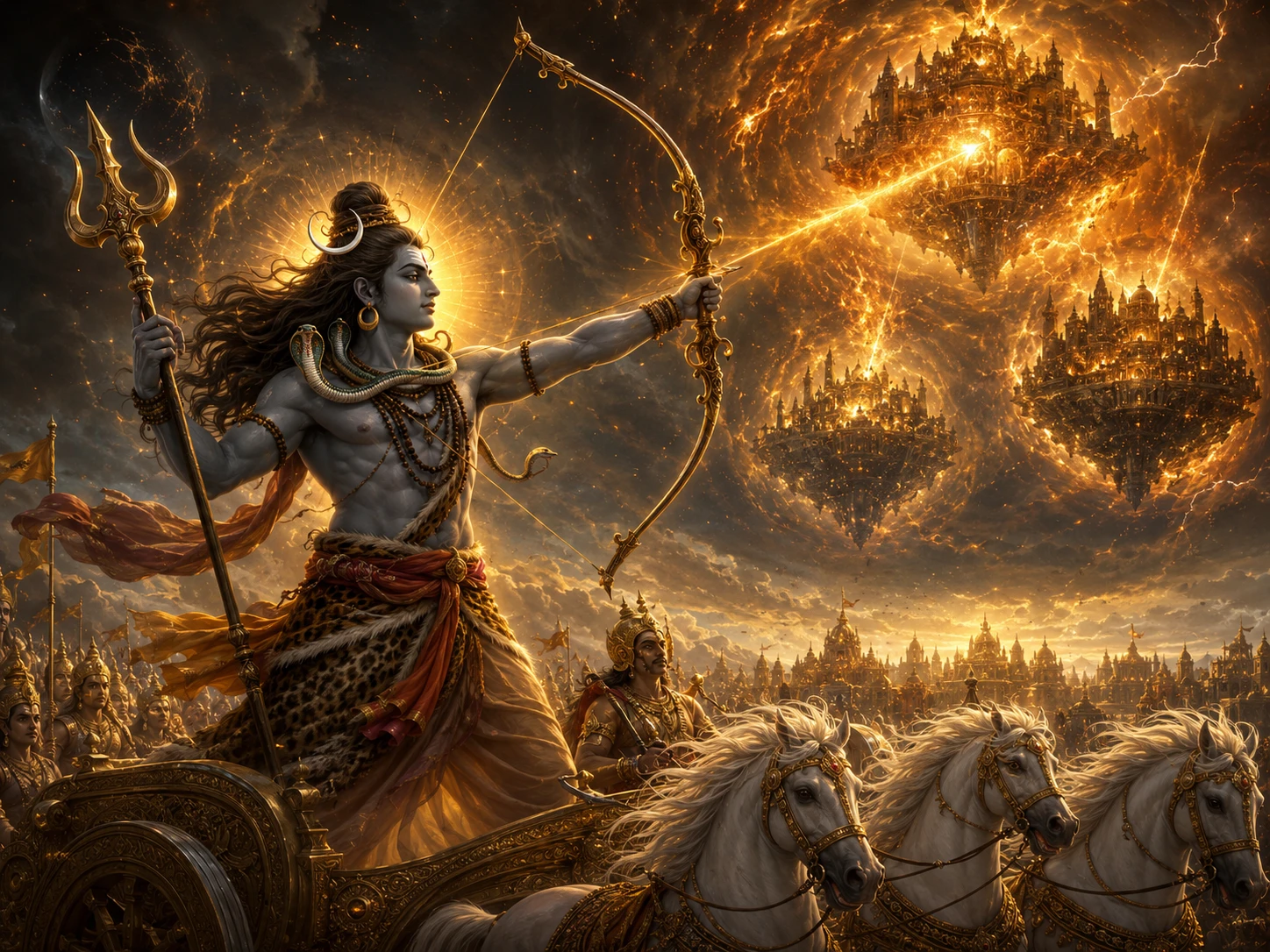
Tripurasura -- How Shiva Destroyed Three Flying Cities with a Single Arrow
त्रिपुरासुर -- शिव ने एक बाण से तीन उड़ते नगर कैसे नष्ट किए
If the Mahabharata is India's Game of Thrones, then the Tripurasura legend is its Star Wars -- a story about three flying fortress-cities, an architect-genius who built them, a nearly impossible vulnerability, and a god who assembled the entire cosmos into a single weapon system to exploit that one weakness.
The story originates in the Shiva Purana, Matsya Purana, and Mahabharata (Karna Parva, Chapter 34). It explains one of Shiva's most celebrated names -- Tripurari (the enemy of Tripura) or Tripurantaka (the destroyer of the three cities) -- and is the reason Kartik Purnima is one of the most sacred days in the Shaiva calendar.
The Three Sons of Tarakasura
Tarakasura was a powerful Asura who had been killed by Kartikeya (Murugan), Shiva's son. But Tarakasura's three sons -- Tarakaksha, Vidyunmali, and Kamalaksha -- survived. They were not warriors consumed by immediate revenge. They were strategists. They performed severe tapasya to Brahma and asked for a carefully engineered boon.
They did not ask for immortality -- Brahma cannot grant that. Instead, they asked for something cleverer: three cities, built in the sky, that could fly anywhere and could only be destroyed under a single, near-impossible condition. The three cities would orbit in different planes. Once every thousand years, they would align in a single straight line. Only at that precise moment, a single arrow fired by a single being could destroy all three simultaneously. If any other method was tried, the cities would regenerate.
Brahma granted the boon. The probability of all conditions being met -- alignment, single arrow, single shooter -- was so astronomically low that the three brothers considered themselves effectively immortal.
The Architect: Maya Danava
To build the cities, the three brothers commissioned Maya Danava -- the greatest architect in the Asura world, the same Maya who would later build the Mayasabha (the Hall of Illusions) for the Pandavas in the Mahabharata. Maya constructed three cities of breathtaking engineering: Tarakaksha's city was made of gold and orbited in the heavens. Vidyunmali's was made of silver and floated in the sky. Kamalaksha's was made of iron and hovered above the earth.
The three cities were called Tripura -- 'three cities' -- and together they formed a mobile empire. They could appear anywhere, strike any target, and retreat before any army could respond. Think of them as the world's first stealth aircraft carriers -- three self-contained civilisations with offensive capability and near-zero vulnerability.
For a thousand years, the Tripurasuras used these cities to terrorise the cosmos. They attacked Deva territories, disrupted yajnas, conquered kingdoms, and imposed their will across all three worlds. The Devas, unable to breach the flying fortresses, appealed to Shiva.
त्रिपुरं दहतः पूर्वं शूलपाणेर्महात्मनः। धनुष्यायम्यमाणे तु ज्याघोषो दिवमस्पृशत्॥
tripuraṃ dahataḥ pūrvaṃ śūlapāṇer mahātmanaḥ | dhanuṣy āyamyamāṇe tu jyāghoṣo divam aspṛśat ||
When the great-souled Shiva, the trident-bearer, drew his bow to burn the three cities, the twang of the bowstring touched the heavens.
— Mahabharata, Karna Parva, Chapter 34 (Tripura Dahana narrative)
The Cosmic Weapon System -- Shiva's Chariot of the Universe
When Shiva agreed to destroy Tripura, the Devas did not simply hand him a weapon. They assembled the entire cosmos into a single war machine -- the most elaborate divine chariot ever described in Hindu literature.
The Earth became the chariot. Mount Meru became the axle. The Sun and Moon became the two wheels. The Vedas became the four horses. Brahma became the charioteer. Vishnu became the arrowhead. Vayu (wind god) became the feathers of the arrow. Agni (fire god) became the tip. The Pinaka -- Shiva's own bow, the same bow that Rama would later break at Sita's Swayamvar -- was strung with the serpent Vasuki as the bowstring.
This is not just a weapon. It is the universe weaponised. Every element of creation is enrolled into a single act of destruction. The chariot is the earth itself. The arrow contains Vishnu. The bow is strung with a cosmic serpent. The message: destroying entrenched, systemic evil requires the cooperation of the entire cosmos -- no single entity, however powerful, can do it alone.
Shiva waited. For a thousand years, the three cities orbited in their separate planes, never aligning. And then, at the appointed moment, the three cities converged into a single line. In one instant, Shiva drew the Pinaka, aimed, and released. A single arrow, containing the combined power of Vishnu, Agni, and Vayu, pierced all three cities simultaneously. Gold, silver, and iron -- all three burst into flames and crashed into the western ocean.
This moment is called Tripura Dahana -- the burning of the three cities. It is celebrated on Kartik Purnima (the full moon in the month of Kartik, November-December). In many Shaiva temples, a special Deep Daan (lamp offering) is performed on this night to commemorate Shiva's victory.
The Deeper Meaning
The three cities are traditionally interpreted as the three bodies of the individual: the sthula sharira (gross physical body, represented by iron), the sukshma sharira (subtle/astral body, represented by silver), and the karana sharira (causal body, represented by gold). The three demons represent the three malas (impurities) that bind the soul in Shaiva Siddhanta: anava (ego/smallness), karma (accumulated action), and maya (illusion).
Shiva's single arrow is the arrow of jnana (knowledge/self-realisation) that, when aimed at the precise moment of alignment (when the seeker is ready), destroys all three bondages simultaneously. The impossibility of the shot reflects the rarity of true moksha -- it requires cosmic alignment, divine grace, and perfect aim.
For a student preparing for competitive exams in a Kota coaching centre, the metaphor is more practical: the three cities are the three distractions -- social media (gold, glamorous), comparison with peers (silver, reflective), and self-doubt (iron, heavy). They orbit in separate planes, but once in a while they align and paralyse you completely. The Shiva in you -- the focused, still, undistracted consciousness -- must wait for that alignment and strike all three with a single act of concentrated will.
The Tripurasura story is not just mythology. It is a masterclass in systems thinking, patience, and the principle that the hardest problems require solutions assembled from every available resource -- and the discipline to wait for the one perfect moment to act.
The Cosmic Chariot -- Every Component of Shiva's War Machine
| Component | Cosmic Equivalent | Symbolism |
|---|---|---|
| Chariot | The Earth (Prithvi) | The ground of reality; dharma as the vehicle of action |
| Axle | Mount Meru | The cosmic axis; the still centre around which everything revolves |
| Wheels | Sun and Moon | Time (day-night cycle); the rhythm of creation |
| Horses | The Four Vedas | Knowledge drives action; Rig, Yajur, Sama, Atharva |
| Charioteer | Brahma | The Creator guides the vehicle; wisdom steers power |
| Bow | Pinaka (Shiva's bow) | The instrument of focused destruction |
| Bowstring | Vasuki (serpent king) | Kundalini; coiled energy released in a single moment |
| Arrow tip | Vishnu (as the pointed force) | Preservation destroys what threatens dharma |
| Arrow feathers | Vayu (wind god) | Speed and direction; prana guiding the strike |
| Arrow fire | Agni (fire god) | Transformative destruction; purification through burning |
The Tripura Dahana chariot is the ultimate expression of the Hindu idea that cosmic order (rta) requires every element of creation to cooperate against concentrated evil.
Kartik Purnima -- the full moon in November-December -- is celebrated as Tripurari Purnima or Dev Diwali (Diwali of the Gods) in Varanasi. On this night, thousands of earthen lamps are floated on the Ganga at the ghats, creating one of the most visually spectacular religious events in the world. The tradition commemorates Shiva's destruction of Tripura on this night. In Goa, Kartik Purnima is also associated with the traditional practice of floating small paper boats with lamps, symbolising the burning cities falling into the ocean.
Chant Om Namah Shivaya -- Tripurari's Mantra
Shiva destroyed the three cities of illusion with a single arrow. Chant Om Namah Shivaya 108 times on a mala and aim your own arrow at distraction. Its page on Eternal Raga gives the meaning and how to chant it.
Tags
Eternal Raga · शाश्वत राग
Institutional voice — scholarly articles on Sanatan Dharma
Deepen Your Understanding
अपनी समझ और गहरी करें
deities avatars
Who is Shiva?
He is the ash-smeared ascetic who is also the ideal husband. The destroyer of the universe who is called 'The Auspicious One.' The god of death who drank poison to save all life. He sits in meditation on a Himalayan peak, and simultaneously dances the cosmos into existence and annihilation. No deity in Hinduism contains more contradictions -- and no deity resolves them more completely. This is not a mythology explainer. This is an attempt to stand at the foot of the mountain and look up.
deities avatars
Nine Forms of Shiva -- The Many Faces of Mahadeva
He is the silent teacher under a banyan tree and the screaming destroyer on a battlefield. He is half-woman and half-man. He drank the poison that would have ended the universe and his throat turned blue. Nine scripturally-attested forms of Shiva -- from Nataraja to Rudra -- and why each one exists.
deities avatars
Nataraja -- The Cosmic Dancer
One foot crushes a dwarf. The other is raised in liberation. A ring of fire frames the dance. A drum beats creation into existence. An open palm says 'do not fear.' This is Nataraja -- Shiva as the Lord of Dance -- and it is the single most replicated Indian bronze in the history of art. The physicists at CERN chose it to stand outside the world's largest particle accelerator. The Chola bronzesmiths of Tamil Nadu perfected it a thousand years ago. And every time a subatomic particle appears and disappears, the cosmic dance continues.
deities avatars
Daksha's Yagna and Sati -- Why Daksha Hated Shiva
A father so offended by his son-in-law that he held a cosmic sacrifice and invited every god in the universe -- except Shiva. A wife so devastated by the insult that she walked into the sacred fire and burned herself alive. And a husband so enraged by her death that he created a warrior from his dreadlock who destroyed the entire ceremony and beheaded the father-in-law. The Daksha Yagna is not a domestic dispute. It is the origin story of the Shakti Peethas, the theology of Shiva's rage, and the reason Parvati exists.
scriptural exegesis
Ravana Lifts Kailash -- How the Demon King Became Shiva's Greatest Devotee
A ten-headed king tries to uproot God's mountain. God presses it back with his little toe. The king, crushed and trapped, sings for a thousand years -- and the hymn he composes becomes one of the most powerful devotional poems in Sanskrit. The Ravananugraha episode is where arrogance meets devotion, and the result is the Shiva Tandav Stotram.
divine arsenal
Pashupatastra -- The Supreme Weapon Never Used
The most fearsome weapon in the Mahabharata was never deployed on the battlefield. Shiva granted it to Arjuna after a wrestling match in the forests of Indrakila, yet Arjuna carried it through all eighteen days of Kurukshetra without ever invoking it. The Pashupatastra's true power lay not in its destruction, but in its restraint -- a philosophy that modern nuclear doctrine would independently discover thousands of years later.
Kartik Purnima -- the full moon in November-December -- is celebrated as Tripurari Purnima or Dev Diwali (Diwali of the Gods) in Varanasi. On this night, thousands of earthen lamps are floated on the Ganga at the ghats, …
More in Deities & Avatars
33 Koti Devata -- Why Hinduism Has 33 Types of Gods, Not 33 Crore
13 min read
Agni -- The Fire God
19 min read
Annapurna -- Goddess of Food
19 min readThe same translation error that turned '33 Koti' into '33 crore' in Hinduism also happened in Buddhism. The Chinese translation of Buddhist texts rendered 'Sapta Koti Buddha' (7 Supreme Buddhas) as '7 Crore Buddhas.' The…
Deities AvatarsCommunity Reflections
🕉️
Be the first to share your reflection.