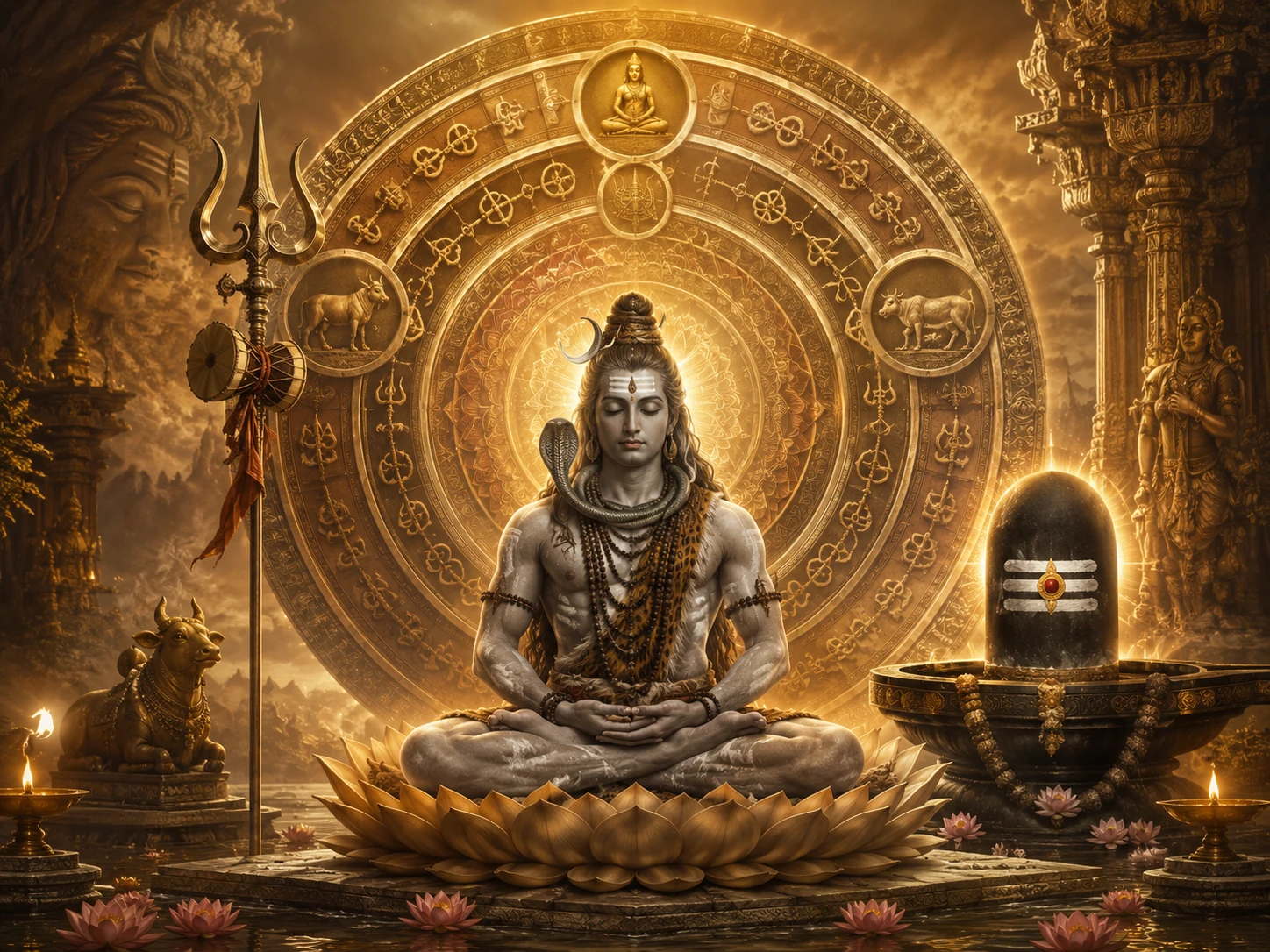
Shaiva Siddhanta -- Pati, Pashu, Pasha
शैव सिद्धान्त -- पति, पशु, पाश
Walk into the Nataraja temple in Chidambaram, Tamil Nadu. The bronze Shiva dances within a circle of cosmic fire. One foot stamps on the demon Apasmara (ignorance). One hand holds the damaru (creation). Another holds fire (destruction). A third gestures Abhaya (fear not). A fourth points to the raised foot (liberation). This is not decoration. It is a philosophical diagram cast in metal -- and the philosophy it encodes is Shaiva Siddhanta, the most rigorous, most systematic, and most influential school of Shiva-centred theology in Hinduism.
Shaiva Siddhanta is to Shaivism what Vishishtadvaita is to Vaishnavism -- a fully articulated theological system with its own scriptures (the 28 Shaiva Agamas), its own saintly canon (the 63 Nayanar saints and the Thirumurai corpus), its own systematic philosopher (Meykandar, 13th century CE), and its own institutional infrastructure (the great Shiva temples of Tamil Nadu, the Shaiva monasteries, the Aadheenam system).
Unlike Advaita Vedanta, which ultimately dissolves the distinction between God and soul, Shaiva Siddhanta maintains that three realities are eternally and irreducibly real: Pati (the Lord, Shiva), Pashu (the individual soul), and Pasha (the bond that fetters the soul). These are called the three Padarthas (categories of reality). Understanding their relationship IS Shaiva Siddhanta.
The system is dualistic-in-practice and pluralistic-in-ontology but monistic-in-goal. Let that complexity sit for a moment. The soul is real and distinct from God (not illusory, as Advaita claims). The bond is real (not merely apparent). But the goal is union with God -- not merger or dissolution, but an intimate, eternal, loving relationship where the soul, freed from its fetters, experiences Shiva's nature as its own. The technical term is Shiva-Sayujya -- becoming like Shiva without becoming Shiva.
For the millions of Shaivites across Tamil Nadu, Karnataka, Kerala, and the global Tamil diaspora -- from the priest at Meenakshi Temple in Madurai to the engineer in Chennai who visits Thanjavur's Brihadeeswara on weekends -- Shaiva Siddhanta is not academic philosophy. It is the operating theology of their devotional life.
पतिः पशुपतिः पाशो मलकर्ममायालक्षणः। शिवज्ञाने तु कैवल्यं पशोः पाशविमोक्षणम्॥
patiḥ paśupatiḥ pāśo malakarma-māyā-lakṣaṇaḥ | śivajñāne tu kaivalyaṃ paśoḥ pāśavimokṣaṇam ||
The Lord (Pati) is Pashupati (Lord of bound souls). The bond (Pasha) is characterised by impurity (Mala), Karma, and Maya. Through knowledge of Shiva comes liberation (Kaivalya) -- the release of the bound soul from its fetters.
— Paushkara Agama (Shaiva Agamic tradition)
The three Padarthas deserve detailed examination.
Pati -- Shiva, the Supreme Lord. In Shaiva Siddhanta, Shiva is not one god among many. He is the Supreme Reality -- omniscient, omnipotent, omnipresent, the material and efficient cause of the universe. He is both Nishkala (formless, transcendent) and Sakala (with form, immanent). He creates not out of need but out of compassion -- to give souls the opportunity to exhaust their Karma and attain liberation. Shiva's five cosmic actions (Panchakritya) are: Srishti (creation), Sthiti (preservation), Samhara (dissolution), Tirobhava (concealment -- hiding his nature so souls can experience the world), and Anugraha (grace -- revealing his nature and liberating souls). The Nataraja icon encodes all five.
Pashu -- the individual soul. The word 'Pashu' literally means 'bound animal' -- a powerful metaphor. The soul is not inherently impure or sinful. It is inherently divine. But it is fettered, like a bull roped to a post. The bull's nature is strength and freedom. The rope is not its nature. Remove the rope and the bull is free. Similarly, the soul's nature is consciousness and bliss (Sat-Chit-Ananda). The fetters are external, not essential. This is a crucial theological point: the soul is not fallen or depraved. It is bound. And what is bound can be unbound.
Shaiva Siddhanta enumerates three fetters (Pasha) that bind the Pashu:
Anava Mala -- the primal impurity. This is not moral sin. It is an innate obscuration of the soul's true nature -- a congenital spiritual blindness that has existed since beginningless time. Anava literally means 'atomicity' -- it is the force that makes the infinite soul perceive itself as finite, limited, separate. It is the root fetter, and it can only be removed by Shiva's direct grace (Shaktipata).
Karma -- the accumulated effects of past actions. Every action generates a result that must be experienced. Good actions generate pleasant results. Bad actions generate unpleasant ones. The soul cycles through births and deaths, experiencing the fruits of its Karma. Shaiva Siddhanta treats Karma not as punishment but as education -- a curriculum designed by Shiva so the soul can learn, grow, and eventually desire liberation.
Maya -- the material substrate from which bodies, worlds, and experiences are constructed. Maya in Shaiva Siddhanta is not illusion (as in Advaita). It is real, eternal, and necessary. It provides the soul with the field of experience needed to work through Karma. Without Maya, there would be no bodies, no worlds, and no opportunity for the soul to learn. Maya is the classroom, not the enemy.
The removal of these three fetters happens in stages and requires the direct intervention of Shiva's grace. The soul cannot liberate itself by its own effort alone. This is where Shaiva Siddhanta departs from both Advaita (where self-knowledge suffices) and Karma Mimamsa (where correct action suffices). In Shaiva Siddhanta, grace (Anugraha) is indispensable. Shiva, as the cosmic teacher (Dakshinamurti), descends into the soul's experience through the guru, through initiation (Diksha), and through the sacred syllables of the Panchakshara mantra (Na-Ma-Shi-Va-Ya) to progressively remove each fetter.
Shaiva Siddhanta vs Other Shaiva Schools
| Dimension | Shaiva Siddhanta | Kashmir Shaivism | Vira Shaivism (Lingayat) |
|---|---|---|---|
| Geographic heart | Tamil Nadu -- Chidambaram, Thanjavur, Madurai | Kashmir -- Srinagar, now preserved in diaspora | Karnataka -- Basavakalyan, Dharwad, North Karnataka |
| Core texts | 28 Shaiva Agamas, Thirumurai, Meykandar's Shivajnanabodham | Shiva Sutras, Spanda Karika, Pratyabhijna texts | Vachanas of Basavanna, Allama Prabhu, Akka Mahadevi |
| God-soul relation | Eternally distinct. Soul is real but bound. Grace liberates. | Soul IS Shiva, temporarily contracted. Recognition (Pratyabhijna) liberates. | Shiva and soul are one. Devotion through Ishtalinga worn on the body. |
| Status of world | Real. Created by Shiva from Maya for souls to learn. | Real manifestation of Shiva's Shakti. World is Shiva's play (Lila). | Real. But caste, ritual hierarchy are rejected. |
| Path to liberation | Charya (service), Kriya (ritual), Yoga (meditation), Jnana (knowledge) -- four stages, culminating in Shiva's grace. | Shaktipata (grace) + Pratyabhijna (recognition of one's identity as Shiva). | Bhakti + social reform. Wearing Ishtalinga, rejecting caste. |
| Social stance | Traditionally Brahminical in structure but devotionally accessible to all (Nayanar saints included non-Brahmin castes). | Esoteric, limited circle of initiates. | Radically egalitarian. Anti-caste, anti-ritual hierarchy. Women saints (Akka Mahadevi). |
All three are Shiva-centred but differ profoundly in metaphysics and social orientation. Shaiva Siddhanta is the most institutionally established (temple infrastructure). Kashmir Shaivism is the most philosophically sophisticated (recognition doctrine). Vira Shaivism is the most socially revolutionary (anti-caste activism).
Shaiva Siddhanta's four-stage path to liberation is one of the most elegant spiritual progressions in Hindu theology.
Charya Pada (the path of service) -- the outermost stage. The devotee serves Shiva by cleaning the temple, lighting lamps, gathering flowers, maintaining the sacred space. This is not menial labour. It is the beginning of ego-dissolution through selfless action. The devotee relates to Shiva as a servant relates to a master (Dasa-Marga). In modern terms, this is the volunteer who arrives early at the Shiva temple in Mylapore, sweeps the courtyard, and arranges the bilva leaves before anyone else wakes up.
Kriya Pada (the path of ritual) -- the devotee performs puja, abhisheka, archana, and other ritual worship. The relationship deepens from servant to son -- the devotee relates to Shiva as a child relates to a parent (Satputra-Marga). The ritual is not mechanical. It is relational -- each offering is an expression of love, each mantra is a conversation.
Yoga Pada (the path of meditation) -- the devotee turns inward. External ritual is transcended (not abandoned, but deepened) into internal meditation. The devotee meditates on Shiva within the heart. The relationship deepens further to friend (Sakha-Marga) -- an intimacy where the devotee and God commune in silence.
Jnana Pada (the path of knowledge) -- the culmination. The devotee receives Shiva's direct grace (Shaktipata), and the three Pashas (Anava, Karma, Maya) are progressively dissolved. The soul recognises its true nature -- consciousness and bliss, inseparable from Shiva yet eternally individual. The relationship is now San-Marga -- the path of truth, where difference and unity are both transcended in the direct experience of Shiva's nature.
This four-fold progression -- from external service to internal knowledge, from servant to intimate -- is reflected in the architecture of South Indian Shiva temples. The outer prakara (enclosure) corresponds to Charya. The inner enclosures correspond to Kriya and Yoga. The garbhagriha (sanctum sanctorum) corresponds to Jnana -- the space where only the priest enters, where the formless and formed Shiva meet in the Lingam. When you walk from the gopuram to the garbhagriha at Brihadeeswara in Thanjavur, you are physically enacting the Shaiva Siddhanta journey from service to union.
The 63 Nayanar saints of Tamil Shaivism include a remarkable range: kings and beggars, Brahmins and Dalits, men and women, warriors and poets. Kannappa Nayanar, a tribal hunter, offered his own eyes to a bleeding Shiva Lingam -- his story is one of the most powerful illustrations of raw Bhakti overriding ritual propriety. Karaikkal Ammaiyar, a woman saint, is depicted as a skeletal figure -- she asked Shiva to remove her beauty so she could love him without distraction. Their stories, collected in the Periya Puranam by Sekkizhar (12th century), form the Shaivite equivalent of the Bhagavata Purana. The Thirumurai -- the twelve-volume Tamil Shaiva canon compiled from the hymns of the Nayanars -- is sung daily in every major Shiva temple in Tamil Nadu and is considered equal in authority to the Sanskrit Vedas within the Shaiva Siddhanta tradition. When the priest at Chidambaram chants Tevaram verses during puja, he is performing a living liturgy that has been continuous for over a thousand years.
Chant Om Namah Shivaya -- The Panchakshara Mantra
The five syllables Na-Ma-Shi-Va-Ya are the heart of Shaiva Siddhanta practice; each is said to loosen one layer of bondage. Chant Om Namah Shivaya 108 times on a mala. Its page on Eternal Raga gives the meaning of each syllable and how to chant it.
Tags
Eternal Raga · शाश्वत राग
Institutional voice — scholarly articles on Sanatan Dharma
Deepen Your Understanding
अपनी समझ और गहरी करें
philosophy darshana
Kashmir Shaivism -- The Philosophy of Divine Recognition
What if liberation is not about gaining something new but recognising what you already are? Kashmir Shaivism says you are already Shiva -- infinite, free, blissful consciousness. You have simply forgotten. The entire universe is Shiva's dance of self-concealment and self-recognition. Your job is to remember.
philosophy darshana
Dvaita vs Advaita -- The Greatest Debate in Hindu Philosophy
Are you and God the same being, temporarily confused? Or are you and God eternally different, connected by love but never identical? This question split Hindu philosophy into rival schools, produced centuries of razor-sharp debate, and still determines whether you pray saying 'I am Brahman' or 'I am Brahman's servant'. The answer depends on which genius you believe -- Shankaracharya or Madhvacharya.
philosophy darshana
Moksha -- What Liberation Really Means
It is not heaven. It is not an afterlife reward. It is not escaping the world. Moksha -- the ultimate goal of Hindu life -- is the recognition that you were never bound in the first place. But each school defines it differently: for Advaita it is knowledge, for Dvaita it is eternal love, for Yoga it is aloneness. Same word, radically different destinations.
philosophy darshana
Bhakti as Philosophy, Not Just Emotion
The intellectual establishment has always underestimated Bhakti. They call it emotional, sentimental, the path for those who cannot do 'real' philosophy. They are wrong. Bhakti has its own sutras, its own epistemology, its own metaphysics, and its own devastating critique of Jnana. Narada, Shandilya, the Alvars, the Haridasas, Mirabai, Tulsidas -- they did not bypass philosophy. They transcended it.
deities avatars
Dakshinamurti -- The Silent Teacher Who Taught the Universe Through Silence
Under a banyan tree sits a young guru, surrounded by old disciples. He says nothing. They understand everything. This is Dakshinamurti -- Shiva as the original teacher -- and his image is the most profound statement on education in any civilisation: the highest knowledge cannot be spoken. It can only be transmitted through presence.
philosophy darshana
Sattva, Rajas, Tamas -- The Three Gunas That Run Your Life
Every mood you have ever felt, every decision you have ever made, every Netflix binge and every 4 AM study session -- Hindu philosophy says it all comes down to three forces. Sattva illuminates, Rajas agitates, Tamas numbs. The Bhagavad Gita's Chapter 14 is essentially a 2,000-year-old personality framework that modern psychology is only now catching up to.
philosophy darshana
Neti Neti -- The Method of Negation That Reveals Everything
What is Brahman? Not the body. Not the mind. Not the intellect. Not the ego. Not the universe. Not even the gods. The Brihadaranyaka Upanishad's 'Neti Neti' is the most radical answer ever given to the most fundamental question -- an answer that works by refusing to answer, stripping away everything false until only truth remains.
The 63 Nayanar saints of Tamil Shaivism include a remarkable range: kings and beggars, Brahmins and Dalits, men and women, warriors and poets. Kannappa Nayanar, a tribal hunter, offered his own eyes to a bleeding Shiva L…
More in Philosophy & Darshana
The 14 Lokas -- Hindu Cosmology as a Map of Consciousness
14 min read
Achintya Bhedabheda -- Chaitanya's Theology of Inconceivable Difference-and-Unity
13 min read
Adhyasa -- Superimposition and the Foundational Error of the Self
13 min readThe same translation error that turned '33 Koti' into '33 crore' in Hinduism also happened in Buddhism. The Chinese translation of Buddhist texts rendered 'Sapta Koti Buddha' (7 Supreme Buddhas) as '7 Crore Buddhas.' The…
Deities AvatarsCommunity Reflections
🕉️
Be the first to share your reflection.