Ashtavinayak -- The Eight Ganesha Shrines of Maharashtra
अष्टविनायक -- महाराष्ट्र के आठ गणेश तीर्थ
In Maharashtra, where Ganesha is loved more widely perhaps than anywhere else, the greatest pilgrimage to him is a circuit of eight temples, most of them within a day's drive of Pune. They are the Ashtavinayak, "the eight Vinayakas". Each houses an image of Ganesha held to be svayambhu -- self-manifested, not carved by human hands but found as it is -- and each has its own legend of how Ganesha came to dwell there, often to bless a devotee or to slay a demon.
The pilgrimage has a traditional order. It begins at Morgaon, visits the other seven, and returns to Morgaon to close the circle. Many pilgrims make it in two or three days by road; others take it slowly over a longer time, as a vow.
The Eight Ashtavinayak Temples
| Ganesha | Place | Known for |
|---|---|---|
| Mayureshwar (Moreshwar) | Morgaon, Pune district | The first and last of the circuit; Ganesha riding a peacock to slay the demon Sindhu |
| Siddhivinayak | Siddhatek, Ahmednagar district | The only one of the eight whose trunk turns to the right; associated with Vishnu gaining success |
| Ballaleshwar | Pali, Raigad district | Named after the boy devotee Ballal; Ganesha appeared in the form of a brahmin |
| Varadavinayak | Mahad, Raigad district | The giver of boons; an oil lamp said to have burned for many decades |
| Chintamani | Theur, Pune district | Ganesha who recovered the wish-granting gem; much loved by the Peshwas |
| Girijatmaj | Lenyadri, Pune district | "Son of Girija (Parvati)"; set in a hillside cave among ancient Buddhist caves, reached by a long flight of steps |
| Vighneshwar | Ozar, Pune district | Remover of obstacles, who defeated the demon Vighnasura |
| Mahaganapati | Ranjangaon, Pune district | The form Shiva worshipped before fighting the demon Tripurasura |
The order given here is the commonly followed one, beginning at Morgaon; local traditions vary slightly, but all begin and end at Morgaon.
The legends behind the eight are told in the Ganesha Purana and the Mudgala Purana, the two Puranas of the Ganapatya tradition, and in local temple histories. Several show Ganesha as the one whom even the great gods must honour before success: Vishnu at Siddhatek before fighting the demons Madhu and Kaitabha, Shiva at Ranjangaon before destroying the three cities of Tripurasura. Others show his love for simple devotees, like the boy Ballal of Pali, beaten by his father for worshipping Ganesha in the forest, to whom Ganesha appeared and stayed.
Many of the temples owe their present buildings to the Peshwas, the eighteenth-century Maratha rulers who were devoted Ganesha worshippers, and to the saint Moraya Gosavi of Chinchwad, a great devotee whose name lives on in the chant every Maharashtrian knows: "Ganapati Bappa Morya!"
ॐ नमस्ते गणपतये। त्वमेव प्रत्यक्षं तत्त्वमसि। त्वमेव केवलं कर्ताऽसि। त्वमेव केवलं धर्ताऽसि ॥
oṃ namaste gaṇapataye| tvameva pratyakṣaṃ tattvamasi| tvameva kevalaṃ kartā'si| tvameva kevalaṃ dhartā'si ||
Om, salutation to you, Ganapati. You alone are the visible truth. You alone are the creator; you alone are the sustainer.
— Ganapati Atharvashirsha, verse 1
At Lenyadri, Girijatmaj is worshipped in one of a group of rock-cut caves that were carved for Buddhist monks some two thousand years ago. Pilgrims climb some three hundred steps up the hillside to reach the shrine -- a reminder of how long these hills have been holy, to more than one tradition.
The Ashtavinayak circuit is busiest during Ganesh Chaturthi and on Sankashti Chaturthi, the monthly fourth day of the waning moon sacred to Ganesha, and on Angarki Chaturthi when that day falls on a Tuesday. The images are simple -- in most, Ganesha is a rounded rock form smeared with orange sindoor, his eyes set with gems -- and that simplicity is part of their power. The pilgrim is not visiting eight works of art but eight places where, devotees believe, Ganesha chose to make himself present.
Recite the Ganapati Atharvashirsha
The Upanishad of Ganesha, recited in his temples, with meaning.
Tags
Eternal Raga · शाश्वत राग
Institutional voice — scholarly articles on Sanatan Dharma
Deepen Your Understanding
अपनी समझ और गहरी करें
deities avatars
Ganesha -- The Elephant God Decoded
An elephant head on a child's body. A broken tusk in one hand and a sweet in the other. A mouse as a vehicle for the largest deity in the room. Nothing about Ganesha makes sense on the surface -- and everything makes sense once you decode the symbols. This is the deity India invokes before every exam, every business launch, and every WhatsApp group creation.
rituals traditions
Ganesh Chaturthi -- The Festival That Became a Freedom Movement
For ten days every Bhadrapada, India brings God home. Literally. A clay idol enters the house as a guest, is worshipped as family, and is immersed in water as a reminder that nothing -- not even the divine -- stays forever. But Ganesh Chaturthi is more than devotion. In 1893, Lokmanya Tilak turned a private puja into a public revolution. The festival that celebrates the Remover of Obstacles itself removed the greatest obstacle of all: colonial isolation.
tantra mantra yantra
Ganesh Yantra -- The Obstacle Remover's Sacred Geometry
Every Hindu ritual begins with Ganesha. Every mantra starts with Om -- and the shape of Om itself encodes Ganesha's form. His yantra is the geometric blueprint of this primacy: a sacred diagram that clears obstacles before you even name them. From JEE aspirants to startup founders, the Ganesh Yantra is India's oldest project-launch protocol.
rituals traditions
Tirtha Yatra -- Why Hindus Travel to Get Closer to God
The word 'Tirtha' does not mean 'holy place.' It means 'crossing point' -- a ford where the river of worldly existence can be crossed to reach the far shore of liberation. Hindu pilgrimage is not tourism with a spiritual label. It is the deliberate journey to locations where the boundary between the material and the divine is believed to be thinnest -- where the crossing is easiest. From Kashi to Kailash, from Char Dham to Kumbh Mela, the tradition maps a sacred geography onto the physical landscape of the subcontinent, turning the act of travel itself into a spiritual practice.
deities avatars
Kartikeya vs Ganesh -- The Cosmic Race Around the Universe That Every Indian Parent Secretly Hopes Their Children Will Understand
Two divine brothers are challenged to race around the universe. Kartikeya, the warrior god, mounts his peacock and flies across all three worlds at cosmic speed. Ganesh, the elephant-headed god, simply walks around his parents and says: 'You are my universe.' Ganesh wins. And in that victory is encoded everything Indian civilisation believes about the relationship between wisdom and strength, devotion and ambition, family and cosmos.
rituals traditions
The Twelve Jyotirlingas -- Shiva's Pillars of Light
From Somnath on the western sea to Rameshwaram at the southern tip and Kedarnath in the Himalayas, twelve shrines are held to be places where Shiva appeared as an endless column of light. Where the Jyotirlingas are, the story behind them, and the hymn that names all twelve.
At Lenyadri, Girijatmaj is worshipped in one of a group of rock-cut caves that were carved for Buddhist monks some two thousand years ago. Pilgrims climb some three hundred steps up the hillside to reach the shrine -- a …
More in Rituals & Traditions
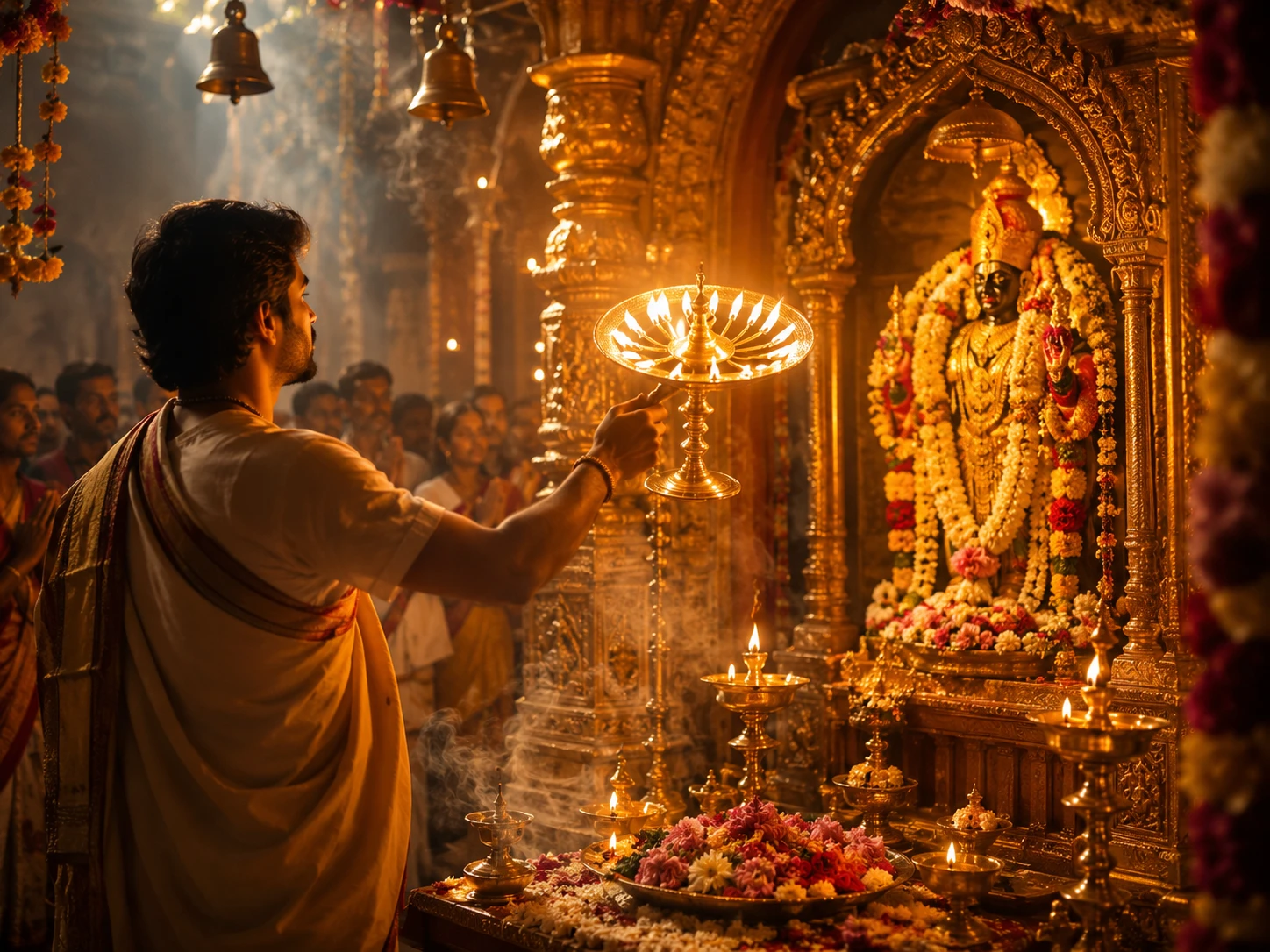
Aarti -- Why Hindus Circle Light Before God
13 min read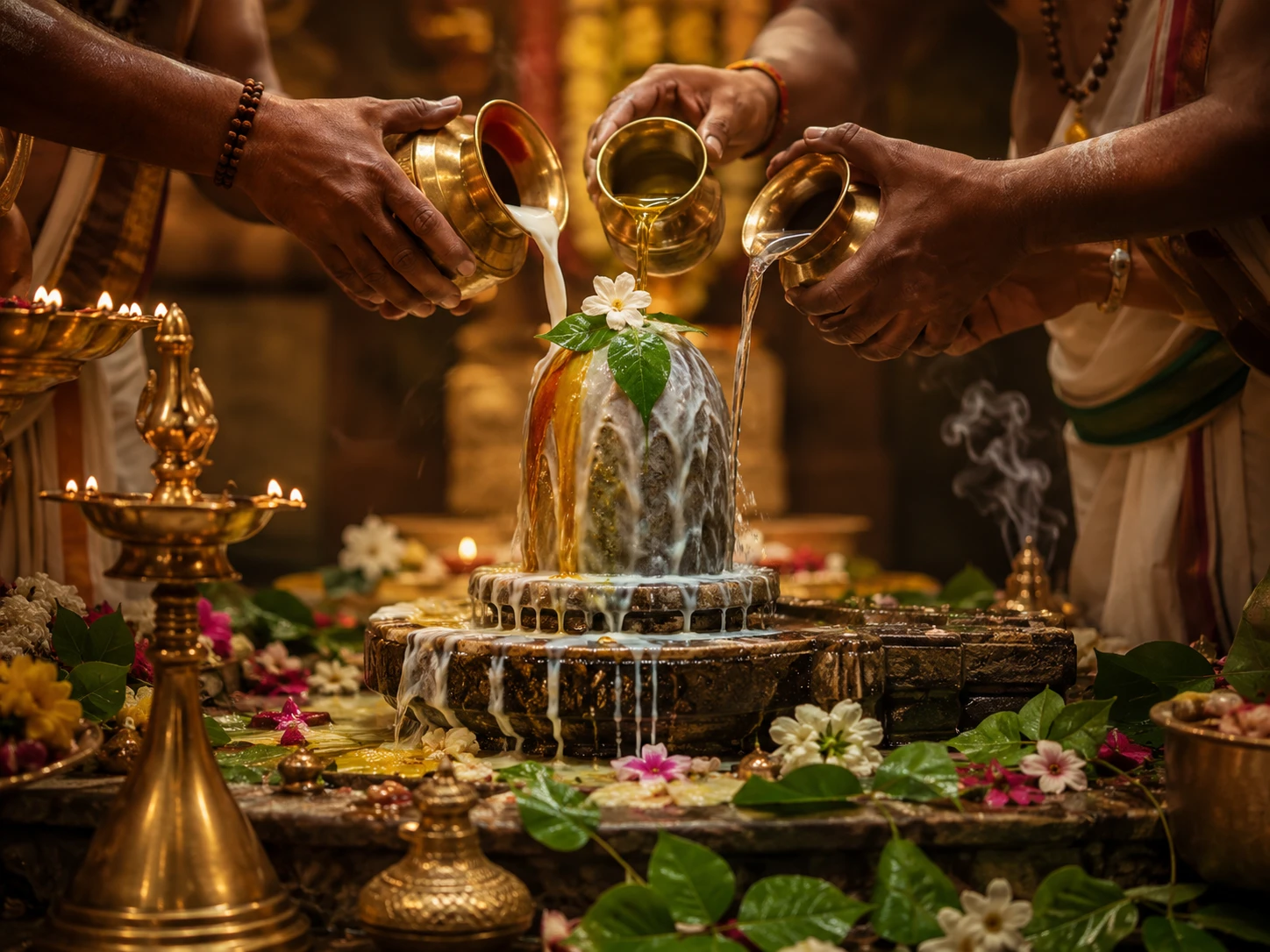
Abhisheka -- Why Hindus Bathe Their Gods
10 min read
Akshaya Tritiya -- The Day Nothing Given Away Runs Out
12 min readThe same translation error that turned '33 Koti' into '33 crore' in Hinduism also happened in Buddhism. The Chinese translation of Buddhist texts rendered 'Sapta Koti Buddha' (7 Supreme Buddhas) as '7 Crore Buddhas.' The…
Deities AvatarsCommunity Reflections
🕉️
Be the first to share your reflection.