Griha Pravesh -- Why Hindus Boil Milk Before Moving Into a New Home
गृह प्रवेश -- नए घर में हिन्दू दूध क्यों उबालते हैं
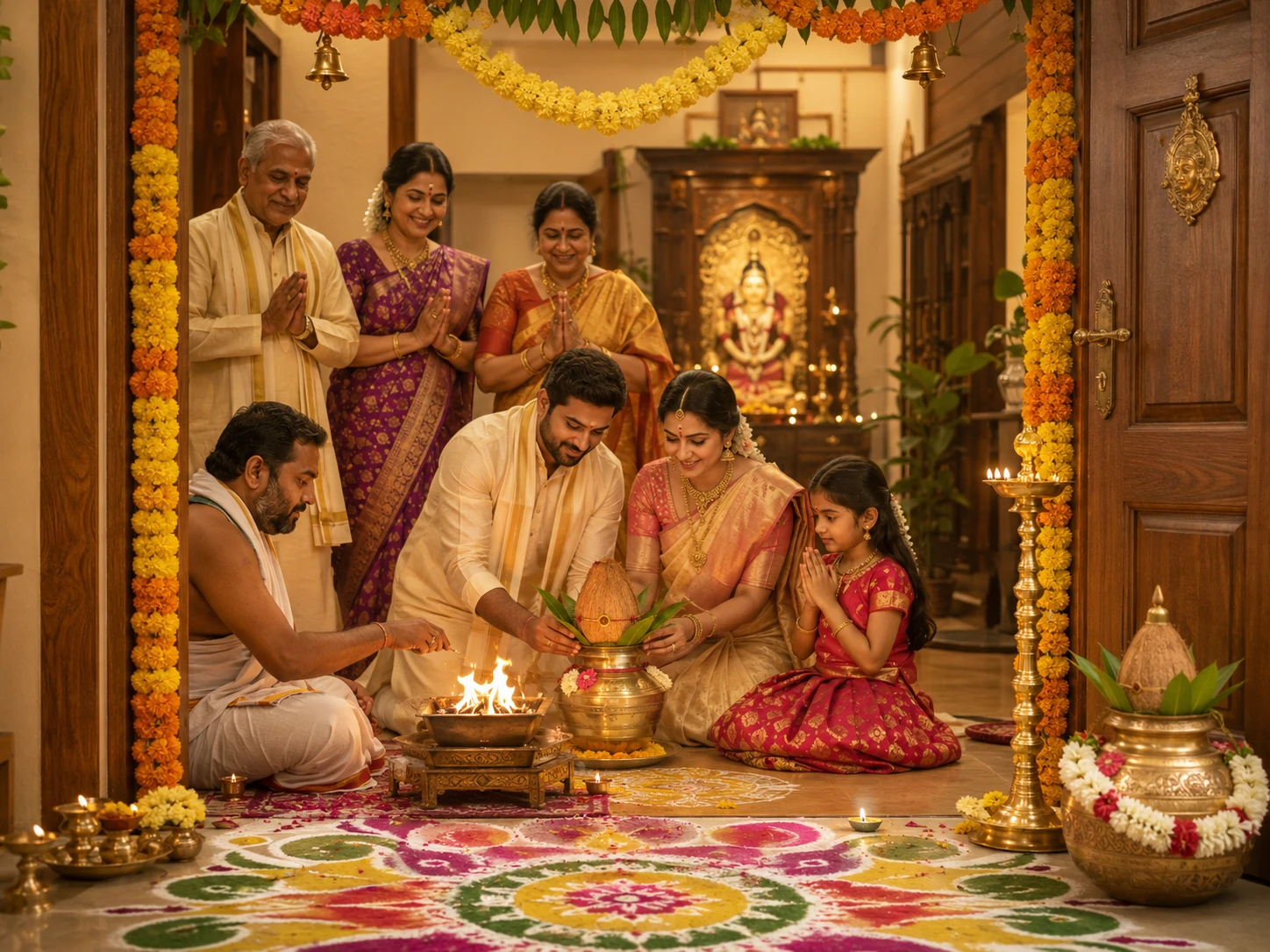
In a newly constructed apartment in Whitefield, Bangalore, a young couple stands at the threshold. The wife holds a brass kalash (pot) filled with water, topped with mango leaves and a coconut. Her husband lights a diya. Their parents watch from behind. The apartment smells of fresh paint and incense. A pandit chants. And then the moment: the wife places her right foot on a heap of rice at the threshold, tips a pot of milk on the stove inside until it overflows, and the family crosses into their new home.
This is Griha Pravesh -- literally 'entering the house' -- and it is one of the most universally observed Hindu ceremonies in modern India. It applies equally to a Rs 30 lakh flat in Noida and a Rs 30 crore villa in Juhu. It is performed by software engineers and shopkeepers, NRIs returning to newly built homes in Kerala and first-generation homeowners in Tier-3 towns. The details vary by region, but the core elements are remarkably consistent: fire (Havan or Diya), water (Kalash), milk (boiled to overflow), threshold crossing (right foot first), and the presence of sacred symbols (Swastika, Om, Toran of mango leaves).
The Dharmashastra tradition classifies Griha Pravesh into three types. Apoorva -- entering a newly constructed home for the first time; this is the most elaborate, requiring a full Vastu Shanti Homa and Navagraha Puja. Sapoorva -- re-entering a home after renovation or a long absence (such as returning from abroad); a simpler ceremony. Dwandva -- re-entering after a calamity (fire, flood, or inauspicious event); this includes specific Prayaschitta (purification) rituals to cleanse the space of negative associations.
The Muhurta for Griha Pravesh is taken extremely seriously. Most families consult a Jyotishi (astrologer) who examines the Panchang for a Shubh Muhurta that avoids Rahu Kala, falls on a favourable Tithi and Nakshatra, and is compatible with the homeowner's horoscope. Certain months are traditionally preferred (Vaishakha, Jyeshtha, Magha, Phalguna) while others are avoided (Ashada, Bhadrapada during Pitru Paksha). The real estate industry in India has internalised this -- builders frequently schedule possession handovers to coincide with astrologically favourable windows, and delayed possessions are sometimes blamed on 'no good Muhurta available this month.'
वास्तोष्पते प्रति जानीह्यस्मान्त्स्वावेशो अनमीवो भवा नः। यत्त्वेमहे प्रति तन्नो जुषस्व शं नो भव द्विपदे शं चतुष्पदे॥
vāstoṣpate prati jānīhy asmān tsvāveśo anamīvo bhavā naḥ yat tvemahe prati tan no juṣasva śaṁ no bhava dvipade śaṁ catuṣpade
O Lord of the dwelling (Vastoshpati), receive us favourably. Be free from disease for us. Whatever we ask of you, be pleased to grant it. Be auspicious for our two-footed (humans) and four-footed (animals) beings.
— Rigveda 7.54.1 (Vastoshpati Sukta)
The Milk Ritual -- Why Overflow Means Abundance
The most visually memorable element of Griha Pravesh is the boiling of milk. A pot of fresh milk is placed on the stove (or a portable gas burner in the new kitchen) and heated until it rises and overflows. The family watches intently, and when the milk spills over, there is often spontaneous joy -- clapping, 'Jai' calls, or simply relieved smiles.
The symbolism is layered. Milk represents purity, nourishment, and maternal abundance (the same associations that make it central to Abhisheka). The act of boiling represents transformation through heat -- the kitchen fire, which will sustain the family's life in this home, is being inaugurated. The overflow represents abundance that exceeds the container -- the family's prayer that this home will hold more prosperity than its walls can contain.
But there is a practical dimension too. In traditional India (and still in many homes), milk is the first thing cooked in a new kitchen. If the stove works, the vessels are clean, the ventilation is adequate, and the milk boils properly without burning -- the kitchen is functional. The milk-boiling ritual is, among other things, a quality check on the most important room in the house.
The direction of the overflow also matters in some traditions. If the milk overflows toward the east or north, it is considered especially auspicious. This connects to Vastu Shastra principles where the northeast (Ishanya) corner is associated with water, purity, and divine energy.
For the NRI couple performing Griha Pravesh in their new condo in Jersey City: the milk boiling ritual works in any kitchen, in any country. The gas stove, the steel pot, the full-cream milk from the Indian grocery store -- the ritual adapts seamlessly. What matters is the intention: we are inaugurating this space as our home, we are asking for abundance, and we are performing the first act of nourishment in a kitchen that will feed our family for years to come.
Three Types of Griha Pravesh
| Type | प्रकार | When | Key Rituals | Elaboration Level |
|---|---|---|---|---|
| Apoorva | अपूर्व | First entry into newly built home | Vastu Shanti Homa, Navagraha Puja, Ganapati Puja, milk boiling, threshold crossing | Most elaborate (2-4 hours) |
| Sapoorva | सपूर्व | Re-entry after renovation or long absence | Ganapati Puja, milk boiling, diya lighting, Sankalpa | Moderate (1-2 hours) |
| Dwandva | द्वन्द्व | Re-entry after calamity (fire, flood, death) | Prayaschitta rituals, Vastu Shanti, Navagraha Shanti, Havan | Elaborate + purification focus |
Most urban Griha Pravesh ceremonies in India today are Apoorva type (new flat/house purchase). The ceremony typically costs Rs 5,000-50,000 depending on elaboration, priest fees, and samagri. Some builders include a basic Griha Pravesh puja kit with possession handover.
The Psychology of Space Consecration
Environmental psychology has a concept called 'place attachment' -- the emotional bond between a person and a physical space. Research consistently shows that people who perform ritual or ceremonial acts when entering a new space develop stronger place attachment, report higher satisfaction with their living environment, and experience lower anxiety about the transition.
Griha Pravesh is a masterclass in manufactured place attachment. Consider what the ceremony accomplishes psychologically:
The Havan fills the space with fragrant smoke, creating a distinct sensory memory associated with the first moments in the home. Every time incense is lit in the future, the olfactory system will trigger recall of this founding moment.
The Rangoli at the entrance creates a visual claim of territory -- an artistic declaration that this doorway now belongs to this family. The Swastika and Om drawn in kumkum are not merely religious symbols; they are boundary markers.
The threshold crossing with the right foot creates a somatic (body-based) memory of entry. The deliberateness of the act -- stepping on rice, entering with intention rather than casually walking in -- ensures that the body remembers this moment as significant.
The milk boiling creates an olfactory-visual anchor: the smell of boiling milk, the sight of overflow, the warmth of the stove. The kitchen is now 'alive' -- it has produced its first nourishment.
The presence of family, friends, and a priest creates social witness to the transition. The home is not privately claimed but publicly inaugurated. The community knows: this family lives here now.
All of these elements combine to create a multi-sensory founding memory that anchors the family's identity to the space. This is not superstition. It is sophisticated ritual engineering that accomplishes in two hours what months of gradual habitation might not: the psychological transformation of a purchased structure into a lived home.
For the interior designer or architect: understanding Griha Pravesh deepens your ability to design spaces that support ritual use. The kitchen stove placement, the threshold width, the entrance orientation, the space for a Havan in the living area -- these are not afterthoughts. They are design requirements that the tradition has specified for millennia.
India's real estate industry -- valued at over $400 billion -- is one of the most Muhurta-sensitive sectors in the economy. Property registration offices in Mumbai, Delhi NCR, and Bangalore report visible spikes in registrations during astrologically favourable windows. Developers like Godrej, Lodha, and Prestige routinely time their possession ceremonies to fall on Shubh Muhurtas, and some offer complimentary Griha Pravesh puja kits (kalash, coconut, samagri, diya) with possession. The Magicbricks and 99acres platforms have integrated Griha Pravesh Muhurta calculators into their apps -- ancient ritual infrastructure embedded in proptech.
Consecrate Your Space with Daily Diya
You do not need to wait for a new home to consecrate your space. Light a ghee diya every evening in your current home and chant 'Om Vastoshpataye Namah' 108 times on a mala. The Vastoshpati Sukta of the Rigveda invokes the lord of the dwelling to protect and bless the space. A daily diya turns any room into a sanctum. The mantra meditation library on Eternal Raga has more mantras for daily japa.
Eternal Raga · शाश्वत राग
Institutional voice — scholarly articles on Sanatan Dharma
Deepen Your Understanding
अपनी समझ और गहरी करें
rituals traditions
Muhurta -- Why Hindus Obsess Over the Right Moment
Your grandmother checked the panchang before scheduling your mundan. Your parents consulted an astrologer before fixing your wedding date. Your colleague will not sign a business contract without checking the Choghadiya. The Hindu tradition divides every 24-hour day into 30 Muhurtas of 48 minutes each -- some auspicious, some neutral, some to be avoided -- and this time-quality framework has governed Indian life from Vedic fire rituals to modern real estate transactions.
rituals traditions
Havan Vidhi -- The Vedic Fire Ritual That Purifies Air, Mind, and Karma
Every major Hindu milestone -- birth, thread ceremony, wedding, housewarming, death -- involves fire. The havan is the oldest continuous ritual technology in Hinduism, dating to the Rig Veda. You pour ghee, herbs, and grains into a consecrated fire while chanting 'Svaha,' and Agni carries your offering to the gods. Modern science confirms: the smoke actually does purify the air. Here is the complete procedure.
rituals traditions
Puja at Home -- The Complete Beginner's Guide
You have a small mandir shelf in your apartment. A brass diya your mother gave you. A photo of a deity you feel drawn to. And absolutely no idea what to do next. This guide is for you -- the 22-year-old in Pune who just moved out, the NRI in New Jersey setting up a puja corner for the first time, the curious soul who wants to start but does not know where.
rituals traditions
Sankalpa -- The Ritual GPS That Locates You in the Cosmos Before Every Puja
Before any Hindu ritual begins, there is a quiet declaration that most people rush through without understanding. It names the current cosmic age, the ruling Manu, the Yuga, the year, the season, the month, the fortnight, the day, the star, the continent, the country, the river, your name, your lineage, and your exact intention. This declaration -- Sankalpa -- is the most sophisticated geo-temporal tagging system in any religious tradition. It tells the universe: I am here, I am this person, and I intend to do this specific act.
rituals traditions
The 16 Samskaras -- Rites of Passage from Womb to Pyre
Hinduism does not leave life to chance. From the moment a couple decides to conceive to the moment the body returns to the five elements, there are sixteen rituals -- samskaras -- designed to refine the human being at every critical transition. Think of them as firmware updates for the soul, installed at precisely the right moments.
rituals traditions
Panchopachara Puja -- The 5 Offerings That Engage All Five Senses
You do not need a pandit, a pavilion, or a two-hour ritual to worship. The Panchopachara Puja -- five offerings representing the five elements and engaging the five senses -- is the tradition's elegant minimum viable puja. Sandalwood for earth, flowers for space, incense for air, lamp for fire, food for water. Five items. Five minutes. A complete act of devotion.
rituals traditions
Why Bells, Lamps, and Flowers -- The Sensory Engineering Behind Hindu Worship
Hindu worship is not random. Every bell, every lamp, every flower, every stick of incense, every drop of water addresses a specific sense, invokes a specific element, and produces a specific psychological effect. The puja is a sensory design system -- a five-element, five-sense immersive experience engineered three thousand years before UX designers existed. Here is the complete map.
India's real estate industry -- valued at over $400 billion -- is one of the most Muhurta-sensitive sectors in the economy. Property registration offices in Mumbai, Delhi NCR, and Bangalore report visible spikes in regis…
More in Rituals & Traditions
Aarti -- Why Hindus Circle Light Before God
13 min read
Abhisheka -- Why Hindus Bathe Their Gods
10 min read
Akshaya Tritiya -- The Day Nothing Given Away Runs Out
12 min readThe same translation error that turned '33 Koti' into '33 crore' in Hinduism also happened in Buddhism. The Chinese translation of Buddhist texts rendered 'Sapta Koti Buddha' (7 Supreme Buddhas) as '7 Crore Buddhas.' The…
Deities AvatarsCommunity Reflections
🕉️
Be the first to share your reflection.