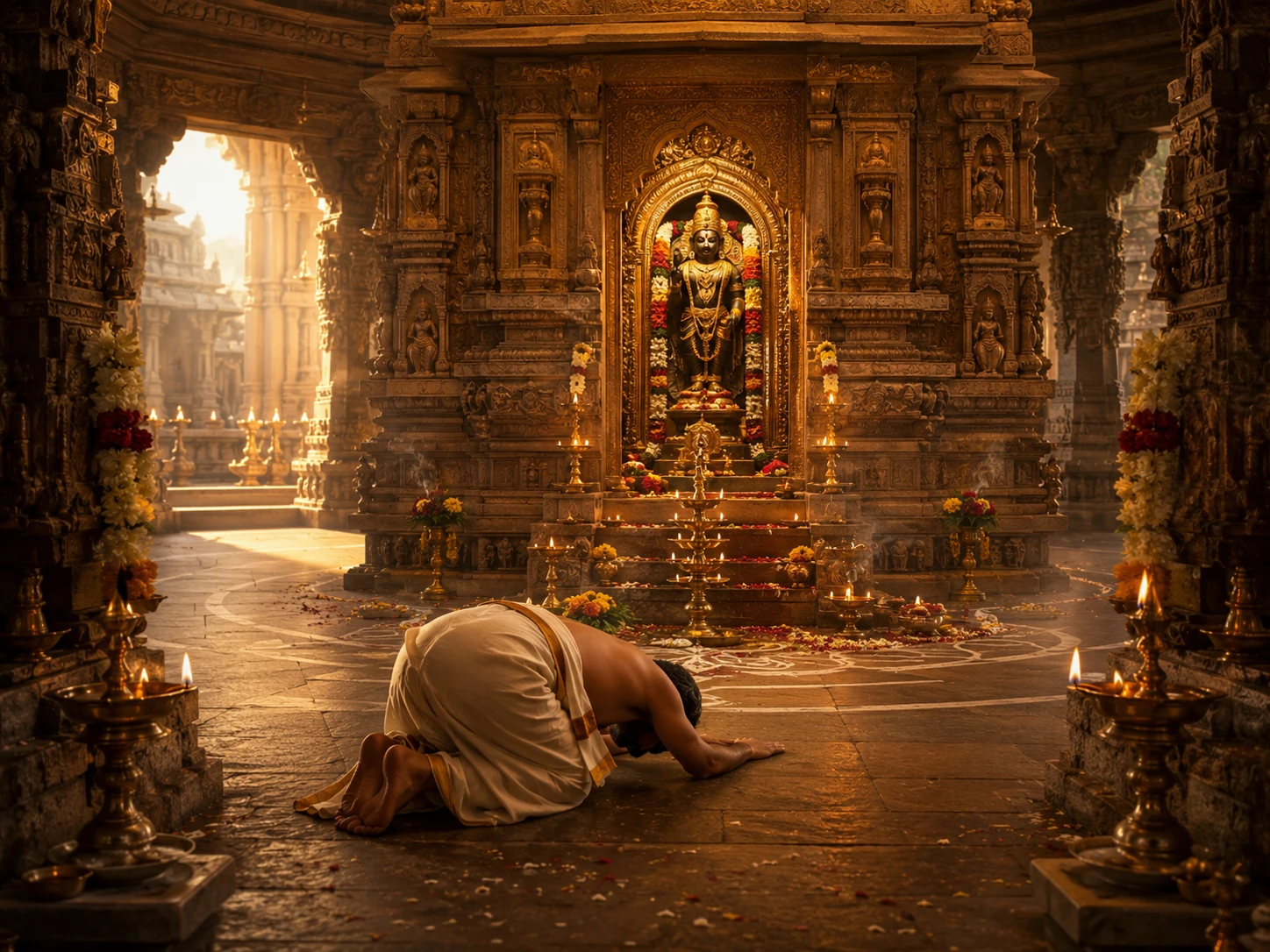
Pradakshina and Namaskara -- Why Hindus Walk Clockwise and Touch the Ground
प्रदक्षिणा और नमस्कार -- हिन्दू दक्षिणावर्त क्यों चलते और भूमि क्यों छूते हैं
Two of the most physically visible acts in Hindu worship require no mantra, no priest, no material offering, and no money. They require only your body and your willingness to use it as an instrument of devotion.
Pradakshina -- walking clockwise around a sacred object -- is performed around temples, deities, sacred trees (Peepal, Neem, Banyan), the Tulsi plant, the sacred fire, and even revered persons. The word comes from 'Pra' (forward) and 'Dakshina' (right side) -- moving forward with the right side toward the sacred centre. In every Pradakshina, the deity or sacred object remains to your right -- the auspicious side in Hindu tradition.
Namaskara -- bowing or prostrating before the divine or an elder -- ranges from the simple Anjali Mudra (palms joined at the chest) to the full Sashtanga Namaskara (eight points of the body touching the ground: two feet, two knees, two palms, chest, and forehead). Between these extremes lie several gradations: the standing bow (Pranama), the kneeling bow, and the Panchanga Namaskara (five-point prostration).
Both practices are so embedded in Indian life that they extend far beyond the temple. A child touches an elder's feet (a form of Namaskara) before leaving for school. A bride and groom perform Pradakshina around the sacred fire during the wedding. A new car is circumambulated before its first drive. A cricket team's coach receives Namaskara from players before a match in some traditional setups. These are not religious acts in the narrow sense -- they are cultural expressions of a worldview that treats respect, humility, and the body's participation in devotion as natural as breathing.
The question worth asking is: why does the body matter? Why not simply think respectful thoughts? The tradition's answer is precise: the body is not separate from the mind. Physical postures create mental states. Walking clockwise creates a meditative rhythm. Prostrating on the ground creates ego-dissolution. The body teaches the mind what the mind cannot teach itself.
यानि कानि च पापानि जन्मान्तरकृतानि च। तानि तानि विनश्यन्ति प्रदक्षिणपदे पदे॥
yāni kāni ca pāpāni janmāntara-kṛtāni ca tāni tāni vinaśyanti pradakṣiṇa-pade pade
Whatever sins have been committed across lifetimes, they are destroyed with every step of Pradakshina.
— Skanda Purana (traditional attribution)
Types of Namaskara
| Type | प्रकार | Body Position | When Used | Who Performs |
|---|---|---|---|---|
| Anjali Mudra | अंजलि मुद्रा | Palms joined at chest, standing | Greeting, prayer, temple entry | Everyone -- universal |
| Pranama | प्रणाम | Standing bow with folded hands | Before elders, teachers, deities | All ages |
| Panchanga | पंचांग | Five points touch ground (knees, hands, head) | Temple worship, guru darshan | Common in South India |
| Sashtanga | साष्टांग | Eight points: feet, knees, palms, chest, forehead flat on ground | Full prostration before deity or guru | Men (traditionally); women do Panchanga |
| Dandavat | दण्डवत | Body stretched like a stick, face down, arms extended forward | Supreme surrender, Vaishnava tradition | Devotees in ISKCON, Gaudiya tradition |
| Pada Sparsha | पाद स्पर्श | Touching feet of elder with right hand, then touching own eyes | Daily greeting to parents, teachers, elders | Children and younger family members |
In many South Indian traditions, women perform Panchanga (five-point) rather than Sashtanga (eight-point) Namaskara because the tradition holds that a woman's body should not fully touch the temple floor. However, this distinction is not universal and varies by community.
Why Clockwise? The Science of Dakshinayana
The clockwise direction of Pradakshina is not arbitrary. It reflects the Hindu cosmological observation that all celestial bodies -- planets around the sun, the moon around the earth, electrons around the nucleus (in the Bohr model) -- move in a consistent orbital direction when viewed from above the north pole. By walking clockwise, the devotee aligns their personal orbit with the cosmic orbit.
The Agama texts specify that Pradakshina should always be performed with the right side (Dakshina) toward the deity. The right side is considered the auspicious side in Hindu tradition -- the right hand receives and gives blessings, the sacred thread sits on the right shoulder-to-left-hip axis, and the right foot enters sacred spaces first. Keeping the deity to your right during circumambulation ensures that the auspicious channel remains open.
There is also a physiological dimension. Walking in a rhythmic circle creates a meditative state -- the repetitive motion, the constant visual focus on the temple structure, and the absence of decision-making (you are simply following the path) allow the mind to settle. Research on walking meditation (published in the Journal of Evidence-Based Complementary and Alternative Medicine) confirms that repetitive circular walking reduces anxiety and improves emotional regulation. The tradition's Pradakshina achieves the same effect while adding the devotional dimension of sacred centre-focus.
The number of Pradakshinas varies by deity. Ganesha receives one (representing his cosmic singularity -- the story of Ganesha circling his parents and winning the race against Kartikeya). Shiva receives three (some traditions say a half-Pradakshina, stopping at the Gomukhi channel of the Shiva Linga and returning, to avoid crossing the sacred water outflow). Vishnu receives four. Surya receives seven. Devi receives three or four depending on tradition. The Peepal tree receives seven or 108 Pradakshinas on Saturdays (associated with Shani).
Girivalam -- the circumambulation of sacred hills -- is perhaps the most physically demanding form of Pradakshina. The Girivalam around Arunachala hill in Tiruvannamalai, Tamil Nadu, is a 14-km barefoot walk performed on Purnima nights by hundreds of thousands of devotees. The Govardhan Parikrama near Mathura is 21 km. The Narmada Parikrama -- walking around the entire course of the Narmada river -- is over 2,600 km and takes months to complete. These are Pradakshinas of the landscape itself -- the earth as deity, circumambulated with the body as the instrument of prayer.
The Arunachala Girivalam in Tiruvannamalai is one of India's largest monthly pilgrimages. On every Purnima (full moon) night, an estimated 2-5 lakh devotees walk the 14-km barefoot circuit around Arunachala hill -- believed to be a manifestation of Shiva as a column of fire. The walk begins at sunset and continues through the night. The Tamil Nadu government deploys special buses, medical teams, and crowd management for each Purnima. The Karthigai Deepam festival in November-December, when a massive flame is lit atop Arunachala, attracts over 30 lakh devotees for Girivalam. Ramana Maharshi, who lived on Arunachala for over 50 years, considered the hill itself to be his guru -- making every Girivalam a Guru Pradakshina.
Perform a Pradakshina Today
Visit your nearest temple and perform three pradakshinas -- walking slowly, mindfully, with your right side toward the deity. Or circle the Tulsi plant in your home courtyard. As you walk each round, chant 'Om Namah Shivaya' or your ishta devata's mantra. Three rounds, three minutes of embodied devotion. The mantra meditation library on Eternal Raga has mantras to choose from.
Eternal Raga · शाश्वत राग
Institutional voice — scholarly articles on Sanatan Dharma
Deepen Your Understanding
अपनी समझ और गहरी करें
rituals traditions
Temple Darshan Etiquette -- The Complete Protocol for Visiting a Hindu Temple
Most Hindus visit temples. Few know the correct sequence. There is a reason you remove shoes before entering, ring the bell at the threshold, worship Ganesha first, walk clockwise around the sanctum, accept prasad in the right hand, and never point your feet at the deity. Every rule has a Vedic, architectural, or psychological rationale. This is the complete user guide to Hindu temple darshan.
rituals traditions
Puja at Home -- The Complete Beginner's Guide
You have a small mandir shelf in your apartment. A brass diya your mother gave you. A photo of a deity you feel drawn to. And absolutely no idea what to do next. This guide is for you -- the 22-year-old in Pune who just moved out, the NRI in New Jersey setting up a puja corner for the first time, the curious soul who wants to start but does not know where.
rituals traditions
Why Bells, Lamps, and Flowers -- The Sensory Engineering Behind Hindu Worship
Hindu worship is not random. Every bell, every lamp, every flower, every stick of incense, every drop of water addresses a specific sense, invokes a specific element, and produces a specific psychological effect. The puja is a sensory design system -- a five-element, five-sense immersive experience engineered three thousand years before UX designers existed. Here is the complete map.
rituals traditions
Panchopachara Puja -- The 5 Offerings That Engage All Five Senses
You do not need a pandit, a pavilion, or a two-hour ritual to worship. The Panchopachara Puja -- five offerings representing the five elements and engaging the five senses -- is the tradition's elegant minimum viable puja. Sandalwood for earth, flowers for space, incense for air, lamp for fire, food for water. Five items. Five minutes. A complete act of devotion.
rituals traditions
Sandhyavandana -- The Daily Vedic Practice That Even Rama and Krishna Never Skipped
Three times a day, at the junction of night and day, morning and afternoon, afternoon and night, the twice-born Hindu is commanded to stop everything and perform Sandhyavandana. It combines pranayama, the Gayatri Mantra, water offerings, and meditation into a single twenty-minute ritual. The Ramayana shows Rama doing it in the forest. The Mahabharata shows Krishna doing it before battle. And somewhere in India right now, an IIT student is doing it in his hostel room.
rituals traditions
The 16 Samskaras -- Rites of Passage from Womb to Pyre
Hinduism does not leave life to chance. From the moment a couple decides to conceive to the moment the body returns to the five elements, there are sixteen rituals -- samskaras -- designed to refine the human being at every critical transition. Think of them as firmware updates for the soul, installed at precisely the right moments.
deities avatars
Ganesha -- The Elephant God Decoded
An elephant head on a child's body. A broken tusk in one hand and a sweet in the other. A mouse as a vehicle for the largest deity in the room. Nothing about Ganesha makes sense on the surface -- and everything makes sense once you decode the symbols. This is the deity India invokes before every exam, every business launch, and every WhatsApp group creation.
The Arunachala Girivalam in Tiruvannamalai is one of India's largest monthly pilgrimages. On every Purnima (full moon) night, an estimated 2-5 lakh devotees walk the 14-km barefoot circuit around Arunachala hill -- belie…
More in Rituals & Traditions
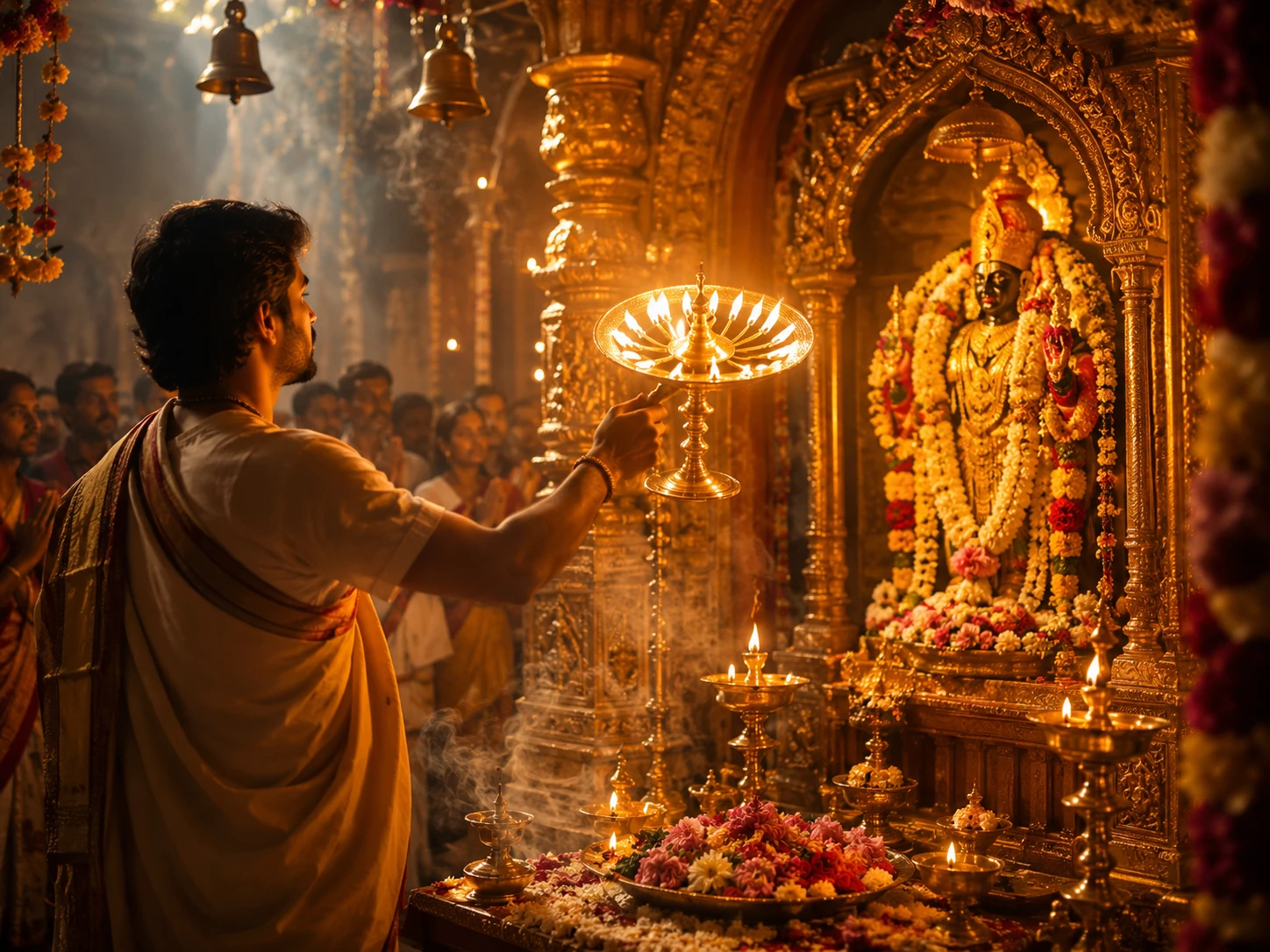
Aarti -- Why Hindus Circle Light Before God
13 min read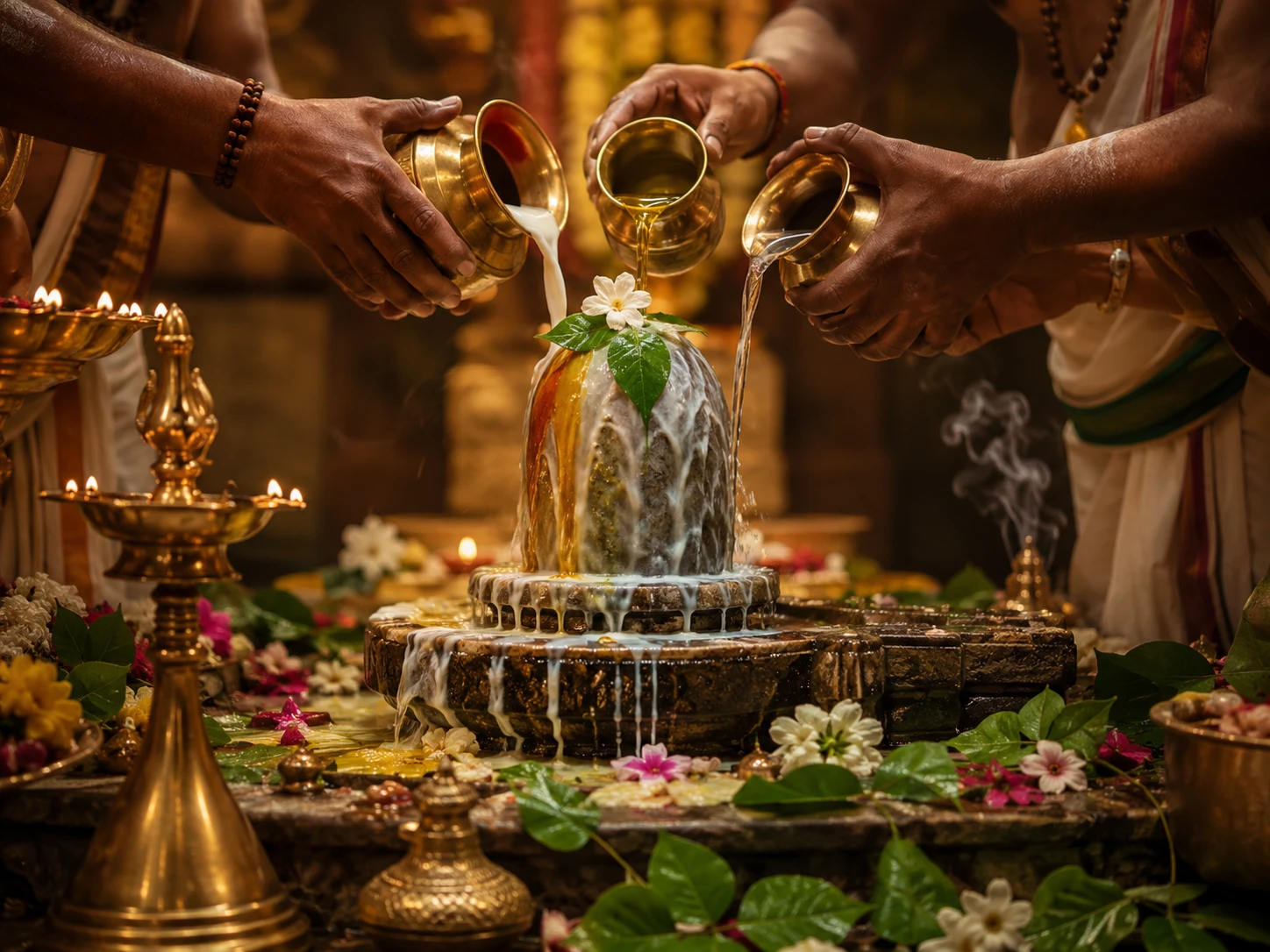
Abhisheka -- Why Hindus Bathe Their Gods
10 min read
Akshaya Tritiya -- The Day Nothing Given Away Runs Out
12 min readThe same translation error that turned '33 Koti' into '33 crore' in Hinduism also happened in Buddhism. The Chinese translation of Buddhist texts rendered 'Sapta Koti Buddha' (7 Supreme Buddhas) as '7 Crore Buddhas.' The…
Deities AvatarsCommunity Reflections
🕉️
Be the first to share your reflection.