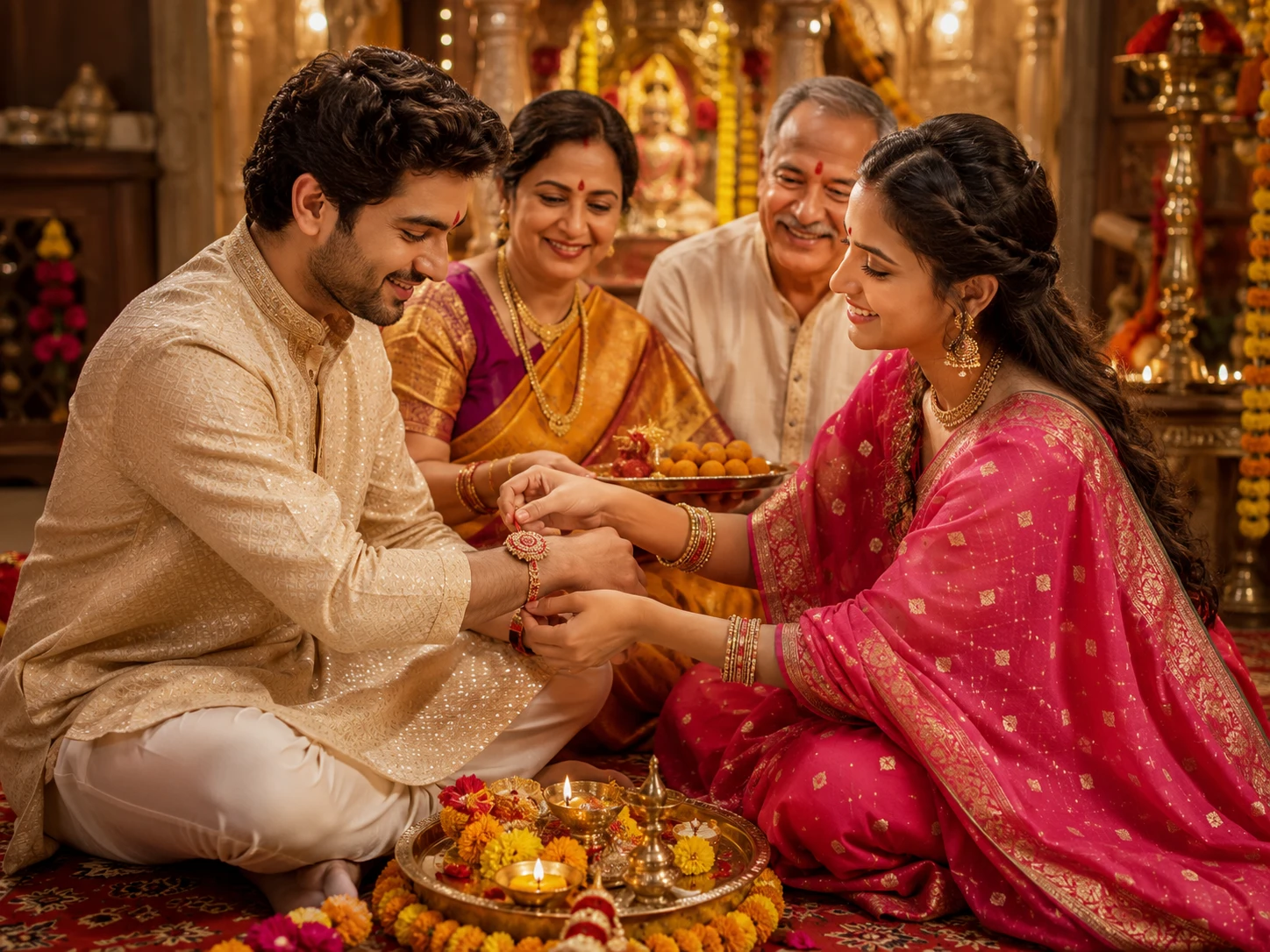
Raksha Bandhan -- The Thread That Binds Protection to Love
रक्षा बन्धन -- वो धागा जो रक्षा को प्रेम से बाँधता है
Raksha Bandhan falls on Shravan Purnima (the full moon day of the month of Shravan, July-August) -- coinciding with the conclusion of the rainy season's first phase and the renewal of the Yajnopavita (Upakarma/Avani Avittam) in many Brahmin communities.
The oldest reference to the Raksha thread comes from the Bhavishya Purana, where Indrani (Sachi), the wife of Indra, tied a protective thread (Raksha Sutra) on Indra's wrist before his battle against the demon Vritra. This thread, sanctified by mantras, gave Indra divine protection and he emerged victorious. The thread was not ornamental -- it was a charged talisman, a physical channel for the wife's protective shakti to flow to the warrior.
The Yama-Yamuna legend adds another dimension. Yamuna (the river goddess) tied a Rakhi on Yama (the god of death), who was so moved that he granted her immortality and declared that any brother who received a Rakhi from his sister would be blessed with long life. This origin story explains why Raksha Bandhan is specifically a sister-to-brother ritual: the feminine protective energy (Raksha Shakti) flows from the sister to the brother through the thread.
The Draupadi-Krishna connection is the most popularly cited. When Krishna cut his finger on the Sudarshana Chakra, Draupadi tore a strip from her saree and bandaged his wound. Krishna, moved by her spontaneous care, declared her his sister and promised infinite protection -- a debt he repaid during the Vastraharan (disrobing) episode in the Kaurava court.
The historical legend of Rani Karnavati of Mewar sending a Rakhi to Mughal Emperor Humayun (seeking his protection against Bahadur Shah of Gujarat) has been widely cited, though historians debate its veracity. Whether factual or literary, the legend encodes the Rakhi's power to create bonds of protection across political and religious boundaries.
In modern India, Raksha Bandhan has expanded beyond biological siblings. Soldiers receive Rakhis from schoolchildren at the border. Prime Ministers receive Rakhis from citizens. Women tie Rakhis on trees during environmental campaigns. The thread's meaning has evolved from sibling protection to universal protection -- anyone can be a Rakhi-brother, anyone can be a Rakhi-sister, and the covenant of care applies wherever the thread is tied.
The Rakhi market in India is estimated at Rs 8,000-10,000 crore annually, making it one of the largest gift-economy festivals. But the tradition's core remains unchanged: a thread, a prayer, a promise. The most expensive designer Rakhi and the simplest cotton thread carry identical spiritual weight. What matters is not the thread's material but the sister's intention -- and the brother's willingness to honour the covenant it represents.
येन बद्धो बली राजा दानवेन्द्रो महाबलः। तेन त्वामनुबध्नामि रक्षे मा चल मा चल॥
yena baddho balī rājā dānavendro mahābalaḥ tena tvām anubadhnāmi rakṣe mā cala mā cala
With the same thread by which the mighty demon king Bali was bound, I bind you. O Raksha (protector), do not waver, do not waver.
— Raksha Bandhan Mantra (Bhavishya Purana tradition)
Raksha Bandhan -- Origin Stories
| Story | कथा | Characters | Thread Significance | Source |
|---|---|---|---|---|
| Indrani-Indra | इन्द्राणी-इन्द्र | Wife ties thread on husband-king | Battle protection talisman | Bhavishya Purana |
| Yama-Yamuna | यम-यमुना | Sister ties on brother (Death God) | Immortality boon, brother's longevity | Puranic tradition |
| Draupadi-Krishna | द्रौपदी-कृष्ण | Draupadi bandages Krishna's finger | Spontaneous care creates eternal bond | Mahabharata folk tradition |
| Bali-Vishnu | बलि-विष्णु | Lakshmi ties on Bali to free Vishnu | Devotion binding even a demon king | Bhagavata Purana |
| Karnavati-Humayun | कर्णावती-हुमायूँ | Rajput queen to Mughal emperor | Cross-religious protection covenant | Historical legend (debated) |
The Bali-Vishnu story adds a cosmic dimension: when Vamana bound Bali and sent him to Patala, Lakshmi tied a Rakhi on Bali to secure Vishnu's release from his promise to guard Bali's kingdom. This makes Raksha Bandhan a festival where even the divine needs protection -- and that protection comes through a thread tied with love.
Raksha Bandhan coincides with Upakarma (Avani Avittam) in South Indian Brahmin traditions -- the annual renewal of the sacred thread (Yajnopavita). On the same Shravan Purnima when sisters tie Rakhis in North India, Brahmin men in Tamil Nadu, Karnataka, and Kerala change their old sacred thread for a new one, recommitting to Vedic study. The day also marks Hayagriva Jayanti (the birthday of Vishnu's horse-headed avatar of knowledge) in Sri Vaishnava tradition. One Purnima, three celebrations: sibling protection, Vedic renewal, and the birth of divine knowledge.
Chant the Raksha Mantra This Shravan Purnima
While tying or receiving a rakhi, chant the traditional Raksha Bandhan mantra: 'Yena baddho Bali raja...' It turns the rakhi from a decorative thread into a raksha sutra, the same protective thread Shachi tied on Indra's wrist. The mantra is not yet on Eternal Raga; learn its pronunciation from a family elder or the family priest. The mantra library has other protective hymns.
Tags
Eternal Raga · शाश्वत राग
Institutional voice — scholarly articles on Sanatan Dharma
Deepen Your Understanding
अपनी समझ और गहरी करें
rituals traditions
Upanayana -- The Sacred Thread That Makes You 'Twice-Born'
A boy sits before a sacred fire. A guru whispers the Gayatri Mantra into his ear for the first time. A three-stranded cotton thread is draped over his left shoulder and under his right arm. From this moment, he is Dvija -- 'twice-born.' His first birth was biological; this one is spiritual. The Upanayana is not a quaint coming-of-age ceremony. It is the formal initiation into the world of Vedic knowledge, the beginning of the Brahmacharya Ashrama, and one of the sixteen Samskaras that the tradition considers essential for a complete human life.
rituals traditions
Vrata -- What a Hindu Vow Really Means (It Is Not Just Fasting)
Your mother kept Karva Chauth without water for sixteen hours. Your grandmother observed Ekadashi every fortnight without fail. Your colleague skips lunch on Tuesdays 'for Hanuman.' The world sees Hindu fasting as dietary restriction. The tradition sees it as something far more radical: Vrata is a voluntary, time-bound act of self-imposed discipline that rewires the relationship between desire and willpower. Fasting is the most visible expression. But the real Vrata happens inside.
rituals traditions
Shravan / Aadi -- The Holiest Month in the Hindu Calendar (And Why It Belongs to Shiva)
When the monsoon arrives and India turns green, the Hindu calendar enters its most intensely devotional month. In North India, it is Shravan (Sawan) -- Shiva's month, when every Monday sees millions fasting, every Shiva temple overflows, and the Kanwar Yatra sends 30 million pilgrims walking barefoot to collect Ganga water. In South India, it is Aadi -- Devi's month, when Amman temples blaze with special pujas and women perform Aadi Pooram and Aadi Perukku rituals. Same monsoon, different deities, identical intensity.
rituals traditions
Navratri -- Nine Nights That Transform India
For nine nights, India becomes a different country. In Gujarat, millions dance garba till dawn. In Bengal, the streets turn into open-air art galleries. In Varanasi, nine temples light up in sequence. In Mysore, the palace blazes with 100,000 bulbs. Navratri is not a single festival -- it is nine nights of goddess worship that unite India's most diverse traditions into one cosmic celebration.
rituals traditions
Diwali -- Five Days of Light
Diwali is not one night of firecrackers. It is a five-day arc from Dhanteras to Bhai Dooj, layering wealth, ancestors, Lakshmi, community, and sibling bonds into a single liturgical sequence. Its origins span Rama's return, Krishna's Narakasura victory, Jain Mahavira's nirvana, and Sikh Bandi Chhor Divas -- making it the most theologically layered festival in the Indian calendar.
rituals traditions
Holi and Holika Dahan -- The Night a Child's Faith Burned an Empire
Before the colours fly, the fire burns. The night before Holi, India lights bonfires to commemorate the moment a five-year-old boy named Prahlad sat in flames and survived because he chanted Vishnu's name -- while the demoness Holika, who was supposed to be fire-proof, burned to ash. The story comes from the Bhagavata Purana, Seventh Canto, and it is one of Hinduism's most powerful narratives about the cost of faith and the fragility of power.
rituals traditions
The 16 Samskaras -- Rites of Passage from Womb to Pyre
Hinduism does not leave life to chance. From the moment a couple decides to conceive to the moment the body returns to the five elements, there are sixteen rituals -- samskaras -- designed to refine the human being at every critical transition. Think of them as firmware updates for the soul, installed at precisely the right moments.
Raksha Bandhan coincides with Upakarma (Avani Avittam) in South Indian Brahmin traditions -- the annual renewal of the sacred thread (Yajnopavita). On the same Shravan Purnima when sisters tie Rakhis in North India, Brah…
More in Rituals & Traditions
Aarti -- Why Hindus Circle Light Before God
13 min read
Abhisheka -- Why Hindus Bathe Their Gods
10 min read
Akshaya Tritiya -- The Day Nothing Given Away Runs Out
12 min readThe same translation error that turned '33 Koti' into '33 crore' in Hinduism also happened in Buddhism. The Chinese translation of Buddhist texts rendered 'Sapta Koti Buddha' (7 Supreme Buddhas) as '7 Crore Buddhas.' The…
Deities AvatarsCommunity Reflections
🕉️
Be the first to share your reflection.