Palm Leaf Manuscripts -- India's Paper Before Paper
ताड़पत्र पाण्डुलिपियाँ -- काग़ज़ से पहले का भारतीय लेखन
The Sarasvati Mahal Library in Thanjavur holds over forty-nine thousand manuscripts. The majority are written on palm leaves. Most are in Sanskrit, though there are also Tamil, Telugu, Marathi, and Modi-script records. A small team of conservators works through them one by one, re-oiling the leaves, re-stringing the bundles, photographing each folio, and slowly building a digital catalogue. They have been doing this for about forty years. At the current rate, the complete digitisation of the collection will take another thirty. And this is only one library. The Bhandarkar Oriental Research Institute in Pune holds another twenty-nine thousand. The Government Oriental Manuscripts Library in Chennai holds over seventy-two thousand. Kerala's Oriental Research Institute and Manuscripts Library in Thiruvananthapuram holds over sixty-five thousand. Varanasi, Mysore, Jaipur, Jodhpur, Kolkata, each has its own collection. Add all the private family and temple collections scattered across India, and the estimated total crosses four million surviving manuscripts. A majority are on palm leaves.
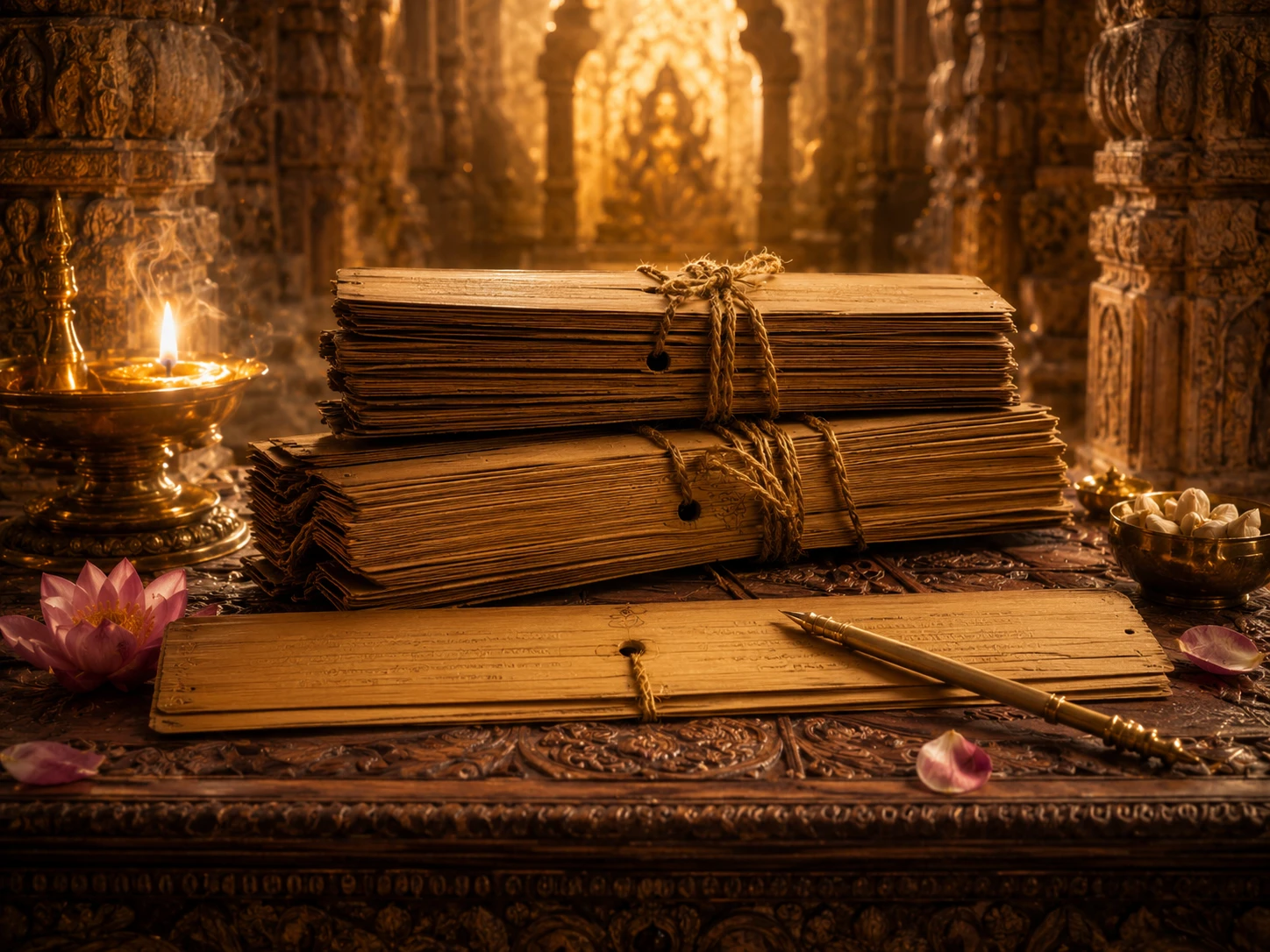
A palm leaf manuscript, in Sanskrit, is called tada-patra or tala-patra. In Tamil, it is olai chuvadi, the palm-leaf book. In Odia, it is pothi. In Assamese, a closely related tradition using agarwood bark strips is called sanchipat. In Himalayan Sanskrit tradition, birch bark takes the place of palm leaves; those manuscripts are called bhoja-patra. The medium varies. The form does not. Long narrow strips, all cut to the same dimensions, written on both sides, bundled together by a cotton string passing through one or two punched holes, and held between two wooden covers painted with lacquer and bound with further string. When a reader opens a pothi, he unties the outer string, lifts the top wooden cover, and turns the leaves like loose pages in a manila folder.
For about two thousand years, this was the physical body of Indian knowledge. Every surviving Sanskrit text before the seventeenth century, every Tamil Sangam poem, every Ayurvedic pharmacopoeia, every astronomical table, every Jain Kalpa Sutra, every Buddhist Tripitaka copy, every shakha of the Vedas, reached us because someone, generation after generation, kept scratching the letters into fresh palm leaves and binding them with cotton string. The reverence that ends up on a museum label reading 'ancient wisdom' was, up close, the patient work of countless copyists in ashram libraries, temple strongrooms, and royal archives.
या कुन्देन्दुतुषारहारधवला या शुभ्रवस्त्रावृता या वीणावरदण्डमण्डितकरा या श्वेतपद्मासना । या ब्रह्माच्युतशङ्करप्रभृतिभिर्देवैः सदा वन्दिता सा मां पातु सरस्वती भगवती निःशेषजाड्यापहा ॥
yā kundendu-tuṣāra-hāra-dhavalā yā śubhra-vastrāvṛtā yā vīṇā-vara-daṇḍa-maṇḍita-karā yā śveta-padmāsanā | yā brahmācyuta-śaṅkara-prabhṛtibhir devaiḥ sadā vanditā sā māṃ pātu sarasvatī bhagavatī niḥśeṣa-jāḍyāpahā ||
She who is white as the jasmine, moon, or snow, dressed in spotless garments, her hand adorned with the fine staff of the veena, seated on the white lotus; she who is always saluted by the devas headed by Brahma, Vishnu, and Shiva; may that revered Sarasvati protect me, she who removes the last trace of intellectual dullness.
— Saraswati Stotra, recited at the opening of every manuscript study in traditional Indian learning; attributed to Agastya in some traditions, widely collected in Agama-Kalpadruma and other puja-paddhati compilations
Every traditional Sanskrit class in every gurukul in India still begins the day with this verse. Before a student opens a palm leaf manuscript to copy or study, he bows to Sarasvati, the goddess who holds the veena in one hand and a pothi in the other. That pothi in the goddess's hand is the iconographic sign that in the Hindu imagination, knowledge has a specific material form. It is not abstract. It is shaped like a bundle of palm leaves tied with string. Sarasvati does not hold a book in the codex-form we know today. She holds the form that dominated Indian knowledge for twenty centuries. When a priest in a Bengaluru IIT alumnus's home installs Sarasvati on the altar during Saraswati Puja in the run-up to the final exams, the devi in that plastic or brass murti is holding a palm leaf pothi. The IIT student may have never touched one. The goddess who protects his engineering degree still does.
The craft of making a palm leaf manuscript begins with the tree. The talipot palm (Corypha umbraculifera), found across South India and Sri Lanka, and the palmyra palm (Borassus flabellifer), more common in the drier plains, provide the two main leaf types. Talipot leaves are preferred for longer texts because they are larger and more supple. Palmyra leaves are sturdier and better for shorter, high-use manuscripts. The leaves are cut young, before they open fully. They are boiled in water with turmeric and lime for preservation, then dried slowly in the shade (direct sun makes them brittle), and finally polished with a smooth stone or conch-shell to create a writing-ready surface. Only then are they cut to standard dimensions: usually about thirty to forty centimetres long, four to six centimetres wide.
The writing tool is a stylus, in Sanskrit lekhani or salaka. It is a thin iron or steel rod with a pointed tip, held like a pen but used like an engraver. The scribe does not ink the letters. He scratches each letter into the leaf, following the script strictly from left to right, leaf by leaf. When one side is full, he turns it over and writes on the other. Once the manuscript is complete, the entire surface is wiped with a paste made of lampblack or charcoal mixed with oil. The ink settles into the scratched grooves. The excess is rubbed off. What remains is a black-inked text on a golden-yellow leaf. The letters are permanent as long as the leaf survives, and the leaf survives for four to six hundred years under the right conditions.
The oldest surviving Sanskrit manuscript we know of, the Spitzer Manuscript of the Natyashastra, dates to around the third century CE and was discovered in Kizil, Chinese Turkestan. It is in fragmentary condition, the leaves crumbling at the edges, but the script is still legible. The Bower Manuscript, discovered in 1890 near Kucha in Chinese Turkestan by Lieutenant Hamilton Bower of the British Indian Army, dates to the fifth century CE and contains, among other things, an Ayurvedic treatise on medicine. The manuscript is not actually on palm leaves; it is on birch bark cut to palm-leaf dimensions. This tells us two things. First, that Indian manuscript culture was already standardised by the fifth century; the birch-bark sheets imitate the palm-leaf format. Second, that the pothi form had already travelled along the Silk Road into Central Asia, carried by Buddhist monks and Indian merchants moving between Taxila, Mathura, and Kucha.
The survival of these ancient manuscripts is often accidental. The Spitzer Manuscript survived because it was buried in the dry sands of Turkestan. The Bower Manuscript was found in an abandoned Buddhist monastery at Kucha. Wet climates like Bengal and Kerala have destroyed almost every palm-leaf manuscript that was not constantly recopied. Dry climates like Rajasthan and Jaisalmer, or dry monastery libraries like those at Mount Abu, Shravanabelagola, and the Jain bhandars of Patan, have preserved manuscripts seven or eight hundred years old. The oldest complete Sanskrit Ramayana manuscript, housed at the Asiatic Society in Mumbai, dates to 1020 CE. The oldest Mahabharata manuscript with complete Adi Parva, held at the Bhandarkar Institute in Pune, is from 1156 CE. Both have been recopied countless times before, but these specific physical objects are what we now have.
The recopying tradition is what kept Indian knowledge alive when paper was not available. A senior monk at a monastery, a temple priest, or a royal scribe would spend his lifetime copying older manuscripts that were beginning to wear out. In South India, the practice was so systematic that temple archives maintained what were essentially copyist-departments. The Tirumala temple inscriptions from the thirteenth century record endowments for specific scribes with named salaries. The job was hereditary, and the skill of the kaisika (hand-writing style) was passed from father to son. When a manuscript reached the end of its useful life, another one was copied from it, sometimes with corrections, sometimes with errors, sometimes with marginal notes added. The textual variations we now see in Sanskrit editions, the slight differences between the southern recension of the Mahabharata and the northern, the different readings of the same Rig Veda hymn in different shakhas, all trace back to the decisions of individual copyists working, leaf by leaf, in poorly lit rooms four or five centuries ago.
Indian Manuscript Materials and Regions
| Material | Sanskrit Name | Region | Lifespan | Typical Contents |
|---|---|---|---|---|
| Talipot palm leaf | Tada-patra / Tala-patra | South India, Sri Lanka, Odisha | 400-600 years in dry storage | Vedas, Sanskrit philosophy, Ayurveda, Jyotisha, Agamas, Tamil Sangam |
| Palmyra palm leaf | Tada-patra (shorter) | Drier plains of South and East India | 300-500 years | Royal records, temple accounts, shorter religious texts, daily chronicles |
| Birch bark | Bhurja-patra / Bhoja-patra | Kashmir, Himachal, Uttarakhand, Nepal | 800-1000+ years in dry Himalayan climates | Kashmiri Sanskrit, Tantra, Yoga texts, Abhinavagupta's Tantraloka |
| Agarwood bark (sanchi) | Sanchi-pat | Assam, Arunachal Pradesh | 400-600 years | Vaishnava devotional literature, Srimanta Shankardeva's works, Ahom chronicles |
| Paper (imported) | Kagad / Kagaz | North India after 13th century, everywhere after 16th | 200-400 years depending on quality | Later Sanskrit commentaries, Mughal-era Persian, Hindi verse |
| Copper plates (grants) | Tamra-patra | All India | Almost indefinite with care | Royal land-grants, temple inscriptions, village boundaries |
The Assamese sanchipat tradition is one of the most distinctive. Agarwood bark is stripped, soaked, smoothed, and cut to palm-leaf dimensions; the resulting strips are slightly softer and allow written (not engraved) script with a reed pen. Srimanta Shankardeva's fifteenth-century Kirtana-ghosha is traditionally preserved on sanchipat, and the Kamakhya temple in Guwahati retains a small collection of sanchipat manuscripts dating to the Ahom period.
The Thanjavur Sarasvati Mahal Library is the most famous surviving manuscript library in India, but it is not the oldest idea. Temple-libraries called Sarasvati-bhandara existed by the twelfth century, explicitly attached to major temples and staffed by professional librarians. Epigraphical evidence from Karnataka, Tamil Nadu, and Odisha names these libraries, their endowments, and their staff salaries. Jaisalmer's Jain Bhandar, held by the Lodhurva community, is perhaps the best-preserved of these old repositories; it holds manuscripts dating back to the eleventh century, kept in sealed rooms with specific humidity controls maintained by hand for over eight hundred years. The monks turn each manuscript once a year to prevent pages sticking together. The routine has not changed since the Chaulukya dynasty.
The royal patronage of Serfoji II of Thanjavur in the early nineteenth century made the Sarasvati Mahal what it is today. Serfoji learned Sanskrit, English, French, Italian, and Latin in his youth, and he sent scholars to northern India, to Varanasi, to Bengal, and even to Europe to collect or copy manuscripts. His agents bought, borrowed, or commissioned fresh copies of thousands of texts. When Serfoji died in 1832, the collection included Ayurvedic treatises, astronomical tables, music treatises like Sharangadeva's Sangita Ratnakara, mathematical works, philosophy, literature, and a European section including Lavoisier's Traité Élémentaire de Chimie and an atlas from 1692. The library has been a public trust since 1918 and is now maintained by the Tamil Nadu government. It remains one of the few places on earth where you can see a palm leaf manuscript being unrolled by a conservator in real time.
The estimated total loss of Indian manuscripts over the centuries is staggering and often underdiscussed. The Nalanda library was burned by Bakhtiyar Khilji around 1193 CE; chroniclers writing within a generation described the smoke rising from the burning palm leaves for months. The Vikramashila and Odantapuri libraries went the same way. Puranic chronology and Buddhist records together suggest Nalanda alone may have held close to one million manuscripts. In South India, the Srirangam temple library was damaged during the Delhi Sultanate's fourteenth-century raids; what survived was hidden in Tirupati and nearby hills. The Thanjavur Saraswathi Mahal's collection, at forty-nine thousand, feels vast. Placed against what we have lost, it is a fragment.
The National Mission for Manuscripts, started by the Government of India in 2003, estimates that over ten million manuscripts still survive in India, including uncatalogued private and family collections. More than five million are in Sanskrit. The Mission's target to digitise and publish the entire corpus has an estimated completion horizon of fifty years at current funding levels. An average conservator can process about four hundred manuscripts per year. At that rate, India's surviving palm-leaf manuscripts contain roughly twenty thousand conservator-years of unread material. Most of it has never been translated into any modern language, including modern Hindi. The knowledge in those bundles is not lost. It is physically present, engraved into palm leaves, waiting for someone to read it.
The regional variations in manuscript culture tell us something about the geography of Indian learning. Kerala's manuscript tradition, held largely by Namboodiri Brahmin families and by temples like Thrissur Vadakkunnathan and the Guruvayur archives, is particularly rich in astronomy and mathematics. The Kerala School of mathematics, which produced infinite series expansions for trigonometric functions around 1400 CE (three centuries before the European work of Leibniz and Gregory), preserved its results in palm leaf manuscripts like Madhava's Yukti-Dipika and Jyeshthadeva's Yuktibhasha. These texts were unknown to Western mathematical history until Charles Whish wrote a paper on them in 1835, and even then they were dismissed as derivative. Only in the late twentieth century, when scholars like K. V. Sarma of the Adyar Library and K. Ramasubramanian of IIT Bombay carefully catalogued and analysed these manuscripts, did the Kerala School's genuine priority become undeniable. Those manuscripts had been sitting in temple libraries for four hundred and fifty years. They were waiting.
The Jaisalmer Jain Bhandar holds something different: the world's most complete set of early Svetambara Jain agama manuscripts, copied between the eleventh and fifteenth centuries. The humidity and temperature in Jaisalmer are ideal for long-term preservation of palm leaves. When the renowned Jain scholar Muni Jinavijaya accessed the collection in the 1930s and 1940s, he found Jain texts considered lost for centuries, including early commentaries on the Kalpa Sutra and unrecorded versions of the Uttaradhyayana. Several of his publications between 1935 and 1950 transformed the field of Jain studies, but he always noted that his sources were palm leaves in a Rajasthan desert town that had been carefully preserved, sometimes hidden, by monks he himself had begged to be allowed to see.
The Himalayan birch-bark tradition produced its own distinctive literature. Kashmir's Sanskrit heritage, dominated by Shaiva Tantric works of Abhinavagupta and his lineage, reached us almost entirely through birch-bark manuscripts. Abhinavagupta's Tantraloka (eleventh century), a work of over thirty-seven chapters and thousands of verses, survived because Kashmiri families kept making fresh copies on birch bark for eight centuries. After the 1990 exodus of the Kashmiri Pandits, many of these manuscripts were moved to Jammu and Delhi; others remained in Kashmir and were partially digitised in the 2010s by scholars affiliated with the Indira Gandhi National Centre for the Arts. The materials reveal a continuous Sanskrit intellectual tradition that western Indology, focused on Sanskrit's Vedic and epic phases, largely missed until the late twentieth century.
A palm-leaf manuscript, held in the hand, is a surprisingly small object. A full Mahabharata on palm leaf would be fifteen or twenty bundles, each bundle about six or seven centimetres thick, weighing a kilogram or two. A complete Ramayana fits in four or five bundles. A Bhagavad Gita with commentary sits in one slim bundle the size of a modern paperback. The physical compression is part of what made manuscripts portable across the subcontinent's trade routes and monastic networks. A wandering sadhu could carry his copy of the Ashtadhyayi in a cloth sling on his shoulder. A Buddhist monk on his way from Kashmir to Nalanda could fit a full Abhidharma section into his bedroll. The pothi was designed for travel.
But the pothi also required ritual handling. A traditional Sanskrit reader does not place the manuscript on a table without an asana (cloth). He touches it to his forehead before opening. He does not eat or drink while it is open. He does not read aloud from it in the presence of unritualised listeners. He does not turn the page with a wet finger. These rules are not about hygiene. They are the ritual handling protocols appropriate to Sarasvati's physical presence. The pothi is Sarasvati's body in small. Damaging it is an insult to the goddess. A manuscript irretrievably ruined is cremated, not discarded; a small ceremony marks the return of the vidya to the goddess, and a new copy is commissioned.
In twenty-first century India this ritual attention survives most clearly in pandit families in Varanasi, Mithila, Puri, Thanjavur, Mysore, and Trivandrum. A Mithila pandit's son studying for his Sanskrit Acharya degree at a Kashi Vidyapith might touch his great-grandfather's palm leaf Vyakarana bundle once a year, on Saraswati Panchami in January or February, to receive the family's vidya-blessing. He will not read it every day. He uses a modern Devanagari-printed Vyakarana textbook for daily study. But the pothi holds the family's lineage, and every Saraswati Panchami the bundle is taken out, garlanded, anointed with sandalwood paste, and its outermost leaf is kissed by every family member. This is how living tradition treats the object. The manuscript is not a book in the sense of the English word. It is an heirloom in the full anthropological sense.
The future of palm-leaf manuscripts is partly a technology story. The Indira Gandhi National Centre for the Arts in Delhi, with field offices across India, has been leading a multi-decade digitisation effort. High-resolution photography captures each folio. Optical character recognition for Devanagari, Grantha, Sarada, Bengali, and other manuscript scripts has improved dramatically since 2020 with the arrival of transformer-based models trained specifically on Indian scripts. The National Digital Library of India now hosts scans of several lakh folios. But digitisation is not the same as reading. Reading requires a scholar who can work with the specific handwriting of a specific copyist, understand the idiosyncrasies of that school, and reconcile the leaf-by-leaf text with parallel manuscripts. India currently has perhaps two thousand scholars trained to this level. The National Mission for Manuscripts has been running intensive training programmes to grow that number, but the demographic challenge is real.
The paradox of twenty-first-century India is that its palm-leaf heritage is simultaneously more accessible and less read than ever before. An IIT Madras undergraduate can download a high-resolution scan of a sixteenth-century Srirangam Prasthanatrayi manuscript from the INDIAN digital repository in 2026, open it on her laptop in a hostel room, and realise within five minutes that she cannot read the Grantha script in which it is written. The digital file is free. The skill to read it takes twelve years of focused gurukul-style training. The gap between access and comprehension has widened, not narrowed. Projects like the Sanskritjnana initiative at IIT Madras, the Samskrita Bharati language camps, and university Sanskrit departments are trying to close the gap, but the task is intergenerational.
And yet the manuscripts themselves have not stopped working. Every Saraswati Panchami, every upanayana in a traditional family, every temple festival, every ayurvedic practitioner consulting his grandfather's prescription book, reaches out to a palm-leaf manuscript somewhere in India. The object is not obsolete. It has simply become rarer, and therefore more precious, and therefore more carefully guarded. A Sarasvati murti on a Bengaluru puja shelf in 2026 still holds a palm leaf pothi in her left hand. The form of knowledge is remembered even by those who can no longer read it. The form waits, patiently, for the reader who might one day return.
Read the Texts the Manuscripts Preserved
Libraries such as the Sarasvati Mahal in Thanjavur and the Bhandarkar Oriental Research Institute in Pune hold thousands of manuscripts; the Bhandarkar Institute's critical edition of the Mahabharata was built by comparing hundreds of them. Eternal Raga's Scriptures library holds texts these manuscripts carried down -- the Gitas, Upanishads, Ramayana and Puranas -- with Sanskrit and translation.
Tags
Eternal Raga · शाश्वत राग
Institutional voice — scholarly articles on Sanatan Dharma
Deepen Your Understanding
अपनी समझ और गहरी करें
sacred artefacts
Sacred Vessels -- Akshaya Patra, Kamandalu, and Amrit Kalash
Three vessels define Hindu ritual. The Akshaya Patra fed the Pandavas through twelve years of exile. The kamandalu sits beside every ascetic from Vyasa to the sadhu at Prayagraj. The amrit kalash rose from the churned ocean and reshaped cosmic order. Each vessel teaches a different lesson about what it means to hold the sacred.
sacred artefacts
Utsava Murti -- The Processional Deity
The stone god in the sanctum never leaves. The metal god on the palanquin walks every street. This is the utsava murti, the deity that comes out to meet you. Every Chola bronze in a museum was once carried in procession. Every Brahmotsavam at Tirumala, every Rath Yatra at Puri, every temple car at Madurai, runs on the same principle: the god moves so the devotee need not travel to the sanctum to be seen.
sacred artefacts
Divine Gems -- Syamantaka, Kaustubha, and Chintamani
Hindu mythology's most precious stones are not mere ornaments -- they are plot devices, moral tests, and cosmic forces. The Syamantaka Mani turned Krishna into a detective. The Kaustubha emerged from the Ocean of Milk to sit forever on Vishnu's chest. The Chintamani fulfils every wish -- and teaches why that might be the worst thing that could happen to you.
sacred artefacts
Temple Bells -- Sound as Purification
You never enter a Hindu temple in silence. Your first act at the threshold is to reach up and strike the bell. There is a verse for why. There is an alloy-ratio for the metal. There is an agamic rule for when to ring it, and who may. The temple bell is not decoration. It is the audible signal that ordinary space has just become sacred.
sacred artefacts
Divine Ornaments -- Vaijayanti, Kundala, and Kirit
Hindu deities are never shown bare. Every garland, earring, and crown carries a name, a cosmology, and a story. The Vaijayanti on Vishnu's chest holds the five elements. Karna was born with his kundalas fused to his ears. Arjuna earned the title Kiriti from Indra's crown. This is the grammar of divine adornment.
sacred artefacts
Sacred Thrones and Asanas of the Deities
No Hindu deity stands or sits on bare ground. Every god is placed on a specific seat, and every seat carries a name, a cosmology, and a rule. Vishnu reclines on Shesha. Shiva sits on a tiger. Durga commands the simhasana. Lakshmi rests on a lotus in full bloom. The throne is not where the deity happens to be. The throne is what tells the viewer which deity this is.
The National Mission for Manuscripts, started by the Government of India in 2003, estimates that over ten million manuscripts still survive in India, including uncatalogued private and family collections. More than five …
More in Sacred Artefacts
Ashtadhatu -- The Sacred Eight-Metal Alloy of Indian Temples
12 min read
Banalinga -- The Stone God Made Himself in a River Over Millions of Years
13 min read
Celestial Trees -- Kalpavriksha and Parijata
12 min readThe same translation error that turned '33 Koti' into '33 crore' in Hinduism also happened in Buddhism. The Chinese translation of Buddhist texts rendered 'Sapta Koti Buddha' (7 Supreme Buddhas) as '7 Crore Buddhas.' The…
Deities AvatarsCommunity Reflections
🕉️
Be the first to share your reflection.