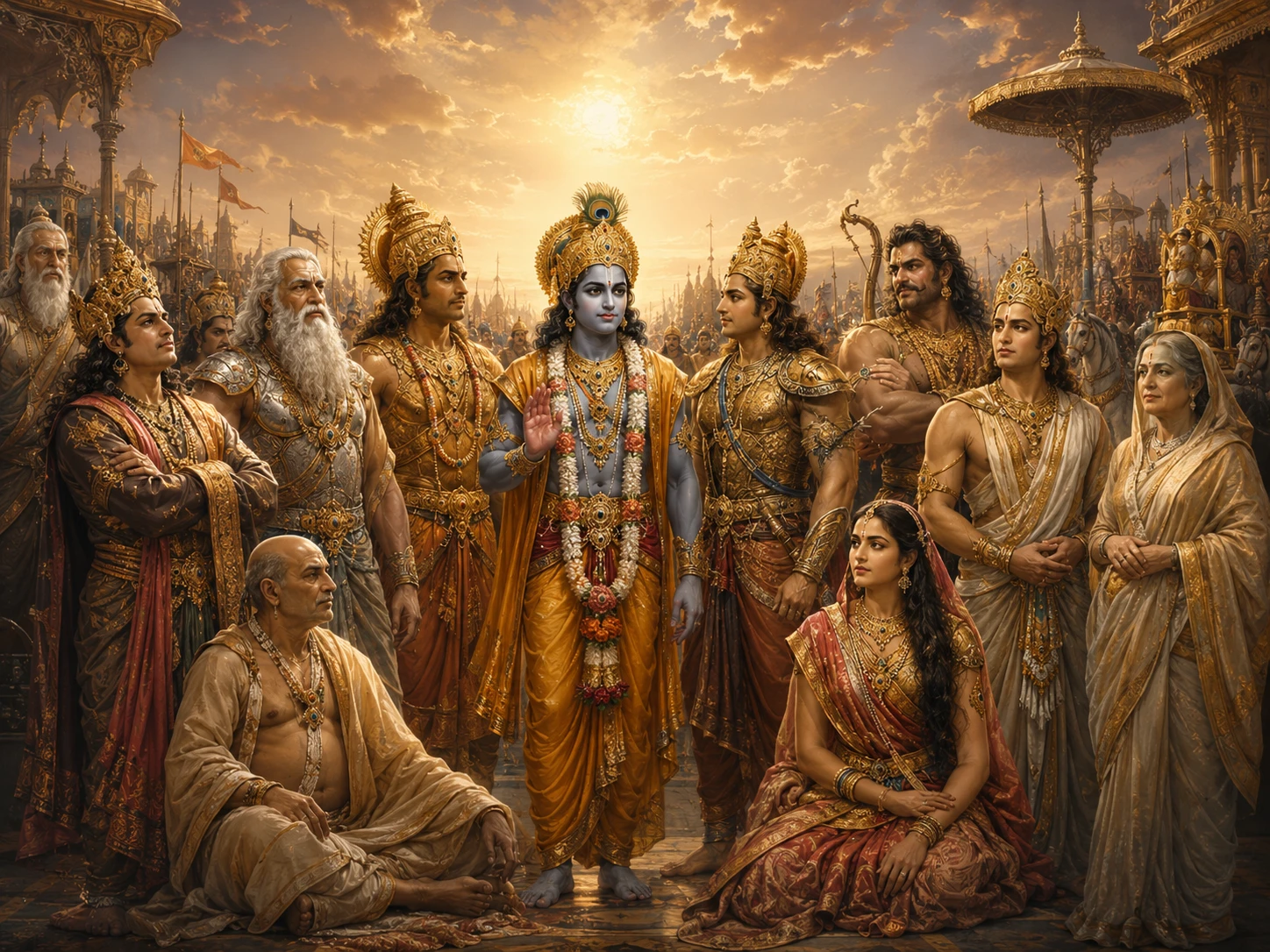
Bhishma -- The Man Who Kept the Wrong Promise
भीष्म -- वह आदमी जिसने ग़लत प्रतिज्ञा निभा दी
Bhishma is the most respected character in the Mahabharata. He is also, on a closer reading, one of the most catastrophic. Both judgements are correct. The text wants you to hold them together.
The respect is real and earned. He took, in a single moment of pure devotion to his father, a vow so severe that the heavens trembled and the gods named him Bhishma -- the one who took the terrible vow. He renounced the throne of the most powerful kingdom in the Indo-Gangetic plain. He renounced marriage. He renounced sexuality. He renounced lineage. He did all of this so that an old man could marry a fisherwoman he had fallen in love with, and the fisherwoman's father could be assured that the children of that marriage would inherit. The act has no equivalent in any other world epic. It is the most extreme single sacrifice in the Mahabharata, and it was made for what amounts to a soap-opera setup.
The catastrophe is also real. The vow he made to make his father happy is the same vow that, decades later, prevented him from intervening when Amba came to him asking to be married. The same vow prevented him from acting decisively when Dhritarashtra's son Duryodhana grew into something monstrous. The same vow forced him onto the wrong side of the Kurukshetra war, fighting against his beloved Pandava grandsons, killing tens of thousands of men in defence of a cause he himself knew to be unjust. The vow was a promise to serve whoever sat on the throne of Hastinapura. The vow did not include the clause every dharmic vow should include -- I will serve unless serving you means destroying everyone I love. Bhishma had no exit.
This is why the text places Bhishma's death not at the climactic moment of his fall, but in a long retreating coda. He fell on the tenth day of the war, on the bed of arrows. He did not die. He used his iccha-mrityu boon to delay death, lying on the arrows for fifty-eight days more, waiting for uttarayana, the auspicious northern movement of the sun. The Pandavas came to him during those fifty-eight days. He gave them the Shanti Parva and the Anushasana Parva -- discourses on dharma, kingship, ethics, varnashrama -- the longest sustained ethical discourse in the Indian tradition outside the Gita itself. The man who could not act in his own life had become, on the bed of arrows, the great teacher of right action.
The Mahabharata wants you to feel both the respect and the catastrophe at once. Bhishma was magnificent. Bhishma was wrong. The two are not in contradiction. They are in fact connected. The same intensity of commitment that made the vow magnificent also made it impossible to revise. Read his life as the Mahabharata's deepest exploration of how a single noble decision, taken too young and held too rigidly, can become the architecture of a lifetime of harm.
परित्यजाम्यहं राज्यं मैथुनञ्चापि सर्वशः। ऊर्ध्वरेता भविष्यामि दाश सत्यं ब्रवीमि ते॥
parityajāmy ahaṃ rājyaṃ maithunaṃ cāpi sarvaśaḥ ūrdhvaretā bhaviṣyāmi dāśa satyaṃ bravīmi te
I renounce the kingdom and all sexuality completely. I shall be one whose semen rises upward (urdhvareta -- the celibate yogi). O fisher-king, I tell you the truth.
— Mahabharata, Adi Parva 100.97 -- the actual text of Devavrata's terrible vow before the fisher-king Dasharaja
Bhishma's birth is among the strangest in the Mahabharata. He was originally one of the eight Vasus, celestial beings, and was cursed by the sage Vasishtha to be born as a mortal because of his role in the theft of Vasishtha's wish-fulfilling cow Nandini. Seven of the Vasus were cursed to brief mortal lives. The eighth, Prabhasa -- who would become Bhishma -- received a longer curse because his role in the theft was more central. He would live a full mortal life, suffer through it, and die at the chosen moment of his death.
The goddess Ganga had agreed to deliver the eight Vasus from their curse. She married King Shantanu of the Kuru dynasty on one condition -- he would never question her actions. The condition is the standard structure of Indian myth where a mortal man marries a divine woman. Shantanu accepted. Ganga gave birth to seven sons in succession. Each one she carried to the river and drowned the moment after birth. Each was a Vasu being released from his curse to return to the celestial realm. Shantanu, bound by his promise, said nothing.
With the eighth son, his patience finally broke. He stopped Ganga at the riverbank. He demanded an explanation. Ganga gave him the explanation, then left him -- because the condition had been violated. The eighth son, Prabhasa-as-Devavrata, would now have to live the full mortal life that Vasishtha's curse had specified. Ganga took him with her to her celestial home, raised him there for several years, and then returned him to Shantanu as a young man, fully trained in the arts of statecraft and warfare. Devavrata grew up royal, brilliant, beloved.
This is the boy who would, a few years later, take the terrible vow. The point is not that he was perfect. The point is that he had been raised to be perfect. The Vedic-period education of a kshatriya prince in the Kuru house was the most rigorous education available in his world. He was the heir to a stable kingdom. He had the love of his father. He had no rival for the throne. The vow he was about to take was not necessary. It was something he chose, freely, in a moment of devotion that he himself could not fully see the consequences of.
Shantanu fell in love with Satyavati, the fisher-king Dasharaja's adopted daughter, when he saw her ferrying boats on the Yamuna. Satyavati had the gift of a divine fragrance after a sage's blessing. Shantanu went home obsessed. Devavrata noticed his father's distress, learned the cause from the king's charioteer, and went directly to Dasharaja with a marriage proposal on his father's behalf.
Dasharaja made his condition explicit. My daughter's son, he said, must be the king after Shantanu. Devavrata immediately renounced the throne. Dasharaja was not satisfied. Even if you renounce, your sons will claim the throne. They will fight my grandson. I cannot allow my daughter's children to enter such a household.
Devavrata stood there in front of the fisher-king and made the second renunciation. The text records the exact words at Adi Parva 100.97. I renounce the kingdom completely. I renounce sexuality completely. I shall be urdhvareta -- the celibate yogi whose semen does not flow downward but rises in tapasya. There will never be a son of mine to claim anything from your grandson. The vow is total. The witnesses are the gods themselves. Flowers fell from the heavens. Voices proclaimed -- bhishma, bhishma -- the one who has taken the terrible vow.
Shantanu, when he heard, was overwhelmed. He gave his son a single boon in return -- iccha-mrityu, death by his own choice. Death would not come to Bhishma until Bhishma chose. The boon would be activated fifty-eight days after the bed of arrows, on the day of uttarayana, when Bhishma finally consented to die.
What the Mahabharata wants the reader to notice, but does not state explicitly, is what Devavrata gave up. Not just sexuality. Not just the throne. He gave up the right to make a binding moral correction at any future point in his life. Every situation that would arise -- Amba's plea, the dice game, Draupadi's disrobing, Krishna's peace mission, the war itself -- would be one in which Bhishma was bound by an oath taken in his early twenties to defend whatever king sat on the Hastinapura throne. He had pre-committed himself to forty more years of service to a position. He had not pre-committed himself to dharma. The two would diverge, and Bhishma would have to choose. The vow had already chosen for him.
Bhishma's name in Sanskrit -- bhīṣma -- comes from the root bhī, meaning 'fear'. The literal sense is 'one who is fearsome' or 'one who has done a fearsome thing'. The vow was not called terrible because it was bad. It was called terrible because it was awe-inspiring -- a feat so unprecedented that it produced fear in the gods themselves. The Hindi 'भीष्म' carries the same connotation. The most respected character in the Mahabharata is named for the most terrifying thing he ever did.
After the vow, Bhishma's life became one long performance of regency. He served his father Shantanu. He served his half-brother Chitrangada, who was killed in battle young. He served his other half-brother Vichitravirya, for whom he had to find brides.
The Amba episode is the moment Bhishma's vow first produces serious harm. Bhishma went to the swayamvara of the three princesses of Kashi -- Amba, Ambika, Ambalika -- and abducted all three for Vichitravirya, by force, against the assembly. Abduction was a recognised form of kshatriya marriage. The other suitors did not give chase successfully. Bhishma brought the three princesses to Hastinapura.
Amba, the eldest, then told him she had already chosen King Shalva at heart and was promised to him. Bhishma, respecting that, sent her back to Shalva. Shalva refused her -- she had been won by another man, even if not married, and was therefore considered tainted. Amba returned to Bhishma. She asked him to marry her himself. He could not. The vow. She asked him to compel Vichitravirya to marry her. Vichitravirya refused -- he could not marry a woman who loved another. Amba was now caught between three men, none of whom would accept her, all because of the original abduction.
She went to Parashurama, Bhishma's own martial guru. She begged him to force Bhishma to either marry her or accept her as Vichitravirya's wife. Parashurama agreed. He challenged Bhishma to a duel. The duel lasted twenty-three days. Neither could defeat the other. Eventually the celestial gandharvas intervened. The duel ended without resolution. Amba's question remained unanswered.
Amba, her life destroyed by Bhishma's vow and the rigidity around it, did the only thing left to her. She performed tapasya. She vowed to be reborn in such a form that she could kill Bhishma. She lit her own pyre. In her next birth, she became Shikhandini, daughter of King Drupada -- and through tapasya and a yaksha's body-exchange, became Shikhandi, the warrior who would stand in front of Arjuna's chariot on the tenth day of Kurukshetra and cause Bhishma to drop his bow.
The Amba episode is the Mahabharata's first warning that Bhishma's vow has consequences he did not anticipate. The man who could not marry her could not protect her. The vow he had taken to keep his father happy became, by simple consequence, the cause of a young woman's destruction. He felt the wrong of it. He did not have the latitude to correct it. The text shows him sympathetic but bound. This is the structure that will repeat for the rest of his life.
Bhishma's Five Failures of Intervention
| Moment | What Bhishma Could Have Done | Why He Did Not | What Happened Instead |
|---|---|---|---|
| Amba's plea after Shalva's rejection | Married her, or compelled Vichitravirya to marry her, or acknowledged the wrong of the abduction publicly | The vow of celibacy and his belief that compelling his half-brother would violate his vow of service to the throne | Amba performed tapasya, was reborn as Shikhandi, and became the instrument of Bhishma's own fall |
| The dice game in the Hastinapura sabha | Stopped the proceedings as the seniormost member of the assembly, declaring the rigged game and the disrobing illegal | He was bound by service to whoever sat on the throne -- in this case Dhritarashtra -- who had not stopped the game himself | He sat in silence as Draupadi was dragged in by the hair and Dushasana attempted to disrobe her |
| Krishna's peace mission | Used his accumulated authority to force Duryodhana to accept the five villages, threatening to withdraw from the Kaurava side if necessary | He had vowed lifelong service to the throne; threatening to withdraw was, in his reading, a violation of the vow | The peace mission failed. The war became inevitable |
| Command of the Kaurava army on day one | Refused command, citing dharmic objection to the war's cause | Refusing command would have been read as cowardice and as breaking his vow of service to whoever sat on the throne | He took command. He killed thousands of soldiers from the side his own conscience supported. He fell on day ten by his own arrangement -- telling Yudhishthira how he could be killed |
| Day ten -- the moment of falling | Continued fighting, leveraging the iccha-mrityu boon to refuse death indefinitely | He had already arranged for his own fall by giving instructions through Shikhandi; this was his oblique way of stepping out of an oath he could not openly break | He fell on the bed of arrows, kept himself alive through iccha-mrityu for fifty-eight days, and gave the Shanti Parva discourses to Yudhishthira -- finally acting in dharma's voice from a position the vow no longer constrained |
Notice the pattern. At every major moment, Bhishma had the moral clarity to know what should be done. He never had the operational latitude to do it. The vow had pre-committed him to a kind of service that did not include moral correction. He arranged his own fall on day ten as the only way out he had ever found.
After Vichitravirya died young without heirs, the dynasty faced extinction. Satyavati asked Bhishma to break his vow and produce sons with Vichitravirya's widows -- the niyoga practice was permitted in such cases. Bhishma refused. The vow was the vow. Satyavati then summoned her own son from before her marriage to Shantanu -- the rishi Vyasa, the future composer of the Mahabharata itself. Vyasa fathered Dhritarashtra, Pandu, and Vidura on Vichitravirya's widows and a serving maid. The dynasty continued. The fact that the man who had renounced lineage was now the regent for sons fathered by an outsider rishi is the Mahabharata's quiet first irony at Bhishma's expense.
The second irony is longer. Bhishma raised Dhritarashtra and Pandu as his own grandchildren. He raised the hundred Kauravas and the five Pandavas as his own great-grandchildren. He had renounced lineage, and yet the entire next two generations of the Kuru house were, in every meaningful sense, his children. He loved Yudhishthira. He loved Arjuna. He loved Bhima. He had taught them. He had blessed their swayamvaras. He had presided over their Rajasuya yajna at Indraprastha. He was bound by a vow taken decades before any of them was born to fight on the side of the cousin trying to destroy them.
The night before the war, when the Pandavas crossed the lines to seek the blessings of their elders, Bhishma blessed Yudhishthira. He told him -- I cannot fight against you in spirit, but I will fight with full force in body. The vow demands it. He also told him -- you cannot defeat me by ordinary means. Use Shikhandi. I will not fight a person born female. Shikhandi will be the screen behind which you must shoot.
This is a remarkable passage. The grandfather is telling the grandson exactly how to kill him. He is using the vow's own logic to find a way out. He cannot break the vow openly. He cannot refuse to fight. He cannot defeat the Pandavas without crossing his own conscience. The only solution is to engineer his own defeat. He gives Yudhishthira the technical means and walks back to his tent.
On the tenth day of the war, Arjuna, with Shikhandi standing in front of him on the chariot, shot a continuous stream of arrows at Bhishma. Bhishma, true to his pre-arrangement, lowered his bow. The arrows pierced his entire body -- his armour, his chest, his arms, his legs, his throat. He did not fall to the ground. The density of arrows was such that he came to rest on the arrows themselves, suspended above the earth. Three more arrows were shot to support his head, which had fallen back. He asked for water. Arjuna shot an arrow into the ground and a spring of water rose to his lips. The Kuru elders, the Pandavas, the Kauravas -- all of them gathered around him. He was alive but pierced. He used the iccha-mrityu boon to refuse death. He waited.
Bhishma waited fifty-eight days on the bed of arrows, from the tenth day of the war until uttarayana -- the auspicious northern movement of the sun -- arrived. During those fifty-eight days, he gave the Pandavas the entire Shanti Parva and Anushasana Parva of the Mahabharata. These two parvas together are 18,000 verses long -- nearly twenty per cent of the entire epic. The longest sustained ethical and political discourse in Indian literature was given by a man who had been pierced through with arrows and was holding off death by sheer will. The Mahabharata seems to be saying something quietly here. The man who could not act through his life was, on the bed of arrows, given more time and more authority to teach than any other character in the text. The teaching came at the cost of his ability to live by it.
धर्मे चार्थे च कामे च मोक्षे च भरतर्षभ। यच्छ्रोष्यसि महाराज तत्ते वक्ष्यामि साम्प्रतम्॥
dharme cārthe ca kāme ca mokṣe ca bharatarṣabha yac chroṣyasi mahārāja tat te vakṣyāmi sāmpratam
On dharma, on artha, on kama, and on moksha, O bull of the Bharatas -- whatever you wish to hear, O great king, that I shall now speak to you.
— Mahabharata, Shanti Parva 56.2 -- Bhishma to Yudhishthira on the bed of arrows, opening of the Rajadharma instructions
When uttarayana finally arrived, fifty-eight days after his fall, Bhishma assembled the Pandavas and the few surviving Kuru elders around the bed of arrows. He spoke to each. He blessed them. He gave the kingdom into Yudhishthira's hands with explicit instruction. He thanked Krishna for everything. He apologised to Draupadi for not having stopped the dice game. The text records the apology directly. He could not undo what had been allowed in his presence, but he could name it. The act of naming, fifty-eight days late, is the closest the text allows him to a moral correction.
He then withdrew his pranas, vital airs, in the yogic technique he had carried since youth. He sent them upward through the spinal channel, drew them out through the brahmarandhra at the crown of the head, and released his soul. The body died. The Vasu Prabhasa returned, after many decades on earth, to his celestial origin. The curse was complete. The boon was used. The vow was kept to the last.
Why does Bhishma matter to you in 2026?
Because the rigid promise is the most respected moral failure in Indian life. Indians, more than most cultures, are taught from childhood that a vow is sacred, a promise is sacred, a word given is sacred. The values are not wrong. They are foundational. But the Mahabharata is offering a corrective the popular imagination has not absorbed. A vow taken at one age, in one set of circumstances, with one understanding of consequences, is not always wise to keep at fifty, at sixty, at seventy, when the circumstances have changed and the consequences are now visible.
The modern Indian Bhishma is everywhere. The eldest son who promised his dying father to keep the family business intact and is now, twenty-five years later, watching it bleed because the business model is dead and his siblings want out. He cannot release them. He gave his word. The doctor who promised her parents she would never marry outside the community and now, at forty-three, is watching the man she loves marry someone else because she cannot break the promise. The civil servant who promised the senior who recruited him that he would never accept a corporate offer and is now, thirty years later, in a department where his integrity is being weaponised by people who took no such promise. The marriage where the wife stays not for love, not for the children, not for any current reason -- but because she promised on the wedding mandap that she would. None of these vows is small. None of these people are weak. They are all running Bhishma's pattern. The vow taken from the highest motive at the youngest age has become the cage from which the rest of life is conducted.
The Mahabharata's corrective is not the breaking of vows. The corrective is the willingness to revisit a vow when its keeping has become destructive. Krishna himself, in the Gita, takes vows to fight, then steps off the chariot to attack Bhishma -- he was willing to break a vow to save Arjuna. Krishna's example is the opposite of Bhishma's. The text places them on opposite sides of the war for a reason. One is bound by a vow he cannot break. The other is willing to break a vow when something more important is at stake. The Mahabharata is asking you which of the two you most resemble.
The diagnostic question is concrete. Pick a promise in your life that has been quietly damaging for a long time. The promise to a parent. The promise to a spouse. The promise to a partner. The promise to a community. The promise to yourself, taken at twenty, that no longer fits at thirty-five. Ask yourself what dharma actually requires of you now -- not what the original promise required of the younger you. If those two diverge, you have located your Bhishma. The Mahabharata's question for him is the same question it has for you. Was the original promise the dharmic act, or has the keeping of it become the adharmic one?
Read Bhishma's death scene in Anushasana Parva
The final chapter of Bhishma's life -- his withdrawal of pranas at uttarayana, his last counsel to Yudhishthira, his apology to Draupadi -- is in the closing sections of the Anushasana Parva. Read it slowly. Notice that the man who could not act in his life found his moral voice only on the bed of arrows. The text is asking whether you will wait that long.
Tags
Eternal Raga · शाश्वत राग
Institutional voice — scholarly articles on Sanatan Dharma
Deepen Your Understanding
अपनी समझ और गहरी करें
scriptural exegesis
The Kurukshetra Within -- Reading the Mahabharata as a Mirror of Your Mind
Vyasa wrote that whatever exists in the world also exists in the Mahabharata, and whatever is not there exists nowhere. This is not a boast. It is an instruction: every character in the epic is a character inside you. Read the war as a map of your mind.
scriptural exegesis
Duryodhana -- The Entitled Mind
He was the eldest, the heir, the host of Hastinapura. He had a hundred brothers, an unbreakable friendship with Karna, and a kingdom older than the Pandavas had ever held. And yet he could not bear that anything good went to anyone but himself. Duryodhana is what happens when birth-privilege gets confused for self-worth.
scriptural exegesis
Draupadi in the Sabha -- The Trial That Started the War
A queen was dragged into a court full of kings, warriors, and elders. Not one stood up. She asked a single legal question that nobody could answer. Then she swore an oath that burned a civilization to the ground. Draupadi's Sabha episode is not a story about a helpless woman. It is the most devastating indictment of institutional silence in world literature.
scriptural exegesis
The Dice Game -- The Darkest Hour of the Mahabharata
A king who cannot say no to a challenge. An uncle whose dice are loaded with the bones of the dead. A court full of elders who watch injustice and say nothing. And a woman who asks one question that nobody in the room can answer: 'Did my husband lose himself first, or me?' The dice game in the Sabha Parva is not a plot device. It is the moral black hole at the centre of the Mahabharata. Everything before it is prologue. Everything after it is consequence. And the central horror is not what happens -- it is who lets it happen.
scriptural exegesis
Kurukshetra Battle Alliances -- Which Kings Joined Which Side
Seven akshauhinis against eleven. 1.5 million warriors against 2.4 million. The Kurukshetra war was not two families fighting -- it was the entire Indian subcontinent choosing sides. From the Pandyas of Tamil Nadu to the Kambojas of Central Asia, from the Yadavas of Dwaraka to the Kekayas split down the middle -- here is the geopolitical map of who joined whom and why, sourced from Udyoga Parva.
scriptural exegesis
After Kurukshetra -- What Happened Next
The war ended. The Pandavas won. And then everything fell apart. Krishna's clan destroyed itself in a drunken brawl. Dwaraka sank into the sea. Arjuna's divine powers vanished. And the five brothers who fought the greatest war in history walked into the Himalayas to die. The Mahabharata's post-war chapters are darker, stranger, and more relevant than the war itself.
scriptural exegesis
Vidura Niti -- The Wisest Counsel That the King Heard and Still Ignored
The night before the Pandavas' exile ended, when war was one decision away, a sleepless king called his wisest adviser. For eight chapters of the Udyoga Parva, Vidura -- the bastard son who could never be king, the only man in Hastinapura who always told the truth -- delivered 593 verses of raw, unfiltered counsel on leadership, ethics, self-mastery, and statecraft. Dhritarashtra listened to every word. Agreed with every point. And then did the opposite. Vidura Niti is not just political philosophy. It is the anatomy of a man who knew the right thing, had the right adviser, and chose wrong anyway.
Bhishma's name in Sanskrit -- bhīṣma -- comes from the root bhī, meaning 'fear'. The literal sense is 'one who is fearsome' or 'one who has done a fearsome thing'. The vow was not called terrible because it was bad. It w…
More in Scriptural Exegesis
Abhimanyu and the Chakravyuha -- The Boy Who Knew How to Enter but Not How to Leave
14 min read
Adbhuta Ramayana -- The Ramayana Where Sita Becomes Kali
9 min read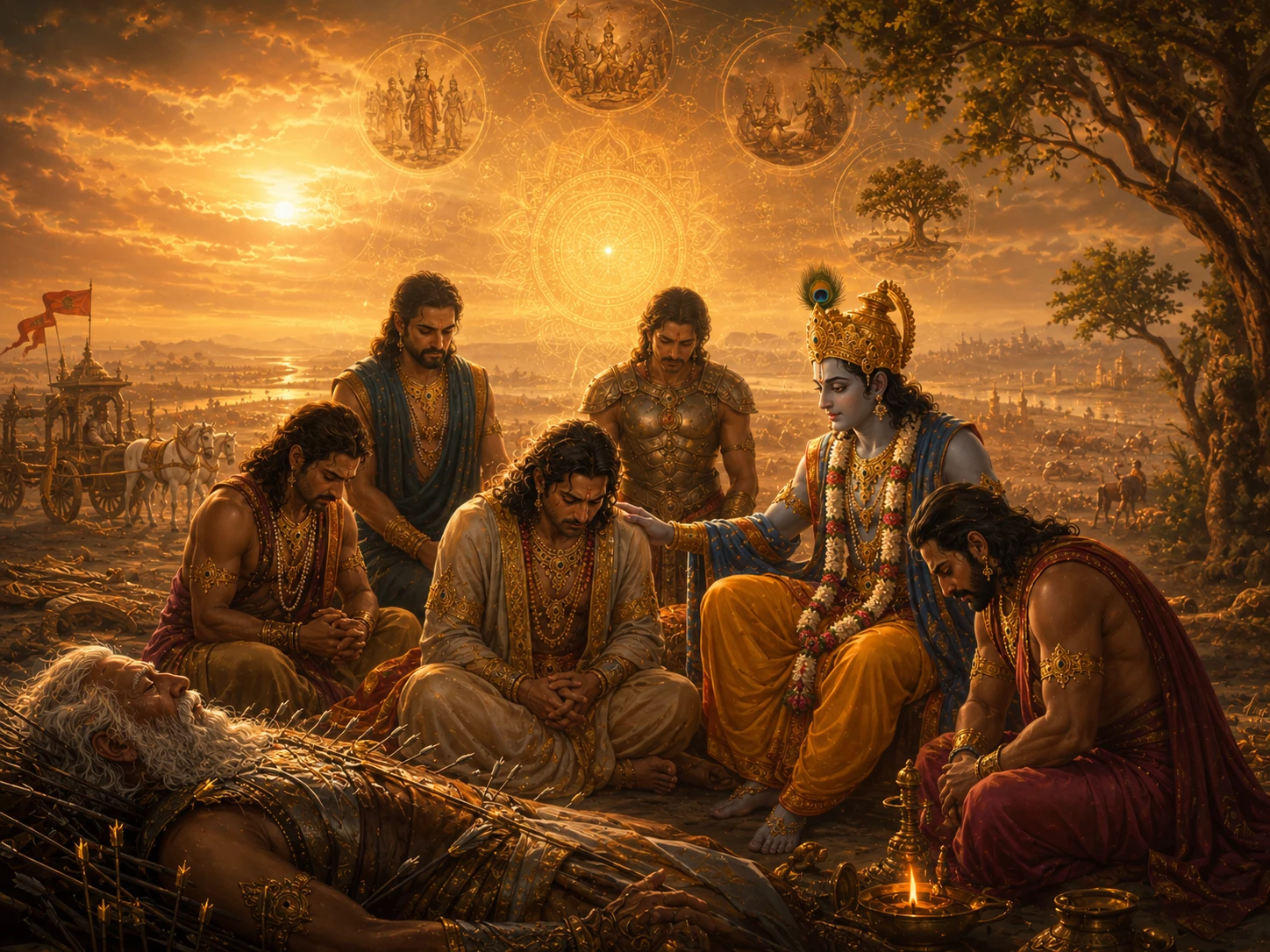
After Kurukshetra -- What Happened Next
14 min readThe same translation error that turned '33 Koti' into '33 crore' in Hinduism also happened in Buddhism. The Chinese translation of Buddhist texts rendered 'Sapta Koti Buddha' (7 Supreme Buddhas) as '7 Crore Buddhas.' The…
Deities AvatarsCommunity Reflections
🕉️
Be the first to share your reflection.