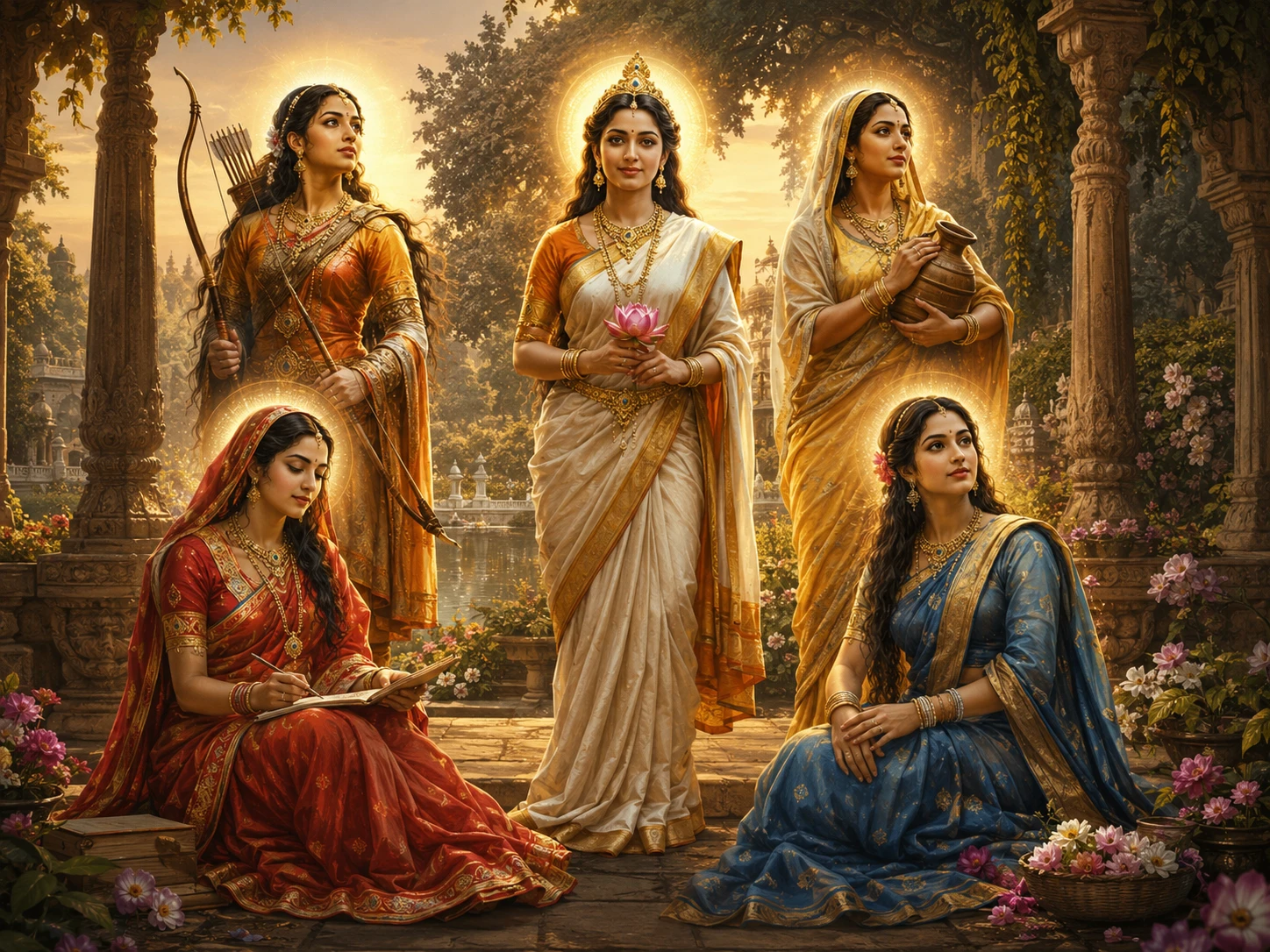
Pancha Kanya -- The Five Maidens Who Redefine Female Virtue
पञ्चकन्या -- वे पाँच स्त्रियाँ जिन्होंने स्त्री-धर्म की परिभाषा बदली
In countless Hindu households across India, a single Sanskrit shloka is recited each morning before any other prayer. Five names. Five women. The promise that remembering them daily destroys the greatest sins. This is the Pancha Kanya shloka, and it remains one of the most quietly subversive verses in the entire Hindu tradition.
The five names are Ahalya, Draupadi, Kunti, Tara, and Mandodari. Read the shloka without thinking, and it sounds like a routine listing of virtuous women. Read it carefully, and a question rises that the tradition refuses to answer directly. Why these five?
Ahalya was cursed for her encounter with Indra. Draupadi married five brothers. Kunti gave birth to Karna before she was married. Tara remarried Sugriva, the brother of her slain husband. Mandodari was the queen of Ravana, the most infamous adharmi in Hindu literature. None of these five fits the simple template of pativrata that later cultural memory often demands of women. And yet the tradition has chosen these five, not others, as the women whose remembrance is mahapatakanashanam -- destroyer of the greatest sins.
The shloka does not explain itself. It simply lists the names and makes its claim. The work of understanding why is left to the reader. That work is what this article attempts.
अहल्या द्रौपदी कुन्ती तारा मन्दोदरी तथा। पञ्चकन्याः स्मरेन्नित्यं महापातकनाशनम्॥
ahalyā draupadī kuntī tārā mandodarī tathā pañcakanyāḥ smaren nityaṁ mahāpātaka-nāśanam
Ahalya, Draupadi, Kunti, Tara, and Mandodari -- one who remembers these five maidens daily is freed from the gravest of sins.
— Traditional Smarana Mantra (Smriti tradition; recited in daily sandhya across Hindu households)
The first puzzle of the shloka is the word kanya. In modern Hindi and Sanskrit usage, kanya often means an unmarried girl. None of these five women fits that meaning. Each was married. Each bore children. Each lived a long adult life with all its complications.
The older Sanskrit usage of kanya is broader. It means a maiden in the sense of a woman whose essential being was never reduced by what happened to her. A woman who remained whole through every test. The tradition is making a precise theological claim by using this word. These five women retained their kanya-tva -- their essential integrity -- through circumstances that the surface morality of any age would have called staining.
This is the shloka's first refusal of easy reading. It is not honouring purity in the conventional sense. It is honouring an integrity that survived contact with what looked like its opposite. To call Ahalya, Draupadi, Kunti, Tara, and Mandodari kanya is to declare that what happened to them, or what they did, did not touch the centre of who they were.
The second puzzle is the word smaranam. The shloka does not say recite, chant, or worship. It says remember. Smarana is the deepest form of religious attention in Hindu tradition. To remember is to hold in the mind, to let the figure walk through one's day, to allow the figure's choices to inform one's own. The five kanyas are not deities to be propitiated. They are figures whose stories the tradition wants embedded in every Hindu's daily consciousness, especially as a moral compass for difficult choices.
Begin with Ahalya. Wife of the rishi Gautama, she was either deceived by Indra coming in her husband's form, or she recognised Indra and chose him -- the Bala Kanda of Valmiki Ramayana itself preserves both readings, refusing to settle the question. Gautama cursed her to become invisible, motionless, fasting on air, until Rama's foot would one day touch her in the forest of Mithila and restore her form.
The Eternal Gyan article on Ahalya Moksha covers her redemption in detail. What matters here is the shloka's choice. Of all the wives of all the rishis, Ahalya is the one chosen as the first kanya. The tradition is acknowledging that she was tested at the most fundamental level -- her marital integrity -- and that her response, whatever it was, did not destroy her dharmic standing. She bore the curse without bitterness. She waited centuries in silence. When liberation came, she did not protest its delay. The shloka asks Hindus to remember her not as someone who failed a test, but as someone who carried a verdict that may not have been wholly hers to begin with.
This is already a complicated act of remembrance. It refuses to ask whether Ahalya did the thing or did not. It asks instead what kind of woman survives the verdict either way.
Draupadi is the second kanya. Born from the yajna fire of Drupada, married to five Pandava brothers through a sequence that began with Arjuna's archery feat and ended with Yudhishthira's casual remark to Kunti about sharing what they had won. Vyasa explains the polyandry through karmic accumulation across past lives -- the shloka, however, simply names her and moves on.
The Eternal Gyan articles on Draupadi in the Sabha and Draupadi the full biography cover her arc in detail. The shloka's choice of Draupadi pivots on something specific. In the most public humiliation any woman in Hindu literature endures, Draupadi did not lose her sense of dharma. When Yudhishthira had already lost himself in the dice game, when Bhishma and Drona sat in silence, when even Krishna chose not to physically intervene, Draupadi's question -- did Yudhishthira have the right to wager me after he had already lost himself? -- was the only voice that named the legal and dharmic violation in the room.
A woman whose body was being threatened with public undressing held to the technical analysis of dharma when every man around her had abandoned it. That is what the shloka honours. Not that she had five husbands. Not that she was beautiful or quick of speech. That when the floor of dharma was collapsing, she alone remained standing on it.
Kunti is the third kanya, and here the shloka becomes most interesting. Pritha, daughter of Surasena of the Yadavas, was given in adoption to her cousin Kuntibhoja. The young Kunti served the irascible sage Durvasa with such patience that he gifted her a mantra: any deva she invoked would give her a son.
Kunti was unmarried. The mantra was a gift, not a duty. But she was young and curious. She invoked Surya. The sun god appeared in person, and despite her plea that she had only been testing, he restored her physical kanya status by his power, and a son was born. She set him afloat in a basket on the river. That child was Karna.
She later married Pandu. After his curse made physical relations fatal for him, she invoked Yama, Vayu, and Indra to bear Yudhishthira, Bhima, and Arjuna. She shared the mantra with Madri, who invoked the Ashvins for Nakula and Sahadeva. After Pandu's death, Kunti raised five sons in widow's grief. She watched them lose their kingdom, lose their wife in the sabha, go into thirteen years of exile. On the eve of the Kurukshetra war, she went to Karna and revealed what she had hidden for sixty years -- that he was her firstborn, that the men he was about to fight were his brothers. She asked him to spare them. Karna refused except for Arjuna. After the war, she went into the forest with the blind Dhritarashtra and Gandhari, and died with them in a forest fire.
The Pancha Kanya shloka chooses Kunti specifically over Sita in its older form. Why? Because Sita's tests came from outside -- abduction, exile, agni pariksha. Kunti's tests came from her own choices and their permanent consequences. A pre-marital child she could not raise. A secret that broke the man it concerned. Five sons whose dharmic struggles she witnessed without being able to ease. The shloka honours a specific kind of female ethical struggle here -- the struggle of a woman whose own actions, not just her circumstances, contained irreducible complexity.
For a software engineer in Bangalore who is a single mother, for a woman in any Indian metro who carries a secret she cannot share with her grown children, for anyone whose past keeps writing into their present -- Kunti is the kanya the tradition placed in her shloka.
Tara is the fourth kanya. The Tara of the Pancha Kanya shloka is the wife of Vali, the vanara king of Kishkindha, and later wife of Sugriva. Some Sanskrit commentators have conflated her with the Tara who was Brihaspati's wife in the Soma-Tara episode, but the standard reading anchors her in the Kishkindha Kanda of the Ramayana.
Tara was renowned for her counsel. When Sugriva returned to Kishkindha and challenged Vali a second time, Tara saw what no warrior could see -- that Sugriva would not have come back unless he had powerful new support. She begged Vali not to step out, warning him that something had changed in the universe of forces. Vali, in his pride, dismissed her counsel. He stepped out, and Rama's arrow struck him from concealment.
In his dying moments, Vali reproached Rama for an unjust killing. Tara herself raged at Rama in some recensions, weeping over her husband's body. Then, in the Kishkindha Kanda's quiet aftermath, when Sugriva took the throne, Tara accepted Sugriva as her husband by levirate custom -- the practice that allowed a widow to marry her husband's brother to preserve household and lineage. The text records this without scandal. It records this without elevation either. It simply says it happened, and it happened by dharma.
Later, when Sugriva forgot his promise to Rama and lost himself in pleasure, it was Tara who reminded Lakshmana of the rules of diplomatic conduct, who calmed Lakshmana's rage when he stormed Kishkindha to confront Sugriva, and who set the search for Sita back on track. The Ramayana describes her as one whose intellect rivalled the wisest male counsellors of the age.
The shloka chooses Tara because she demonstrates a kind of female intelligence that the dharmic tradition rarely names openly -- the intelligence to read a situation accurately when emotion would mislead, to remarry without scandal when dharma permits it, to advise warriors and kings without losing the standing to do so. She is the kanya who refuses the falsehood that widowhood must mean either suttee or social death. The shloka places her in the same line as Ahalya and Draupadi to make a quiet point: a woman who remarries by lawful custom is not lesser than a woman who does not.
Mandodari is the fifth kanya, and her inclusion is the shloka's most challenging move. Daughter of the asura architect Mayasura and the apsara Hema, Mandodari was the chief queen of Ravana of Lanka. She was the mother of Indrajit Meghnad. She was, by every external marker, the queen of the most infamous adharmi in Hindu epic literature.
And yet the Pancha Kanya shloka places her name beside Ahalya and Draupadi.
The Yuddha Kanda of Valmiki Ramayana preserves her counsel to Ravana again and again. She told him to return Sita. She told him that what he had done was beyond the laws of kshatra and dharma both. She told him that no boon, no army, no Lanka of gold could withstand the force he had set against himself. Ravana did not listen. When Ravana fell, Mandodari's vilapa -- her lament over his body -- is one of the most moving passages in all of Sanskrit literature. She did not curse Rama. She did not blame fate. She named precisely what her husband had done wrong, and she grieved a man she had loved while remaining clear about why he had been killed.
Later traditions, particularly the Adhyatma Ramayana and several regional Ramayanas, record that after Ravana's death and Lanka's purification under Vibhishana, Mandodari married Vibhishana by Rama's instruction. This levirate echo, like Tara's, is recorded as a dharmic act of household preservation, not as a fall.
Mandodari's place in the shloka makes a teaching no other figure can make. The household one is born or married into does not determine one's dharma. A woman in the household of the worst adharmi of the age can be more dharmic than any of the men around her, including her husband. She can speak truth in the rooms where truth is most unwelcome. She can love a man and refuse to validate what he has done. She can outlive him without becoming a different woman.
For a young Indian woman whose family business is implicated in something she knows is wrong, for a woman in any household where the dominant figure has chosen a path she finds adharmic, for the daughter-in-law in a politically connected family who watches what she cannot stop -- Mandodari is the kanya the tradition placed in its morning recitation.
The Five Kanyas and Their Tests
| Kanya | कन्या | Husband(s) | The Complication the Shloka Refuses to Erase | Why She is Honoured |
|---|---|---|---|---|
| Ahalya | अहल्या | Rishi Gautama | The Indra incident; centuries of curse | Bore the verdict without bitterness; waited in silence; received liberation without protest |
| Draupadi | द्रौपदी | Five Pandavas | Polyandry; public humiliation in the sabha | Held to dharma's technical question when every man around her abandoned dharma |
| Kunti | कुन्ती | Pandu (and Surya before marriage) | Pre-marital son Karna; sixty-year secret | Carried the cost of her own choices into every loss without breaking under it |
| Tara | तारा | Vali, then Sugriva (levirate) | Remarriage to husband's brother who had displaced him | Counsel that surpassed warriors; remarriage by dharma without scandal |
| Mandodari | मन्दोदरी | Ravana (and Vibhishana in some traditions) | Queen of the age's most infamous adharmi | Spoke dharma in rooms where dharma was unwelcome; loved without endorsing wrong |
The shloka does not soften any of these complications. It does not say Ahalya was wholly innocent, that Draupadi's polyandry was conventional, or that Mandodari's queenship was clean. It names the women, and lets the daily smarana do the teaching.
यत्र नार्यस्तु पूज्यन्ते रमन्ते तत्र देवताः। यत्रैतास्तु न पूज्यन्ते सर्वास्तत्राफलाः क्रियाः॥
yatra nāryastu pūjyante ramante tatra devatāḥ yatraitāstu na pūjyante sarvāstatrāphalāḥ kriyāḥ
Where women are honoured, the gods rejoice. Where they are not honoured, every ritual act bears no fruit.
— Manusmriti 3.56
There is a quiet textual debate about the third name in the Pancha Kanya shloka. Many printed prayer books from twentieth-century North India, particularly those produced by Vaishnava streams, replace Kunti with Sita. The substitution is intuitive at first reading. Sita is the most universally remembered woman in Hindu tradition. Her purity is unquestioned. Her dharmic standing is total. Why would the shloka not name her?
The answer is the entire point of the shloka.
Sita's tests came from outside her -- abduction by Ravana, exile from Ayodhya, the agni pariksha demanded by her husband and her people. Sita is the kanya whose purity was tested by external violence and validated by her own integrity. She is the eternal model of dharmic suffering. But the Pancha Kanya shloka in its older form is not honouring that. It is honouring something stranger and harder to teach.
Kunti's tests came from her own actions and their consequences. The pre-marital invocation of Surya. The decision to set Karna afloat. The lifelong silence. The eventual revelation. Each of these was a choice with permanent weight. Kunti is the kanya whose dharma had to survive contact with her own complicity in difficult outcomes. Her purity is not the absence of action. It is the integrity she preserved while acting.
Replacing Kunti with Sita softens the shloka in a way that betrays its original purpose. It restores the easy template of the woman whose virtue means she did not act, did not choose, did not carry the weight of her own decisions. The older Sanskrit pandits across Varanasi and Pune still teach the Kunti version as the canonical one, precisely because the Kunti version preserves the shloka's harder teaching: that female virtue is most worth remembering not when it is undisturbed, but when it has survived the actual conditions of human existence.
The Pancha Kanya shloka is one of the few smriti-mantras whose canonical form is openly debated, and the variant itself reveals a theological pressure point. The four-syllable substitution of Sita for Kunti changes the entire meaning of the verse. Older Sanskrit pandits across Varanasi, Pune, and Kanchipuram still teach the Kunti-version as the older, more original form. Many printed prayer books from twentieth-century North India, however, quietly switched to the Sita-version, restoring the conventional ideal. The Kunti-Sita debate is, in miniature, the entire history of how Hindu society has wrestled with the difference between the female saint and the female human being.
The five women of the Pancha Kanya shloka share one quality that no morning recitation can erase. Each of them was tested -- not just by external villains, but by the internal contradictions that life inserted into her ethical position. Each had to choose what was right when no choice was clean. Each carried the consequences of those choices into the rest of her life without losing the thread of dharma.
This is what the tradition is honouring when it asks for daily smarana. Not perfect women. Tested women. Women whose dharma had to survive contact with the actual conditions of human existence -- desire, deception, widowhood, secrecy, exile, motherhood inside a difficult household, the failure of the men around them to hold the line of right conduct.
For the young woman in any Indian metro who is making decisions her grandmother would not have understood -- the Pancha Kanya shloka offers something specific. It says that the tradition does not require the absence of difficulty for a woman to be honoured. It requires the integrity to walk through difficulty without losing the centre. A college student in Pune who has chosen a partner her family disapproves of can find Tara in her own life. A divorced single mother in Hyderabad who is rebuilding her career while her son grows distant can find Kunti. A woman married into a household whose patriarch is on Twitter defending the indefensible can find Mandodari. A woman who endured an abusive marriage and is trying to rebuild a self that survived it can find Ahalya. A woman who spoke up at a workplace meeting when no one else would can find Draupadi.
The shloka is not a museum exhibit of ancient women. It is a daily moral compass, and the tradition installed it in morning sandhya for exactly this reason. Five names. Five tests passed. The grace of remembrance offered to anyone who carries a similar test.
Recite the Pancha Kanya Smarana in Daily Sandhya
Add the Pancha Kanya shloka to your morning practice. In its most common form: 'Ahalya Draupadi Kunti Tara Mandodari tatha, pancha-kanyah smaren nityam maha-pataka-nashanam.' It is not yet on Eternal Raga as a page of its own; the mantra library has other morning shlokas and stotras.
Tags
Eternal Raga · शाश्वत राग
Institutional voice — scholarly articles on Sanatan Dharma
Deepen Your Understanding
अपनी समझ और गहरी करें
scriptural exegesis
Ahalya Moksha -- The Woman Who Became Stone and the God Who Set Her Free
She was Brahma's most perfect creation. She was cursed for a crime that may not have been hers. She lay as stone -- or invisible, or in ashes, depending on which text you trust -- for thousands of years. Then a boy-prince's foot touched her, and she rose. Ahalya's story is Hinduism's oldest argument about consent, punishment, and grace.
scriptural exegesis
Draupadi -- The Question That Burned Down a Kingdom
She was born from fire, married to five husbands by accident and rule, hostess of the most magnificent palace ever built, dragged by her hair into a court of silent men, and asked the one question they could not answer. The Mahabharata was written so that question could be asked. The kingdom burned down so that question could be answered.
scriptural exegesis
Draupadi in the Sabha -- The Trial That Started the War
A queen was dragged into a court full of kings, warriors, and elders. Not one stood up. She asked a single legal question that nobody could answer. Then she swore an oath that burned a civilization to the ground. Draupadi's Sabha episode is not a story about a helpless woman. It is the most devastating indictment of institutional silence in world literature.
scriptural exegesis
Agni Pariksha -- Sita's Fire Ordeal and the Interpretations That Divided India
A woman walks into fire to prove she is 'pure.' The man who asked her to do it is called God. For two thousand years, India has argued about what this scene means -- and the argument is far from over. Devotional reading, feminist critique, textual scholarship, and political appropriation all collide in the most contested episode of the Ramayana.
scriptural exegesis
Sita and Draupadi -- The Two Women Who Triggered Two Great Wars
Every Indian knows that the Ramayana happened because Sita was abducted and the Mahabharata happened because Draupadi was disrobed. But here is the question nobody asks: were these women the cause of war, or the consequence of systems that had already failed? The answer reframes both epics.
scriptural exegesis
The Forgotten Women -- Urmila, Madri, Gandhari and the Sacrifices Nobody Tells
Urmila slept for 14 years so Lakshmana could stay awake guarding Rama. Madri walked into her husband's funeral pyre carrying the guilt of his death. Gandhari blindfolded herself for life -- not in submission, but in the most devastating protest a wife has ever made. These women shaped the epics. The epics barely mention them.
scriptural exegesis
Women Power in Ancient India -- Scholars, Warriors, and Queens the Textbooks Erased
Gargi debated the greatest philosopher of her age and he could not defeat her. Maitreyi rejected a fortune for the pursuit of knowledge. Vishpala lost a leg in battle, got an iron prosthetic, and went back to fight. Kaikeyi drove Dasharatha's chariot in war and saved his life. These are not feminist reimaginings. These are the primary texts. And they tell a very different story from the one you were taught.
The Pancha Kanya shloka is one of the few smriti-mantras whose canonical form is openly debated, and the variant itself reveals a theological pressure point. The four-syllable substitution of Sita for Kunti changes the e…
More in Scriptural Exegesis
Abhimanyu and the Chakravyuha -- The Boy Who Knew How to Enter but Not How to Leave
14 min read
Adbhuta Ramayana -- The Ramayana Where Sita Becomes Kali
9 min read
After Kurukshetra -- What Happened Next
14 min readThe same translation error that turned '33 Koti' into '33 crore' in Hinduism also happened in Buddhism. The Chinese translation of Buddhist texts rendered 'Sapta Koti Buddha' (7 Supreme Buddhas) as '7 Crore Buddhas.' The…
Deities AvatarsCommunity Reflections
🕉️
Be the first to share your reflection.