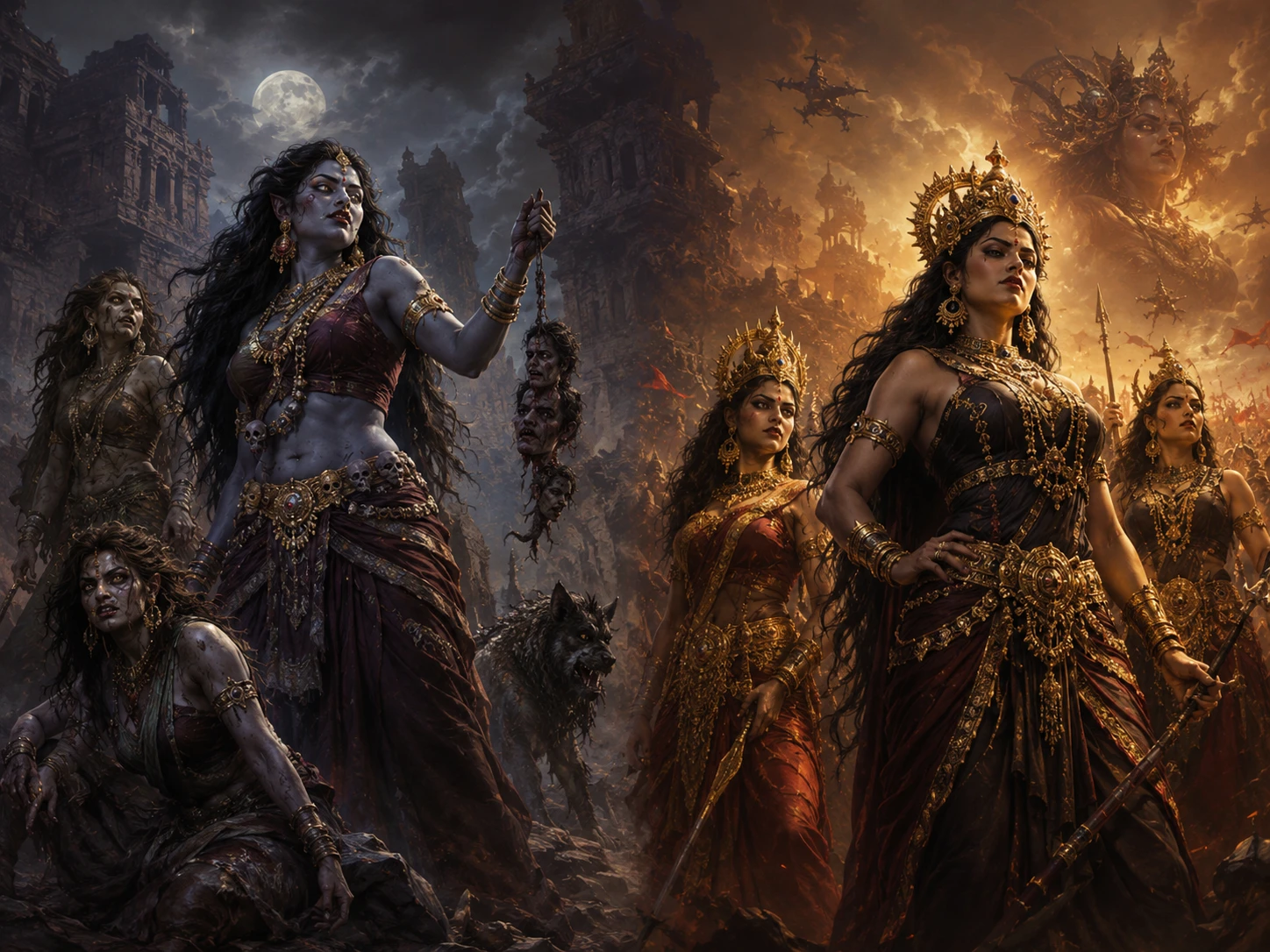
Rakshasis and Asuris -- The Many Faces of the Feminine Adversary
राक्षसियाँ और असुरियाँ -- विरोधी स्त्री के अनेक रूप
Open any social media gallery on Hindu mythology and you will find a row of demonesses. Putana the child-killer. Surpanakha with her cut nose. Holika in the bonfire. Tadaka in the forest. The presentation is always the same: a list of villains, female, defeated. The implication is also always the same: rakshasi means a woman who is bad, and the texts teach us that bad women are killed.
This reading is shallow. The Hindu scriptures preserve a far richer taxonomy of the feminine adversary than the social media gallery shows. There is not one rakshasi-figure in the texts. There are five distinct archetypes, and each archetype carries a teaching that no single figure could carry alone.
The Slain Antagonist who must meet justice -- Tadaka, Surpanakha, Putana, Holika, Lankini, Simhika, and the Mahishi of the Sabarimala tradition. The Redeemed adversary whose birth did not seal her destiny -- Hidimba, who became Bhima's wife and Ghatotkacha's mother. The Compassionate one who recognised dharma from across enemy lines -- Trijata, the rakshasi who comforted Sita in Ashoka Vatika. The Matriarch whose ambition shaped a generation -- Kaikesi, mother of Ravana, Kumbhakarna, Vibhishana, and Surpanakha. The Tragic figure wronged by deception -- Vrinda, whose chastity was broken by Vishnu's deception so that her husband Jalandhara could be killed, and who reincarnated as the Tulsi plant.
Five archetypes. Eleven principal figures. One coherent teaching about the relationship between birth, choice, and dharma in the female ethical life.
द्वौ भूतसर्गौ लोकेऽस्मिन् दैव आसुर एव च। दैवो विस्तरशः प्रोक्त आसुरं पार्थ मे शृणु॥
dvau bhūta-sargau loke'smin daiva āsura eva ca daivo vistaraśaḥ prokta āsuraṁ pārtha me śṛṇu
There are two kinds of beings created in this world, O Arjuna -- the divine and the demonic. The divine I have described at length; now hear from me about the demonic.
— Bhagavad Gita 16.6
Begin with the largest archetype: the Slain Antagonist. These are the rakshasis whose role in the narrative is to be the embodiment of an adharmic force that must be met and defeated. Their stories are short, their fates are violent, and their function is to mark a moral boundary -- this is what dharma will not tolerate, even in the form of a woman.
The shastra's logic here matters. Hindu epic literature does not exempt women from accountability when they have chosen the path of harm. The rakshasi who eats children is not spared because she is female. The asuri who deceives the innocent is not protected because she is a mother. The dharmic warrior is required to act, and the texts record him acting, without sentimentality and without doubt. This is the first lesson of the archetype: dharma applies equally regardless of gender, and the slain rakshasi is the proof.
Tadaka is the first slain rakshasi the Ramayana introduces. The Bala Kanda records her as a woman cursed into rakshasi-hood by Sage Agastya after she and her sons Maricha and Subahu attacked him. Tadaka was originally Suketu's daughter, born by tapasya, granted strength equal to a thousand elephants. After her transformation, she terrorised the forest near the Vindhyas, attacking rishis and disrupting yajnas. Vishvamitra brought the boy Rama to kill her. Rama hesitated to strike a woman. Vishvamitra reminded him that dharma did not exempt rakshasis from the consequences of their actions. Rama's arrow ended her. It was his first kill of his ksatriya career, and the Ramayana records it without softening.
Surpanakha is the next major slain rakshasi, sister of Ravana, daughter of Kaikesi. She approached Rama in Panchavati, proposed marriage, was refused, then attacked Sita in jealous rage. Lakshmana, on Rama's instruction, cut off her nose and ears -- a kshatriya disfigurement intended as humiliation rather than death, the punishment for a woman who attacked another woman. Her humiliation was the spark that brought Khara, Dushana, and finally Ravana into conflict with Rama. The Ramayana frames her not as a victim of sexual rejection, which is the modern reading, but as the agent who chose violence the moment she was refused, and who therefore set the entire war into motion.
Putana is perhaps the most theologically rich among the slain rakshasis. Sent by Kamsa to kill the infant Krishna, she came to Vrindavan disguised as a beautiful nurse with poisoned breast-milk. The Bhagavata Purana describes her finding the baby Krishna, lifting him with maternal affection on her face and murderous intent in her heart, and offering him her breast. Krishna sucked out her life along with her milk. Her demonic form returned in death. Her body fell and crushed trees across the field.
What makes Putana different from the other slain rakshasis is what happened to her after death. The Bhagavata Purana, in Uddhava's lament to Vidura, records that Putana attained sad-gati -- the highest goal -- because she had given Krishna her breast, even with intent to kill. The intent was wicked. The act was the act of a mother. Krishna received it as the latter, and granted her the position of dhatri, nurse-mother. This is the verse that follows in this article. The Putana story is the tradition's way of teaching that no contact with the divine, even from the worst intent, is wholly wasted. The slain rakshasi can still receive grace.
Holika is the rakshasi the Hindu calendar remembers most often, because every Holi begins with her bonfire. The Bhagavata Purana 7.5 records her as the sister of Hiranyakashipu, given a boon -- in widely-held tradition, a cloak that protected her from fire. When Prahlada's father ordered Holika to sit in the fire holding the boy in her lap to kill him, the boon's terms reversed: tradition holds that the cloak flew off and protected Prahlada, and Holika burned. Across India, every Holi night, communities still light bonfires and burn an effigy of Holika. The festival commemorates not her death as such but the failure of malice against the protected devotee.
Three more slain rakshasis complete the archetype. Lankini was the rakshasi guardian of Lanka itself, the personification of the city's defence-shakti. The Sundara Kanda records that when Hanuman leapt across the ocean and entered Lanka by night, Lankini struck him. He struck back -- a single blow that knocked her down. As she fell, Lankini remembered an old prophecy: when a vanara strikes you down with one blow, the time of Lanka has come. She let Hanuman pass. The episode is small but precise. Lankini is the slain antagonist whose defeat is the city's announcement that its protection has been withdrawn from the cosmic order.
Simhika appears in the same crossing. The Sundara Kanda describes her as a sea-rakshasi who had the power to seize whatever she saw moving above her by grabbing its shadow on the water. As Hanuman flew across, Simhika caught his shadow, intending to drag him down and devour him. Hanuman recognised the trick, dove into her open mouth, and tore her apart from inside. Two rakshasis, two episodes, both demonstrating that the dharmic warrior in motion cannot be stopped by feminine adversaries operating from concealment.
Mahishi is the most regional of the slain rakshasis named here, central to the Sthala Purana of Sabarimala in Kerala rather than to the pan-Hindu canon. The South Indian tradition holds that Mahishi was the sister of Mahishasura, the male buffalo-demon slain by Durga in the Devi Mahatmya. Mahishi obtained a boon that no man born of mortal woman could kill her. Ayyappa, born of Shiva and Mohini -- the female form of Vishnu -- was therefore neither a mortal woman's son nor not, and he killed her at the foot of what is now the Sabarimala hill. Today over fifty million pilgrims annually undertake the Sabarimala pilgrimage, and the killing of Mahishi is part of the temple's foundational story. This figure must be distinguished from the male Mahishasura of the Devi Mahatmya. They are separate beings in separate textual traditions.
The second archetype is the Redeemed adversary. Hidimba is the most famous example. The Mahabharata's Adi Parva records that when the five Pandavas were hiding in the forest after escaping the lac-house fire, they entered a forest ruled by the rakshasa Hidimba. Hidimba sent his sister Hidimbi to lure them out for him to eat. She found Bhima awake, watching over his sleeping mother and brothers, and the encounter became something other than what was planned.
Hidimbi -- often called Hidimba in feminine form -- looked at Bhima and was struck not by the appetite her brother had sent her with, but by something far more disturbing in her own life: love. She told Bhima everything. She warned him about her brother. When Hidimba came charging out of the forest, the fight that followed was as much for Hidimbi's choice as for the Pandavas' lives. Bhima killed Hidimba. Hidimbi proposed marriage to Bhima.
Kunti, against every social expectation of the time, agreed -- on the condition that Bhima return to the brothers after Hidimbi bore him a son. Hidimbi accepted. Their son was Ghatotkacha, the rakshasa-warrior who would later die in the Kurukshetra war saving Arjuna's life from Karna's astra meant for Arjuna. The Mahabharata records Hidimbi's grief at her son's death and her dignity as a mother who had raised one of the most loyal warriors of the Pandava cause from her forest household.
Hidimbi is the Redeemed archetype because the text explicitly refuses to treat birth as destiny. Born a rakshasi, raised among rakshasas, sent by her own brother to do harm, she encountered a moment of choice and chose dharma. The Mahabharata honours her without irony. Today in Manali, the Hadimba Devi temple still draws pilgrims who venerate her not as a defeated rakshasi but as a kuldevi -- a household goddess who chose love and lineage over inheritance.
The third archetype is the Compassionate adversary. Trijata is the figure who carries this teaching alone in the Ramayana. She was a rakshasi attendant in Ravana's household, assigned to guard Sita in the Ashoka Vatika after her abduction. Most of the rakshasis assigned to that duty were cruel. They taunted Sita. They threatened her with consumption if she did not yield to Ravana. Some sources record direct physical menace.
Trijata was different. The Sundara Kanda preserves a moving passage in which she has a prophetic dream -- Rama crossing the ocean, the destruction of Lanka, Ravana fallen, Sita restored to her husband. She woke and immediately went to comfort Sita. She told the other rakshasis to stop their cruelty. She told Sita that the dream had revealed Lanka's defeat and that Sita should hold on. She did this in a household where her duty was the opposite, and she did it knowing that if Ravana found out, her own life would be forfeit.
What makes Trijata significant is what she demonstrates about dharma's portability. Dharma is not located in birth, in side, in army, or in household. Dharma is located in recognition. Trijata recognised Rama's truth across enemy lines. She acted on that recognition at her own risk. The Ramayana rewards her quietly: after the war, when Sita is restored and Lanka transferred to Vibhishana, Trijata is named among those who served Sita and is given safe passage and honour. She did not switch sides. She remained a rakshasi of Lanka. But her dharma was Rama's, and the text honours that.
In Tulsidas's Ramcharitmanas, recited every Ramnavmi across North India, Trijata's role is expanded into one of the most memorable minor figures in the entire Ramleela tradition. School children in Lucknow and Varanasi who play her in Ramleela performances each year carry into adult life the memory that she was a rakshasi who chose dharma, and that the tradition placed her among those Sita herself wanted protected when the war ended.
The fourth archetype is the Matriarch. Kaikesi is the figure here, and her story is one of the most consequential in the Ramayana even though she barely appears in the narrative directly. Kaikesi was the daughter of the rakshasa Sumali, born into a clan that had been displaced from Lanka by Vishnu in an earlier yuga and was determined to recover its lost dominion. Sumali engineered her marriage to the rishi Vishrava, the brahmana son of Pulastya, specifically to produce children with both rakshasa fierceness and brahmana power.
The four children Kaikesi bore to Vishrava were Ravana, Kumbhakarna, Vibhishana, and Surpanakha. From this single mother came the king of Lanka, the giant warrior, the dharmic exile who would eventually rule Lanka under Rama, and the rakshasi whose humiliation in Panchavati ignited the war. One mother. Four children. Four very different paths into and through dharma.
The Uttara Kanda records Kaikesi's role explicitly. She nursed her sons on the grievance of their lost ancestral kingdom. She drove them toward the tapasya that would win them the boons that made them invincible. She wanted Lanka. She wanted the asura clans restored. She got both, through Ravana, and the cost was the asuric path that defined his rule.
The Matriarch archetype carries a teaching that the slain-antagonist gallery cannot carry. Mothers shape what their sons become, and the dharmic weight of that shaping is fully theirs. Kaikesi is not blamed for Ravana's actions in any simple way -- Ravana made his own choices. But the Ramayana is also clear that the soil his choices grew in was tilled by his mother. Vibhishana, the same mother's son, made entirely different choices and walked entirely different paths. The text holds both truths together: a mother shapes, and a son still chooses.
For any Indian woman raising sons in a household where the family business or political affiliation pulls toward adharma, Kaikesi is the figure the tradition placed in the archetype. Her sons varied. Her shaping was real. Both are true at once.
The fifth archetype is the Tragic. Vrinda is the figure who carries this teaching, and her story is the most uncomfortable one in this entire taxonomy. The Padma Purana, with variant accounts in the Devi Bhagavata Purana, tells it like this. Vrinda was the wife of the asura Jalandhara, who had become so powerful through the strength of his wife's pativrata-dharma that no deva or weapon could defeat him. Vrinda's chastity was Jalandhara's invincibility. The devas approached Vishnu in despair.
Vishnu took the form of Jalandhara himself and went to Vrinda. She received him as her husband. The act broke her pativrata-dharma without her knowledge or consent. The moment her dharma broke, Jalandhara's invincibility broke with it. Shiva killed him in battle at the same instant Vrinda discovered the deception.
The Padma Purana records what happened next without softening anything. Vrinda turned to Vishnu. She named what he had done. She told him that for an asura's wife, deceit by the highest god was no less a violation than violence by an enemy. She cursed him -- in some recensions, that he would suffer separation from his own wife in his next avatar, which the tradition reads as the foreshadowing of Sita's abduction in the Rama-avatar. Then she ended her own life by entering fire.
From her ashes grew the Tulsi plant. The same plant whose leaves are placed on every Vishnu offering across India, whose worship is performed daily in countless homes, whose marriage to Vishnu in the form of the Shaligrama is celebrated each year as Tulsi Vivaha. The asuri who was wronged by deception became, through her death, the plant most sacred to the very god who deceived her. The tradition does not pretend this resolves the wrong. It records the wrong, records her curse, records her transformation, and lets the worshipper sit with the discomfort of all three.
Vrinda is the kanya the tradition placed in the Tragic archetype precisely because her story refuses easy moralisation. Even devas can act wrongly. Even an asura's wife can be a pativrata. Even justice from the highest level can come at a cost the tradition makes no attempt to erase.
The Five Archetypes of the Feminine Adversary
| Archetype | प्रकार | Principal Examples | Defining Trait | The Dharmic Teaching |
|---|---|---|---|---|
| The Slain Antagonist | मारी गई शत्रु | Tadaka, Surpanakha, Putana, Holika, Lankini, Simhika, Mahishi | Force of adharma in feminine form | Dharma applies regardless of gender; harm chosen must meet its consequence |
| The Redeemed | उद्धार पाई | Hidimba (Bhima's wife, Ghatotkacha's mother) | Capacity for love and dharma despite rakshasi birth | Birth does not seal destiny; the moment of choice rewrites the line |
| The Compassionate | करुणामयी | Trijata (Sita's protector in Ashoka Vatika) | Recognition of dharma across enemy lines | Side does not determine soul; dharma is portable across all loyalties |
| The Matriarch | मातृमुखी | Kaikesi (mother of Ravana, Kumbhakarna, Vibhishana, Surpanakha) | Ambition that shapes a generation | Mothers shape, sons still choose; both truths held simultaneously |
| The Tragic | शोक-विद्ध | Vrinda (wife of Jalandhara, reborn as Tulsi) | Innocence wronged by deception, even from devas | Justice from above can carry costs the tradition records without erasing |
The five archetypes do not exhaust the feminine adversary in Hindu scripture, but they organise the major figures into a coherent moral vocabulary. Mandodari and Tara, who appear in the Pancha Kanya shloka, are sometimes treated as adversary-figures by surface readers, but the tradition places them with the Pancha Kanya, not in any rakshasi-archetype.
अहो बकी यं स्तनकालकूटं जिघांसयापाययदप्यसाध्वी। लेभे गतिं धात्र्युचितां ततोऽन्यं कं वा दयालुं शरणं व्रजेम॥
aho bakī yaṁ stana-kāla-kūṭaṁ jighāṁsayāpāyayad apy asādhvī lebhe gatiṁ dhātry-ucitāṁ tato'nyaṁ kaṁ vā dayāluṁ śaraṇaṁ vrajema
Astonishing! Even Putana, that wicked one, who came intending to kill and gave him her breast smeared with deadly poison -- she attained the position fit for a nurse-mother. To whom else, more compassionate than him, could we ever go for shelter?
— Bhagavata Purana 3.2.23 (Uddhava's lament to Vidura)
The Bhagavata Purana grants Putana, the rakshasi who came to kill the infant Krishna, the position of dhatri -- nurse-mother in Krishna's eternal Goloka. The Sanskrit commentaries on this verse are explicit. The act of giving Krishna her breast, even with intent to murder, was registered by the divine as a mother's act. The intent did not erase the form. Krishna received the form, and the form -- nursing -- carries with it the dharmic weight of motherhood. This is why Krishna granted her sad-gati. In ISKCON Vrindavan, the Janmashtami lila each year still re-enacts the Putana episode, and the closing of the lila explicitly invokes her receiving the position of dhatri. The slain rakshasi who attained the highest is not a contradiction in the Bhagavata's theology -- it is the central illustration of the depth of bhagavad-anugraha, divine grace, that the tradition asks the devotee to remember.
Why does the Hindu tradition keep all five archetypes alive? Why not simplify the gallery into the slain antagonists alone, the way social media does?
The answer is that the five archetypes together form a complete moral vocabulary that the slain-only gallery cannot form. Without Hidimba, the tradition cannot teach that birth does not seal destiny. Without Trijata, the tradition cannot teach that dharma is portable across enemy lines. Without Kaikesi, the tradition cannot teach the weight of maternal shaping on a generation's choices. Without Vrinda, the tradition cannot teach that even the highest gods can act wrongly and that a wronged woman's curse can register in cosmic record. The slain antagonists alone teach justice. The full five teach the texture of dharma in feminine ethical life.
For the contemporary Indian Hindu, the five archetypes are not museum exhibits. They are still alive in daily practice. Holika burns each Holi night across every neighbourhood from Punjab to Tamil Nadu. Hidimba is worshipped as a kuldevi at the Hadimba Devi temple in Manali, drawing pilgrims year-round. Trijata is performed by school children in every Ramleela across North India and serves as the everyday teaching that dharma can be recognised across loyalties. Kaikesi's lesson is taught through the four-children Ramayana question that any thoughtful parent eventually asks: how did the same mother raise a Ravana and a Vibhishana? Vrinda lives as the Tulsi plant in courtyards from Varanasi to Bengaluru, her sacrifice quietly remembered each time a leaf is offered to a Vishnu murti.
The rakshasis and asuris are not the failed shadow of Hindu femininity. They are an essential half of the moral teaching the tradition wants embedded in every Hindu's understanding of how women, dharma, and the world fit together. The gallery of demonesses is the surface. The taxonomy of archetypes is what the tradition actually preserved.
Engage the Five Archetypes Through Festival and Story
Holika Dahan, Tulsi Vivah and the episodes of the Ramayana bring these archetypes to life. Eternal Raga's Eternal Gyan articles cover the festivals, and the Valmiki Ramayana is on the site in full. Walk through them as living teachings, not as defeated shadows.
Tags
Eternal Raga · शाश्वत राग
Institutional voice — scholarly articles on Sanatan Dharma
Deepen Your Understanding
अपनी समझ और गहरी करें
scriptural exegesis
Ramayana Warriors -- Rama's Alliance vs Lanka's Army
Two brothers, a bear king, an exile army of Vanaras, and one defector against the most fortified island-fortress in the world. The Lanka war was not a simple good-vs-evil showdown -- it was a war between two military systems, fought gate by gate, duel by duel. Here is every major warrior from both sides, mapped to their actual battle matchups from Valmiki's Yuddha Kanda.
scriptural exegesis
Non-Human Races of the Epics -- Vanaras, Nagas, Yakshas & Beyond
Hindu mythology is not a two-player game between gods and humans. The epics describe at least eight distinct non-human civilisations -- forest-dwelling Vanaras with their own kingdoms and politics, serpentine Nagas with underground empires, shape-shifting Rakshasas with advanced technology, celestial Gandharvas who controlled music, and wealth-guarding Yakshas. This is the Mahabharata's multiverse -- and it was written millennia before Marvel.
scriptural exegesis
Madhu and Kaitabha -- The Demons Born from Vishnu's Ear Wax
Before the universe existed, Vishnu slept on the cosmic ocean. From the wax of his ears, two demons were born. They stole the Vedas, tried to kill Brahma, and fought Vishnu for five thousand years -- until the Goddess herself intervened. The Madhu-Kaitabha myth is the first episode of the Devi Mahatmya and the reason Vishnu is called Madhusudana.
scriptural exegesis
Prahlada and Narasimha -- Faith That Split a Pillar
A five-year-old boy told the most powerful being in the universe that God exists everywhere -- even in a pillar. His father smashed the pillar to prove him wrong. God stepped out. The Prahlada-Narasimha story is not a children's tale. It is the most radical statement about faith in all of Hindu literature.
scriptural exegesis
Warriors Who Defeated Ravana Before Rama
Before Rama drew his bow, Ravana had already been humiliated by at least five beings -- crushed under Shiva's toe, trapped in Vali's armpit, imprisoned by Kartavirya Arjuna, clawed by Jatayu's father, and humbled by a child-sage. The 'invincible' demon king of Lanka was anything but. Here is the resume of defeats that the Dussehra effigies never mention.
scriptural exegesis
Hanuman's Leap Across the Ocean
100 yojanas of open ocean. Three supernatural obstacles. Zero backup. Hanuman's leap to Lanka is not just mythology's greatest action sequence -- it is a masterclass in overcoming self-doubt, navigating temptation, and executing under impossible pressure.
scriptural exegesis
The Forgotten Women -- Urmila, Madri, Gandhari and the Sacrifices Nobody Tells
Urmila slept for 14 years so Lakshmana could stay awake guarding Rama. Madri walked into her husband's funeral pyre carrying the guilt of his death. Gandhari blindfolded herself for life -- not in submission, but in the most devastating protest a wife has ever made. These women shaped the epics. The epics barely mention them.
The Bhagavata Purana grants Putana, the rakshasi who came to kill the infant Krishna, the position of dhatri -- nurse-mother in Krishna's eternal Goloka. The Sanskrit commentaries on this verse are explicit. The act of g…
More in Scriptural Exegesis
Abhimanyu and the Chakravyuha -- The Boy Who Knew How to Enter but Not How to Leave
14 min read
Adbhuta Ramayana -- The Ramayana Where Sita Becomes Kali
9 min read
After Kurukshetra -- What Happened Next
14 min readThe same translation error that turned '33 Koti' into '33 crore' in Hinduism also happened in Buddhism. The Chinese translation of Buddhist texts rendered 'Sapta Koti Buddha' (7 Supreme Buddhas) as '7 Crore Buddhas.' The…
Deities AvatarsCommunity Reflections
🕉️
Be the first to share your reflection.