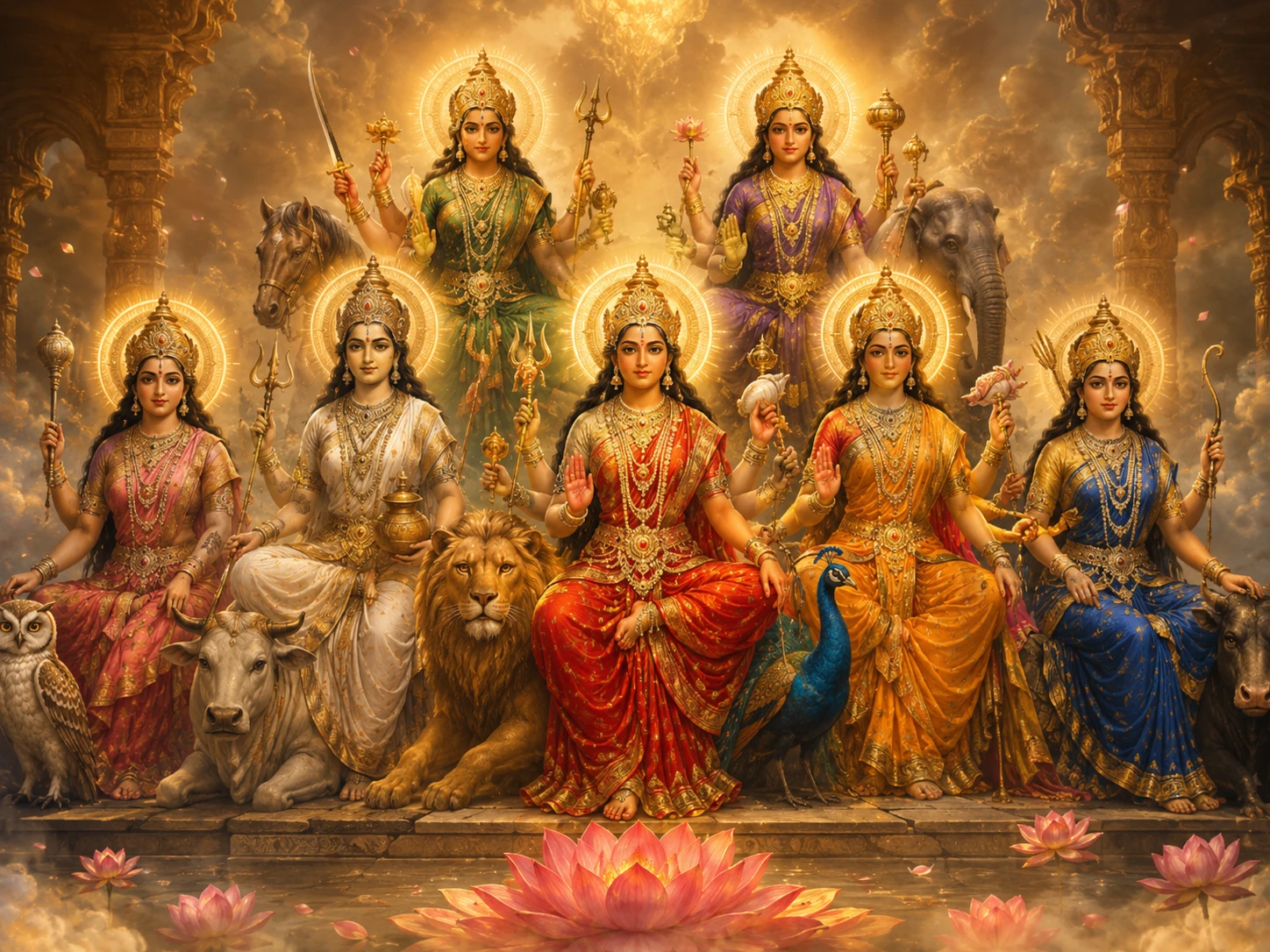
Saptamatrikas -- The Seven Mothers
सप्तमातृका -- सात माताएँ
The Saptamatrikas are the seven mother goddesses of Hindu tradition, depicted together in a row on temple panels from approximately the sixth century CE onward and invoked together in Tantric and Shakta texts as the collective feminine power. Each of the seven is the shakti (energy) of a major male deity and carries the same weapons, the same vahana, and often the same crown as her masculine counterpart. Brahmani corresponds to Brahma, Maheshwari to Shiva, Kaumari to Kartikeya, Vaishnavi to Vishnu, Varahi to Varaha, Indrani to Indra, and Chamunda to the Devi herself in her fierce aspect. Together they are not seven separate goddesses but seven faces of a single feminine principle that can differentiate itself to meet different tasks. When texts speak of a shakti of Brahma, they do not mean a consort; they mean the active power by which the creator actually creates. Brahma without Brahmani is abstract; Brahma with Brahmani is operational. This principle -- that every deva has a corresponding shakti without whom he is not fully effective -- is foundational to Shakta theology and is expressed at its clearest in the Saptamatrika iconography. To see seven goddesses seated together is to see the entire masculine pantheon in its active, functioning form.
The canonical emergence narrative of the Saptamatrikas is in the Devi Mahatmya (chapter 8), part of the Markandeya Purana, composed probably in the fifth to sixth century CE and recited as Durga Saptashati during Navaratri across India today. The asura Raktabija had received the boon that every drop of his blood spilled on earth would become another asura identical to him. When he entered battle with the Devi's army, every wound she or her attendants inflicted produced dozens, then hundreds of additional Raktabijas. The battle was being lost. At this crisis, the Devi Mahatmya narrates, the shaktis of the seven great male gods emerged from their bodies to assist: Brahma's shakti appeared with Brahma's swan vahana, kamandalu, and akshamala; Shiva's shakti appeared on Nandi with Shiva's trident; Kartikeya's shakti appeared on a peacock with the spear. Each shakti took the form, ornaments, and mount of her source deity. They surrounded Raktabija, and Chamunda emerged from Devi's own forehead with her open mouth. She drank every drop of Raktabija's blood as it fell, preventing any new asura from forming. With Raktabija's blood contained, the original Raktabija was killed. The seven mothers had saved cosmic order through the specific division of labour that only collective feminine action can perform: not one warrior but a distributed network of warriors, each specialised, each converging on the same demon from a different direction.
यस्य देवस्य यद्रूपं यथा भूषणवाहनम् । तद्वदेव हि तच्छक्तिरसुरान्योद्धुमाययौ ॥१४॥
yasya devasya yadrūpaṃ yathā bhūṣaṇavāhanam | tadvad eva hi tacchaktir asurān yoddhum āyayau ||14||
Whatever form each god has, with whatever ornaments and mount, in precisely that same form did his shakti emerge to fight the asuras.
— Devi Mahatmya (Durga Saptashati), Chapter 8, verse 14 (Markandeya Purana)
The iconography of the Saptamatrikas is highly specific. Brahmani has four faces (like Brahma), rides a hamsa (swan or goose), holds an akshamala (rosary) and kamandalu (water pot), and is coloured yellow or golden. Maheshwari rides a bull (Nandi), holds a trishula (trident) and damaru, wears a crescent moon in her hair (like Shiva), and is coloured white or red. Kaumari rides a peacock, holds a spear (shakti), wears the crown of a young warrior, and is coloured golden-red. Vaishnavi rides Garuda, holds the shankha (conch), chakra (discus), and gada (mace), and is coloured blue-green. Varahi is boar-faced (like Varaha), holds a plough (hala), rides a buffalo or sits on a throne, and is coloured dark. Indrani or Aindri rides the elephant Airavata, holds the vajra (thunderbolt), has a thousand eyes (like Indra), and is coloured red. Chamunda is skeletal, emaciated, fearsome, holds a skull-cup (kapala) and a khatvanga (staff with skull), is sometimes shown with a protruding tongue, and represents the Devi's terminal destructive aspect -- the force that drinks the last drop of cosmic disorder. Each goddess is thus immediately identifiable by her attributes, and the set of seven constitutes a complete visual statement of Hindu divine femininity's compositional range.
The sculptural programme for the Saptamatrikas is remarkably standardized across regions and centuries. They are typically depicted in a horizontal row, seated in lalitasana (one leg pendant, one leg tucked), with Virabhadra (a fierce emanation of Shiva) at the left end of the row and Ganesha at the right end -- the two male figures serving as framing protectors. The panel usually sits in the ardha-mandapa (half-hall) or on the exterior wall of a temple dedicated to a Shaiva or Shakta deity. The Saptamatrika panels at Ellora Cave 14 and Cave 21 (eighth century), at Elephanta island near Mumbai (sixth century), at Aihole in Karnataka (sixth to seventh century), at Pattadakal (eighth century), and at the Jogeshwari caves near Mumbai are among the most-visited examples, though smaller panels survive at hundreds of temples. A particularly elaborate Saptamatrika dancing panel from Gorgi in Rewa district, Madhya Pradesh, now held at the Allahabad Museum, shows all seven goddesses in vigorous dance-combat postures rather than the usual seated pose -- a rarer iconographic variant that probably dates to the ninth or tenth century. The combination of consistency (the seven identities) with regional variation (dance vs. seated, pattern of weapons, treatment of Chamunda) is characteristic of Hindu iconographic grammar: the theological identity is fixed, but the aesthetic treatment is free.
The Seven Matrikas and Their Masculine Counterparts
| Matrika | Shakti of | Iconography |
|---|---|---|
| Brahmani / ब्राह्मणी | Brahma / ब्रह्मा | Four-headed, hamsa (swan) mount, akshamala and kamandalu, golden. / चार मुख, हंस वाहन, अक्षमाला और कमंडलु, सुनहरी। |
| Maheshwari / माहेश्वरी | Shiva / शिव | Bull mount, trident and damaru, crescent moon in hair, white. / वृषभ वाहन, त्रिशूल और डमरू, केशों में अर्धचंद्र, श्वेत। |
| Kaumari / कौमारी | Kartikeya / कार्तिकेय | Peacock mount, spear, young warrior's crown, golden-red. / मोर वाहन, भाला, युवा योद्धा का मुकुट, सुनहरे-लाल। |
| Vaishnavi / वैष्णवी | Vishnu / विष्णु | Garuda mount, conch, discus, mace, blue-green. / गरुड़ वाहन, शंख, चक्र, गदा, नील-हरित। |
| Varahi / वाराही | Varaha / वराह | Boar-faced, plough, buffalo mount or throne, dark. / वराह-मुख, हल, भैंसा वाहन या सिंहासन, श्याम। |
| Indrani/Aindri / इन्द्राणी/ऐन्द्री | Indra / इंद्र | Elephant Airavata mount, vajra, thousand-eyed, red. / ऐरावत हाथी वाहन, वज्र, सहस्र नेत्र, लाल। |
| Chamunda / चामुण्डा | Devi / देवी | Skeletal, skull-cup, khatvanga, fearsome, dark. / अस्थि-कंकाल, खप्पर, खट्वांग, भयानक, श्याम। |
Some traditions extend the set to eight (Ashtamatrika) by adding Narasimhi (shakti of Narasimha) or Vinayaki (shakti of Ganesha), reflecting a theological position that there should be a shakti corresponding to every major masculine form. The choice of which matrika to add marks the regional sampradaya: Narasimhi is favoured in some Shaiva Siddhanta lineages, Vinayaki in Shakta tradition.
The second major narrative associated with the Saptamatrikas is the Andhakasura episode, narrated in the Matsya Purana and elaborated in the Isanasivagurudevapaddhati. The asura Andhaka, born blind (hence the name), had received the boon that he could only be killed if every drop of his blood touching earth did not produce a duplicate. When he attacked the three worlds, Shiva took up the battle. Every wound Shiva inflicted produced another Andhaka from the spilled blood -- the same problem as with Raktabija. Shiva called forth Yogeshwari, a goddess emerging from the flames of his own mouth, and the other great gods contributed their own shaktis: Brahma, Vishnu, Maheshwara, Kumara, Varaha, Indra, and Yama all sent their feminine energies to join Yogeshwari. These collectively became the Saptamatrikas in this alternative origin narrative. The matrikas then encircled Andhaka, and each drank or licked the blood before it touched the ground. Andhaka, bloodless, could be finished. Both this narrative and the Devi Mahatmya narrative make the same theological point: the Saptamatrikas exist to solve the specific problem of multiplying evil. When any single hero cannot contain a demon whose power is precisely in proliferation, a distributed collective of feminine power is what can succeed. The mother-principle multiplied to match the multiplication of the threat.
The Tantric tradition gives the Saptamatrikas a second, deeper identification that runs alongside their martial-narrative one: the seven matrikas are identified with the phonetic groups of the Sanskrit alphabet. The Devanagari alphabet is traditionally organised into seven consonant groups (vargas) plus the vowel group: ka-varga (k-sounds), cha-varga (ch-sounds), ta-varga (retroflex t-sounds), ta-varga (dental t-sounds), pa-varga (p-sounds), ya-varga (semivowels), and sha-varga (sibilants and h). When the vowel group is added, eight groups emerge, corresponding to the Ashtamatrika. Each matrika presides over one consonant group; she is the energy of sound production in that articulatory region. The theological claim is that the letters of the alphabet are not arbitrary signs but specific feminine energies that together create the entire possibility of language. When a Sanskrit mantra is recited, the tradition holds, one is not making abstract sound; one is invoking the matrikas who constitute each syllable. The Varnamala (garland of letters) is, in Tantric interpretation, the Saptamatrikas themselves in their sonic form. This doctrine is elaborated in texts like the Kamakala-Vilasa and the Para-Trishika, and it informs the practice of bija-mantra meditation where specific syllables are held to carry the presence of specific deities. A serious Sanskrit student in a traditional pathashala or a modern university is, at a theological level, encountering the matrikas each time she recites the alphabet.
The Saptamatrikas are assigned specific correspondences to the seven dhatus (bodily substances) in classical Ayurveda and Shaiva Tantra. Brahmani corresponds to the skin (tvak), Maheshwari to blood (rakta), Kaumari to muscle (mamsa), Vaishnavi to fat (medas), Varahi to bone (asthi), Indrani or Aindri to marrow (majja), and Chamunda to semen/reproductive substance (shukra). Each matrika is considered to preside over the subtle energy of her assigned dhatu, and bodily imbalance in any one dhatu is traditionally correlated with insufficient reverence or attention to the corresponding matrika. This system is discussed in texts like the Agni Purana and in Shaiva Agamas, and survives in some living Ayurvedic traditions as a supplementary diagnostic framework alongside the dosha system. A traditional Ayurvedic physician in Kerala or in Varanasi treating a patient with severe osteoporosis might, in addition to prescribing conventional mineral supplementation and shilajit, recommend specific Varahi-puja as part of the therapeutic regimen. The modern medical framework and the traditional matrika framework are not considered contradictory by these physicians; they are considered complementary, operating at different layers of what constitutes bodily health. Western medical anthropologists have documented these practices in several published studies, noting that patient outcomes in integrated Ayurvedic-allopathic clinics are often comparable to or better than allopathic-alone treatment for certain chronic conditions.
Chamunda, the seventh matrika, deserves separate attention because her theology differs from the other six. The other six matrikas are each a shakti of a male deity; Chamunda is not. She emerged directly from the forehead of Devi in the Raktabija episode, with no masculine source, and in the Andhakasura narrative she similarly emerges from Devi herself. Her name combines Chanda and Munda, the two asuras she killed before Raktabija, who were servants of the demon brothers Shumbha and Nishumbha. Her iconography is also unique: where the other six matrikas are depicted as richly dressed and jewelled, Chamunda is emaciated, skeletal, sometimes shown dancing on a corpse, with her tongue extended to catch falling blood. She is closer in visual type to Kali than to the other matrikas; in fact, some traditions identify Chamunda with Kali directly. This places her outside the symmetrical shakti-of-a-deva pattern and makes her the most theologically interesting of the seven. The other six represent the differentiated feminine energies of the masculine pantheon; Chamunda represents feminine energy that has no masculine reference point, that drinks blood and dances on corpses, that completes what the others have begun. Her presence in the set ensures that Saptamatrika theology is not simply a doctrine of feminine subordination to masculine deities; one of the seven owes nothing to any deva. The goddess's own ferocity is final.
The Ellora Cave 14 Saptamatrika panel and the Cave 21 panel, both carved in the late seventh to early eighth century during the Chalukya-Rashtrakuta period, are among the most studied examples of Saptamatrika sculpture in India. Ellora is a UNESCO World Heritage Site located in Maharashtra's Aurangabad district (recently renamed Chhatrapati Sambhajinagar), and its rock-cut caves include 34 Buddhist, Hindu, and Jain monasteries and temples carved into a basalt cliff face. Cave 14, called Ravan ki Khai, contains a well-preserved Saptamatrika panel on its left wall where all seven goddesses are shown in seated lalitasana, with Virabhadra on the extreme left and Ganesha on the extreme right. The matrikas can each be identified by their distinct vahanas carved at their feet and their weapons. The sculptural programme reflects the Shaiva affiliations of the cave's patrons: Shiva appears repeatedly in other panels, and the Saptamatrikas are positioned as his extended family of feminine allies. The Cave 21 Ramesvara panel is smaller but technically more refined. Both panels together give scholars a clear sense of how a major Shaiva cave temple used the Saptamatrika imagery to assert the complete masculine-feminine cosmic order. A visitor to Ellora today can see these panels with a guide who will explain the iconography; the site is open year-round except during heavy monsoon.
The Saptamatrikas are understood in Tantric Shakta lineages to preside over specific life-transitions and pregnancy-related concerns. Traditional practice across much of India includes invoking the Saptamatrikas during pregnancy, childbirth, and the postpartum period. The 21-day, 40-day, or 6-week period after a birth is considered ritually sensitive; mother and infant remain in a liminal state during which they are particularly vulnerable to both physical and spiritual disturbances. Tantric tradition holds that during this window, the Saptamatrikas provide protective presence if properly invoked. The practice involves a Saptamatrika yantra (diagram) placed in the room where the mother and child are resting, daily offerings of flowers and fruit, and recitation of the Saptamatrika names. The theological logic is specific: the matrikas are mothers themselves, they understand the specific vulnerabilities of mothers, and their collective presence creates a protective circle that a single deity cannot. Modern obstetric medicine obviously addresses the physical dimensions of postpartum care -- nutrition, hygiene, infection prevention -- but the traditional practice continues to be observed alongside medical care in many Hindu families, particularly in rural and semi-urban India. A young mother in Ghaziabad recovering from a caesarean section may well have a Saptamatrika yantra by her bedside, and her physician and her mother-in-law agree without argument that both modern medicine and traditional practice are appropriate.
The Saptamatrikas appear in the Navaratri festival in a specific way that many popular celebrations no longer foreground. The canonical reading of Navaratri is that it is the nine-night festival of Durga's battle with Mahishasura, culminating in Vijayadashami on the tenth day. But the Devi Mahatmya, which is the central textual source for Navaratri, includes the Saptamatrika emergence as a key episode on day seven or eight of the nine-day narrative cycle. Orthodox Navaratri observance in Shakta strongholds like Bengal, Odisha, Assam, and parts of Kerala includes specific puja of the seven matrikas on the seventh night (saptami) or eighth night (ashtami). The ritual involves establishing seven small kalashas (pots) to represent the seven goddesses, offering them separately, and then reciting the chapter 8 of the Devi Mahatmya that narrates their emergence. At the Kalighat temple in Kolkata, at the Kamakhya temple in Assam, and at several Devi temples in Varanasi, this specific ritual is still performed annually during Navaratri. The matrikas thus remain liturgically active, not merely iconographically preserved. A Bengali family observing traditional Durga Puja in Kolkata includes the Saptamatrika invocation as one of the specific prayers of the festival; a North Indian family celebrating with garba and dandiya in Ahmedabad typically does not. Both are observing Navaratri; they are reading slightly different texts of it.
The scholarship on Saptamatrika origins includes the hypothesis, first proposed by archaeologists in the mid-twentieth century, that the seven mother goddesses may have pre-Vedic origins in a fertility-and-protection cult associated with the Pleiades, the seven-star cluster known in Sanskrit as Krittika. The Pleiades are named in Vedic literature as the seven celestial mothers who raise Kartikeya, and the numerical overlap with the Saptamatrikas is suggestive. The hypothesis is that an older seven-mother cult was absorbed into mainstream Hindu theology and given its current form between the fourth and seventh centuries CE, with the Devi Mahatmya narrative providing a unifying literary framework. The cult's pre-Vedic layer is hypothesized from archaeological finds of female terracotta figurines in groups of seven at Indus Valley sites and from comparative material in broader Indian folk tradition, where groups of seven mother goddesses (sometimes called Sati-Asara in rural Maharashtra, Sat Ma in eastern India, and other names) continue to be worshipped outside the classical Sanskrit tradition. Contemporary scholars including Wendy Doniger and David Kinsley have documented this pre-classical stratum and argued that the Saptamatrika is best understood as a bridge concept linking folk goddess worship to classical Hindu theology. For a contemporary Hindu visiting a village shrine of Sat Ma in Bihar or Odisha and asking who these seven mothers are, the answer is simultaneously 'the village's traditional protectors' and 'the Saptamatrikas of the Devi Mahatmya'. Both answers are correct. The tradition is layered rather than linear.
For a contemporary Hindu who wants to begin a Saptamatrika practice, the entry point is recognition rather than elaboration. Begin by learning to recognize the seven matrikas in their standard iconographic forms. Visit a major temple or museum with Saptamatrika panels -- Ellora if you can travel to Maharashtra, the Kamakhya temple in Assam, or any of the many regional Devi temples in Tamil Nadu and Karnataka -- and spend time identifying each of the seven by her distinctive vahana and weapons. For home practice, keep an image or small set of figurines of the seven goddesses on the puja shelf during Navaratri, and on saptami or ashtami (the seventh or eighth night of the nine-night cycle) perform a brief seven-fold puja: light one diya, place a flower and a few grains of rice before each of the seven, and recite each goddess's name slowly. The total observance takes fifteen minutes and does not require Sanskrit knowledge beyond the seven names. The theological purpose is to let the seven presences register separately in awareness rather than as a single aggregate. The practice is particularly recommended for women during pregnancy, in the first year postpartum, during any time of illness in the family, and during major life transitions. It is also recommended for men as a corrective to any tendency to relate to the divine only through masculine forms. The seven mothers close a gap in religious imagination that single-deity devotion cannot close.
Recite the Saptamatrika Names during Navaratri
Recite chapter 8 of the Devi Mahatmya, the slaying of Raktabija, on Saptami or Ashtami of Navaratri. It tells how the seven Matrikas emerged from the gods, and reciting it invokes their presence. The Devi Mahatmya is on Eternal Raga with its meaning.
Tags
Eternal Raga · शाश्वत राग
Institutional voice — scholarly articles on Sanatan Dharma
Deepen Your Understanding
अपनी समझ और गहरी करें
deities avatars
Mahishasuramardini -- The Slayer of the Buffalo Demon and India's Most Iconic Image of Power
No single image has been reproduced more in Indian art than a goddess standing on a buffalo, trident in hand. From Gupta-era gold coins to Kolkata's 40,000 Durga Puja pandals, Mahishasuramardini -- the Slayer of the Buffalo Demon -- is the defining visual of Hindu civilisation's most radical claim: that the ultimate power in the universe is feminine.
deities avatars
Nine Forms of Shiva -- The Many Faces of Mahadeva
He is the silent teacher under a banyan tree and the screaming destroyer on a battlefield. He is half-woman and half-man. He drank the poison that would have ended the universe and his throat turned blue. Nine scripturally-attested forms of Shiva -- from Nataraja to Rudra -- and why each one exists.
deities avatars
Parvati -- Shakti, Wife, Mother, and the Woman Who Moved a Mountain God
She is the daughter of the Himalayas who performed tapas so intense that even Shiva -- the god who burned Kamadeva to ash for daring to disturb his meditation -- was compelled to open his eyes. Parvati is Hinduism's most complete feminine archetype: lover, mother, warrior, philosopher, and the literal other half of god.
deities avatars
Ganesha -- The Elephant God Decoded
An elephant head on a child's body. A broken tusk in one hand and a sweet in the other. A mouse as a vehicle for the largest deity in the room. Nothing about Ganesha makes sense on the surface -- and everything makes sense once you decode the symbols. This is the deity India invokes before every exam, every business launch, and every WhatsApp group creation.
deities avatars
Kartikeya vs Ganesh -- The Cosmic Race Around the Universe That Every Indian Parent Secretly Hopes Their Children Will Understand
Two divine brothers are challenged to race around the universe. Kartikeya, the warrior god, mounts his peacock and flies across all three worlds at cosmic speed. Ganesh, the elephant-headed god, simply walks around his parents and says: 'You are my universe.' Ganesh wins. And in that victory is encoded everything Indian civilisation believes about the relationship between wisdom and strength, devotion and ambition, family and cosmos.
rituals traditions
Tirtha Yatra -- Why Hindus Travel to Get Closer to God
The word 'Tirtha' does not mean 'holy place.' It means 'crossing point' -- a ford where the river of worldly existence can be crossed to reach the far shore of liberation. Hindu pilgrimage is not tourism with a spiritual label. It is the deliberate journey to locations where the boundary between the material and the divine is believed to be thinnest -- where the crossing is easiest. From Kashi to Kailash, from Char Dham to Kumbh Mela, the tradition maps a sacred geography onto the physical landscape of the subcontinent, turning the act of travel itself into a spiritual practice.
scriptural exegesis
Samudra Manthan -- When Gods and Demons Ran a Joint Venture and the Universe Almost Died
A cosmic ocean. A mountain for a churning rod. A serpent king for a rope. Gods on one end, demons on the other. And out came 14 treasures -- including wealth, beauty, medicine, immortality, and one poison so lethal it could end creation itself. The Samudra Manthan is not mythology. It is the original playbook for collaboration, crisis management, and how to handle it when your joint venture partner tries to cheat you.
The Saptamatrikas are assigned specific correspondences to the seven dhatus (bodily substances) in classical Ayurveda and Shaiva Tantra. Brahmani corresponds to the skin (tvak), Maheshwari to blood (rakta), Kaumari to mu…
More in Deities & Avatars
33 Koti Devata -- Why Hinduism Has 33 Types of Gods, Not 33 Crore
13 min read
Agni -- The Fire God
19 min read
Annapurna -- Goddess of Food
19 min readThe same translation error that turned '33 Koti' into '33 crore' in Hinduism also happened in Buddhism. The Chinese translation of Buddhist texts rendered 'Sapta Koti Buddha' (7 Supreme Buddhas) as '7 Crore Buddhas.' The…
Deities AvatarsCommunity Reflections
🕉️
Be the first to share your reflection.