Shani Dev -- The Slow One, Judge of Karma
शनि देव -- मन्द गति वाले, कर्म के न्यायाधीश
Of the nine grahas, the planetary powers of Indian astrology, none is feared like Shani. His transits are blamed for delays, losses and long hardships; on Saturdays queues form at his shrines with offerings of mustard oil and black sesame. And yet in the temples and in the hymns, Shani is not a demon or an enemy. He is a god -- a stern one, whose work is to give each person the exact fruit of their actions.
His name explains his nature. Shanaishchara means "the one who moves slowly" (shanaih charati). Saturn is the slowest of the planets visible to the naked eye, taking about twenty-nine and a half years to circle the zodiac, some two and a half years in each sign. To the ancient astronomers that slowness made him the planet of time, patience, endurance and delay.
नीलाञ्जनसमाभासं रविपुत्रं यमाग्रजम्। छायामार्तण्डसम्भूतं तं नमामि शनैश्चरम् ॥
nīlāñjanasamābhāsaṃ raviputraṃ yamāgrajam| chāyāmārtaṇḍasambhūtaṃ taṃ namāmi śanaiścaram ||
Dark as blue collyrium, son of the Sun and elder brother of Yama, born of Chhaya and Martanda -- to that Shanaishchara I bow.
— Shani Stotram, verse 1
The Puranas make Shani the son of Surya, the Sun, by Chhaya, "shadow". Surya's wife Sanjna could not bear his blazing heat, so she created a woman from her own shadow, left her in her place and went away to do penance. Chhaya bore Surya children, Shani among them. In some tellings Shani's dark complexion -- and his difficult relationship with his father -- go back to this birth from shadow: the son of light born dark.
Shani is thus the brother of Yama, the god of death and dharma, and of the river goddess Yamuna, Sanjna's children. The two brothers share a domain. Yama judges after death; Shani is said to deliver the results of karma within life. That is why Shani is called the dandadhikari, the one entrusted with punishment -- and why his worshippers insist that he is just, not cruel.
Shani at a Glance
| Aspect | Association |
|---|---|
| Parents and siblings | Son of Surya and Chhaya; brother of Yama and Yamuna |
| Planet | Saturn, the slowest visible planet (about 2.5 years in each sign) |
| Day | Saturday (Shanivar) |
| Colour, metal, offerings | Black or deep blue; iron; mustard or sesame oil, black sesame, black cloth, urad dal |
| Vahana (mount) | A crow or vulture; in some images a chariot drawn by them |
| Rules in astrology | Discipline, labour, longevity, delay, justice -- the ripening of karma |
| Shani Jayanti | Jyeshtha Amavasya, the new moon of Jyeshtha |
In astrology, Shani's most dreaded period is Sade Sati, "seven and a half". It is the roughly seven-and-a-half-year span during which Saturn passes through the three signs centred on the sign of one's natal Moon -- the one before it, the Moon sign itself, and the one after, about two and a half years each. Because it comes round about every thirty years, most people pass through it two or three times in a life. Astrologers describe it as a time of pressure and testing, but also of maturing; many teachers stress that Shani's periods reward honesty, hard work and patience, and that what he takes away is what was not built to last.
Much of the folk worship of Shani grows from stories about softening his gaze. One says that when Shani looked at the newborn Ganesha, the child's head was struck off -- the reason, in some accounts, that Shani keeps his eyes lowered. Another, popular in north India, says that Hanuman once freed Shani from Ravana's captivity, and Shani promised not to trouble Hanuman's devotees; so many people worship Hanuman on Saturdays too.
At Shani Shingnapur in Maharashtra, Shani is worshipped as a black stone standing in the open on a platform, without a roof. The village is famous for houses traditionally built without doors to their main rooms, on the belief that Shani himself protects it from theft. At Thirunallar near Karaikal, the Shani shrine within the Dharbaranyeswarar temple is one of the most visited in the south.
एतानि दश नामानि प्रातरुत्थाय यः पठेत्। शनैश्चरकृता पीडा न कदाचिद्भविष्यति ॥
etāni daśa nāmāni prātarutthāya yaḥ paṭhet| śanaiścarakṛtā pīḍā na kadācidbhaviṣyati ||
Whoever rises at dawn and recites these ten names will never suffer the affliction caused by Shanaishchara.
— Shani Stotram, verse 3
The way devotees approach Shani says a good deal about him. He is offered oil, the cheapest of lamps; black things and iron, the colours and metal of labour; and service to the poor, the old and the disabled, whom he is said to protect. Lighting a mustard-oil lamp under a peepal tree on Saturday evening is one of the most widespread practices. None of it is about bribing a cruel god. It is about honouring discipline, humility and fairness -- and that, the tradition says, is what Shani asks for and what he returns.
Recite the Shani Stotram
The ten names of Shani and his hymn of praise, recited on Saturdays, with meaning.
Tags
Eternal Raga · शाश्वत राग
Institutional voice — scholarly articles on Sanatan Dharma
Deepen Your Understanding
अपनी समझ और गहरी करें
deities avatars
Navagraha -- The Nine Planetary Deities Who Govern Your Horoscope and Your Life
Before every job interview, before every wedding, before buying a house or starting a business -- millions of Indians check their Navagraha positions. These nine celestial deities -- the Sun, Moon, Mars, Mercury, Jupiter, Venus, Saturn, and the shadow planets Rahu and Ketu -- constitute the most practically influential theological system in Hinduism. Whether you believe in astrology or not, the Navagraha are shaping Indian culture around you.
deities avatars
Surya's Family -- How One God Fathered Yama, Shani, the Ashwini Kumaras, and All of Humanity
Surya had two wives: Sanjana, who could not bear his radiance, and Chhaya, the shadow she left behind. From Sanjana came Yama (death), Yamuna (the river), Manu (humanity's ancestor), and the Ashwini Kumaras (divine physicians). From Chhaya came Shani (Saturn, karma's enforcer), Tapati (the river), and Savarni Manu (the next cosmic era's ruler). Same father. Two mothers. Ten children. And the entire human race.
deities avatars
Yama -- The God of Death and Dharma
Yama rides a buffalo, carries a noose, and keeps perfect records of every action in every lifetime. He is not the villain of Hindu mythology. He is the judge whose verdicts are based entirely on what a person has done. The Katha Upanishad's finest teaching comes from him, given to a nine-year-old boy who refused to leave without an answer. This is the god of death who is actually the god of dharma.
deities avatars
Hanuman -- The Perfect Devotee
He could lift mountains, leap oceans, and burn Lanka to the ground -- yet his greatest power was this: he never forgot whose work he was doing. Hanuman is not just a mythological hero. He is the operating system of selfless devotion that India still runs on.
vedic sciences
Jyotish Shastra -- The Vedic System of Astronomy and Astrology That India Never Stopped Using
Every year, millions of Indian marriages are fixed only after the kundali matches. ISRO times its satellite launches on muhurtas. JEE students wear navagraha rings. Real-estate agents check Rahu-Ketu transits before closing deals. Whether you believe in it or not, Jyotish Shastra -- the Vedic science of light, time, and celestial influence -- is the most actively practised ancient knowledge system in India today. It spans 9 Grahas, 12 Rashis, 27 Nakshatras, and 2,500 years of continuous mathematical and observational tradition. This article explains the system as the texts describe it -- not as a prediction engine, but as a framework for understanding time, cycles, and the relationship between the cosmos and human life.
tantra mantra yantra
Navagraha Yantras -- The Nine Planetary Magic Squares
Each of the nine Vedic planets has its own yantra -- a magic square where every row, column, and diagonal adds up to the same number. Sun's square sums to 15, Moon's to 18, Mars to 21, all the way to Ketu at 39. These are not superstition. They are India's oldest contribution to combinatorial mathematics -- and they still hang in millions of homes and temples as instruments of cosmic balance.
At Shani Shingnapur in Maharashtra, Shani is worshipped as a black stone standing in the open on a platform, without a roof. The village is famous for houses traditionally built without doors to their main rooms, on the …
More in Deities & Avatars
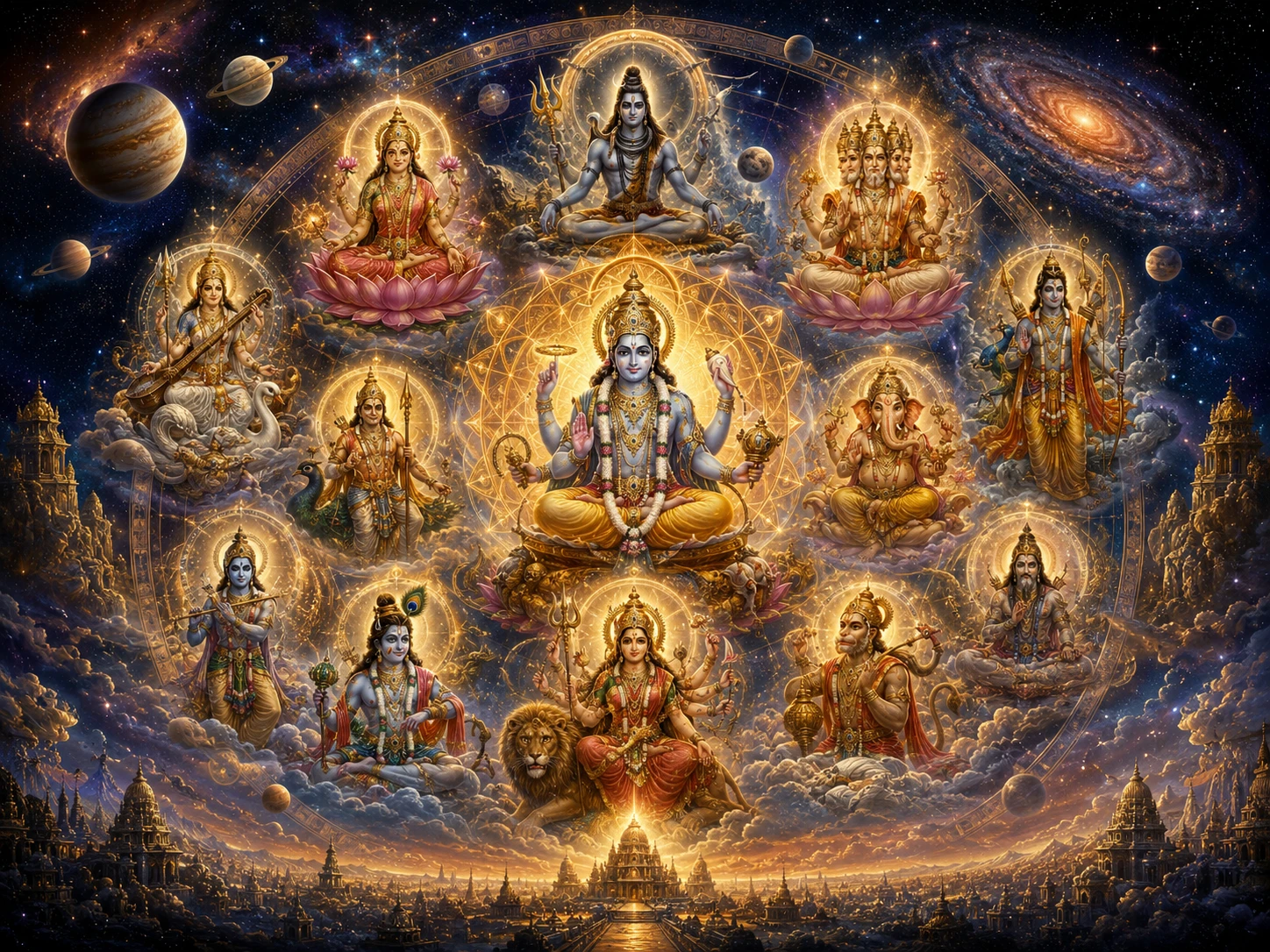
33 Koti Devata -- Why Hinduism Has 33 Types of Gods, Not 33 Crore
13 min read
Agni -- The Fire God
19 min read
Annapurna -- Goddess of Food
19 min readThe same translation error that turned '33 Koti' into '33 crore' in Hinduism also happened in Buddhism. The Chinese translation of Buddhist texts rendered 'Sapta Koti Buddha' (7 Supreme Buddhas) as '7 Crore Buddhas.' The…
Deities AvatarsCommunity Reflections
🕉️
Be the first to share your reflection.