Rama and Bharata -- The Brotherhood That Refused a Throne
राम और भरत -- वह भ्रातृत्व जिसने सिंहासन अस्वीकार किया
The Rama-Bharata relationship is the Ramayana's purest expression of what brotherhood means -- and it is defined not by battlefield heroics or shared adventures but by two acts of renunciation so complete that they have become the template for selfless love in Indian civilisation. Rama renounces the throne to honour his father's word. Bharata renounces the throne because it was never rightfully his. Between these two renunciations, you get the architecture of an ideal relationship: neither brother wants power, both brothers want justice, and each is willing to sacrifice everything so the other does not have to.
The story unfolds primarily in the Ayodhya Kanda (Book 2) of the Valmiki Ramayana, specifically chapters 99 through 115, with the reunion described in Yuddha Kanda 125-128. The context: King Dasharatha has announced that Rama, his eldest and most beloved son, will be crowned crown prince. The entire city of Ayodhya is in celebration. And then, in a single night, everything collapses. Kaikeyi -- Bharata's mother, Dasharatha's second queen -- invokes two boons the king had once granted her. First boon: Bharata shall be crowned instead of Rama. Second boon: Rama shall be exiled to the forest for 14 years. Dasharatha, bound by his word, is destroyed. Rama, hearing the news, shows no anger, no grief, no resistance. He changes into bark cloth and departs with Sita and Lakshmana. Dasharatha dies of grief the same night.
Bharata and Shatrughna are not in Ayodhya when any of this happens. They are visiting their maternal grandfather in the kingdom of Kekaya (in the northwest, near modern-day Punjab/Afghanistan border). When they return and discover what has occurred -- Rama exiled, father dead, mother responsible -- Bharata's reaction is the first indicator of his extraordinary character. He does not celebrate his unexpected fortune. He does not rationalise. He turns on his own mother with fury: 'You have killed my father and exiled my brother for a throne I never asked for. I disown you.'
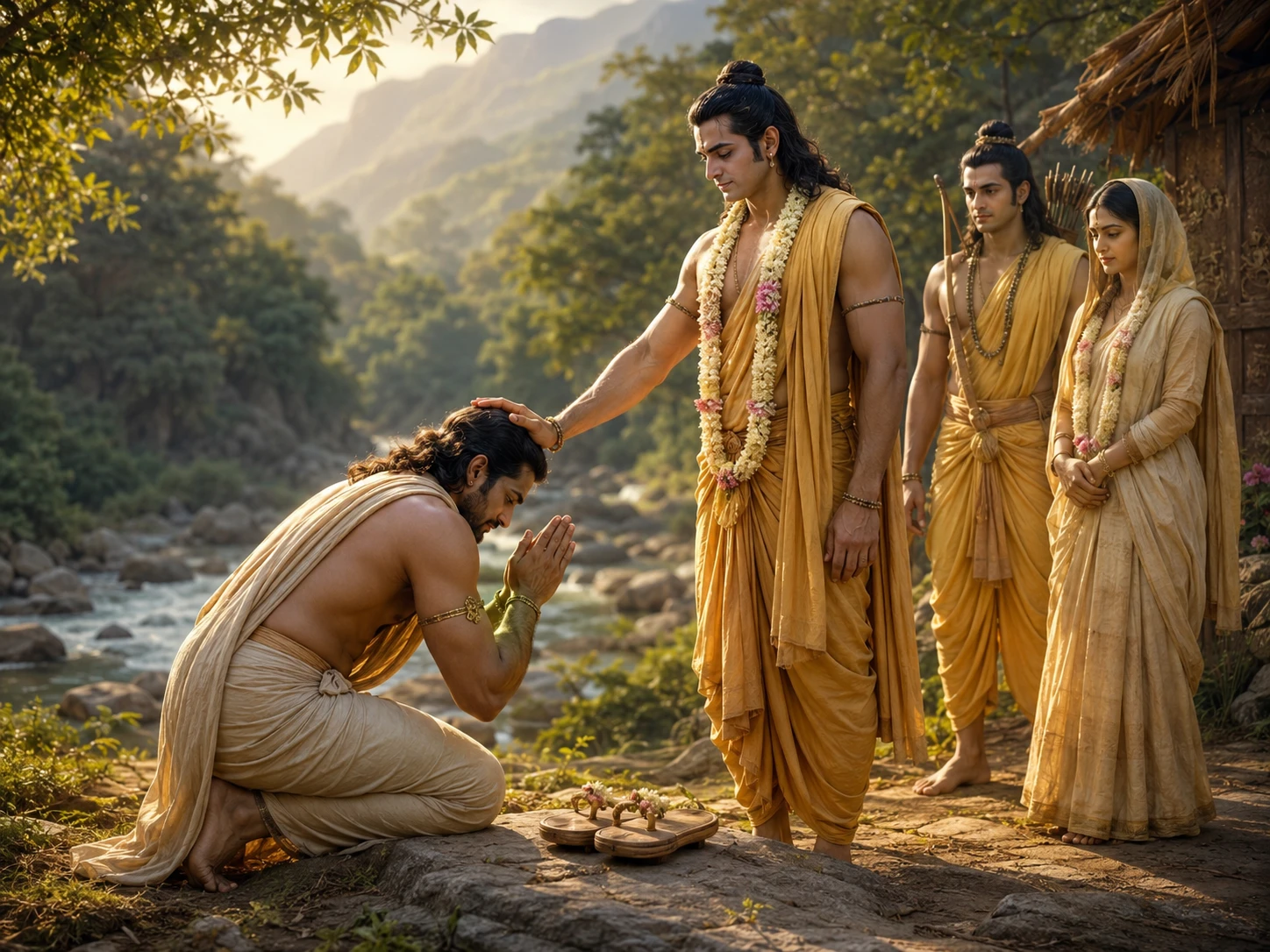
Bharata then does something unprecedented in the literature of kingship. He marches to Chitrakuta -- where Rama, Sita, and Lakshmana are living in a simple hermitage -- with an army and the entire population of Ayodhya. Not to fight. To beg. He begs Rama to return and take the throne. Rama refuses. The debate between them (Ayodhya Kanda chapters 100-111) is one of the most emotionally charged dialogues in all of Sanskrit literature. Bharata argues: 'The kingdom is yours by right of birth, by right of merit, by the wish of our father (before Kaikeyi's manipulation), by the wish of the people. I am holding a stolen inheritance. Come back.' Rama argues: 'Our father gave his word. That word must be honoured. I will return after 14 years. Until then, you rule.'
Even the sages intervene. Jabali, a rationalist advisor, tries to convince Rama that promises to the dead are meaningless and he should be practical. Rama rebukes him sharply -- one of the rare moments where Rama shows anger. Vasishtha, the royal guru, tries a different approach. But Rama is immovable. He has committed to 14 years in the forest and nothing -- not love, not logic, not the sight of his weeping brother -- will change his mind.
Bharata, understanding that Rama will not return, makes a request that defines his character forever. He asks Rama for his wooden sandals -- the padukas. Rama touches the sandals with his feet. Bharata places them on his head and carries them back to Ayodhya. He installs the padukas on the royal throne, coronates them as the symbolic ruler, and announces: 'I am not the king. These sandals are the king. I am the servant of the sandals.' He then moves out of Ayodhya to the village of Nandigrama, dresses in bark cloth, mattes his hair, eats only roots and fruits, and governs the kingdom as a regent -- for 14 years. Every administrative decision is made in the name of the sandals. Every tax collected is reported to the sandals. The throne of the most powerful kingdom in the Ramayana world is occupied by a pair of wooden shoes.
भरतस्तु महातेजा नन्दिग्रामे महायशाः। पादुके ते प्रशासद्भ्यां राज्यं रामस्य रक्षति॥
bharatas tu mahātejā nandigrāme mahāyaśāḥ | pāduke te praśāsadbhyāṁ rājyaṁ rāmasya rakṣati ||
The mighty and illustrious Bharata, dwelling in Nandigrama, protected the kingdom of Rama with those two ruling sandals.
— Valmiki Ramayana, Ayodhya Kanda 115.20
The reunion after 14 years is described in Yuddha Kanda 125-128. Hanuman arrives at Nandigrama first, tells Bharata that Rama has defeated Ravana and is returning in the Pushpaka Vimana. Bharata faints with joy. When he recovers, he offers Hanuman a hundred thousand cows, a hundred villages, and sixteen accomplished brides as reward for the news -- a measure of how desperate his wait has been. He commands Shatrughna to level and decorate the road from Nandigrama to Ayodhya. The entire kingdom turns out. When Rama arrives, Bharata approaches with the padukas on his head, falls at Rama's feet, and says: 'I return your sovereignty today. As your keeper, I have increased the treasury, granary, and kingdom tenfold.'
This is not the action of a man who resented his situation. Bharata did not merely maintain the kingdom -- he grew it. He was a better regent than most kings are kings. And the moment Rama returned, he handed everything back without hesitation, without negotiation, without asking for credit. Rama embraced him. The text says that Vibhishana and the Vanara chiefs -- hardened warriors who had just fought a devastating war -- wept watching the brothers reunite.
The Rama-Bharata relationship carries a specific theological weight in the Vaishnava tradition. Bharata is considered the ideal devotee -- one who serves without possessing, who governs without claiming, who waits without demanding. The Koodalmanikyam Temple in Thrissur, Kerala -- one of the rarest temples in India dedicated to Bharata rather than Rama -- celebrates precisely this quality. For the Tamil Alvars, Bharata's love for Rama is the purest form of bhakti: serving the Lord's sandals when the Lord himself is absent.
Rama vs Bharata -- Two Renunciations, One Standard
| Aspect | Rama's Renunciation | Bharata's Renunciation |
|---|---|---|
| What was renounced | The throne, the city, royal comfort -- accepted 14-year forest exile | The throne that was offered to him -- chose to live as an ascetic regent |
| Why | To honour Dasharatha's word to Kaikeyi | Because the throne belonged to Rama, not him |
| How long | 14 years in the forest, much of it in danger and war | 14 years in Nandigrama, governing a kingdom he refused to call his own |
| Living conditions | Bark cloth, hermitage, forest, war | Bark cloth, matted hair, roots and fruits -- identical to Rama's, by choice |
| The symbolic act | Touched his feet to the sandals before departing | Placed the sandals on the throne and governed in their name |
| What it cost | Separation from family, kingdom, comfort; years of danger | Voluntary poverty despite having access to all of Ayodhya's wealth |
| Modern parallel | The leader who steps down for institutional integrity | The caretaker CEO who builds the company and hands it back to the founder |
| Theological reading | Avatara fulfilling cosmic duty | Ideal devotee serving the Lord's symbol in the Lord's absence |
Bharata's vow included a self-destruction clause: he told Rama that if Rama did not return on the exact day the 14th year ended, he would immolate himself. When Rama's return was slightly delayed, Bharata began preparations for the fire. Hanuman arrived just in time to prevent it.
The 'Bharat Milap' -- the reunion of Rama and Bharata -- is one of the most performed episodes in the annual Ramlila tradition across North India. In Varanasi's famous Ramnagar Ramlila (a UNESCO Intangible Cultural Heritage event), the Bharat Milap scene draws the largest crowd of the entire 31-day performance. The Koodalmanikyam Temple in Irinjalakuda, Thrissur, Kerala, is one of the only temples in India dedicated primarily to Bharata -- not Rama. Nandigrama, identified with the modern village of Nandigram about 22 km from Ayodhya, has a Bharat Kund (sacred pond) where Bharata is said to have performed daily ablutions during the 14-year regency. The paduka-on-throne motif has become a widely used symbol in Indian corporate culture -- some family-business boards keep the founder's portrait or personal item on the chairman's seat during succession transitions as a 'Bharata protocol.'
Read the Ayodhya Kanda on Eternal Raga
The Rama-Bharata story spans the Ayodhya Kanda and culminates in the Yuddha Kanda. Begin at sarga 99, where Bharata meets Rama at Chitrakuta, and read on to sarga 115 and the regency at Nandigrama -- on Eternal Raga with Sanskrit and translation.
Tags
Eternal Raga · शाश्वत राग
Institutional voice — scholarly articles on Sanatan Dharma
Deepen Your Understanding
अपनी समझ और गहरी करें
scriptural exegesis
Ram and Sita -- The Complete Life Chronology
How old was Sita when Ram went into exile? Were they married for 12 years or just one? What does Valmiki Ramayana actually say -- and why do different manuscripts say different things? Social media is full of numbers thrown out of context. This article does what most don't: it lays out every verse, every manuscript variant, every scholarly reading, and lets you see the complete picture. From Chaitra Navami to the banks of Sarayu, this is the life chronology of Ram and Sita as the primary texts present it -- contradictions, critical editions, and all.
scriptural exegesis
Ramayana -- History or Myth? What the Evidence Actually Says
A 48-km limestone bridge between India and Sri Lanka that NASA satellites photographed. An exile route spanning 3,000 km that you can walk today -- every river, cave, and mountain matching Valmiki's descriptions. Astronomical events that planetarium software can verify. Five categories of evidence that turn a simple 'myth or fact?' into a far more interesting question.
scriptural exegesis
Hanuman's Leap Across the Ocean
100 yojanas of open ocean. Three supernatural obstacles. Zero backup. Hanuman's leap to Lanka is not just mythology's greatest action sequence -- it is a masterclass in overcoming self-doubt, navigating temptation, and executing under impossible pressure.
scriptural exegesis
Why Sundara Kanda is the Most Revered
It is the only book of the Ramayana named after a quality, not a place. It is the only one where Rama is absent from the action. And it is the most recited, most parayana'd, most trusted text in living Hindu practice. Why does Sundara Kanda hold this unmatched position?
scriptural exegesis
Suryavanshi -- The Solar Dynasty from the First King to Rama
Rama was not the first king of Ayodhya. He was the 67th. Before him came Ikshvaku, who sneezed into existence from Manu's nostril. Then Harishchandra, who sold himself into slavery for truth. Then Sagara, whose 60,000 sons were burned to ash. Then Bhagiratha, who brought Ganga from heaven to redeem them. Then Raghu, who conquered the world. Then Dasharatha, who gave his life for a promise. This is the Solar Dynasty -- the longest unbroken royal lineage in any mythology on earth.
scriptural exegesis
Ramayana Warriors -- Rama's Alliance vs Lanka's Army
Two brothers, a bear king, an exile army of Vanaras, and one defector against the most fortified island-fortress in the world. The Lanka war was not a simple good-vs-evil showdown -- it was a war between two military systems, fought gate by gate, duel by duel. Here is every major warrior from both sides, mapped to their actual battle matchups from Valmiki's Yuddha Kanda.
scriptural exegesis
The Forgotten Women -- Urmila, Madri, Gandhari and the Sacrifices Nobody Tells
Urmila slept for 14 years so Lakshmana could stay awake guarding Rama. Madri walked into her husband's funeral pyre carrying the guilt of his death. Gandhari blindfolded herself for life -- not in submission, but in the most devastating protest a wife has ever made. These women shaped the epics. The epics barely mention them.
The 'Bharat Milap' -- the reunion of Rama and Bharata -- is one of the most performed episodes in the annual Ramlila tradition across North India. In Varanasi's famous Ramnagar Ramlila (a UNESCO Intangible Cultural Herit…
More in Scriptural Exegesis
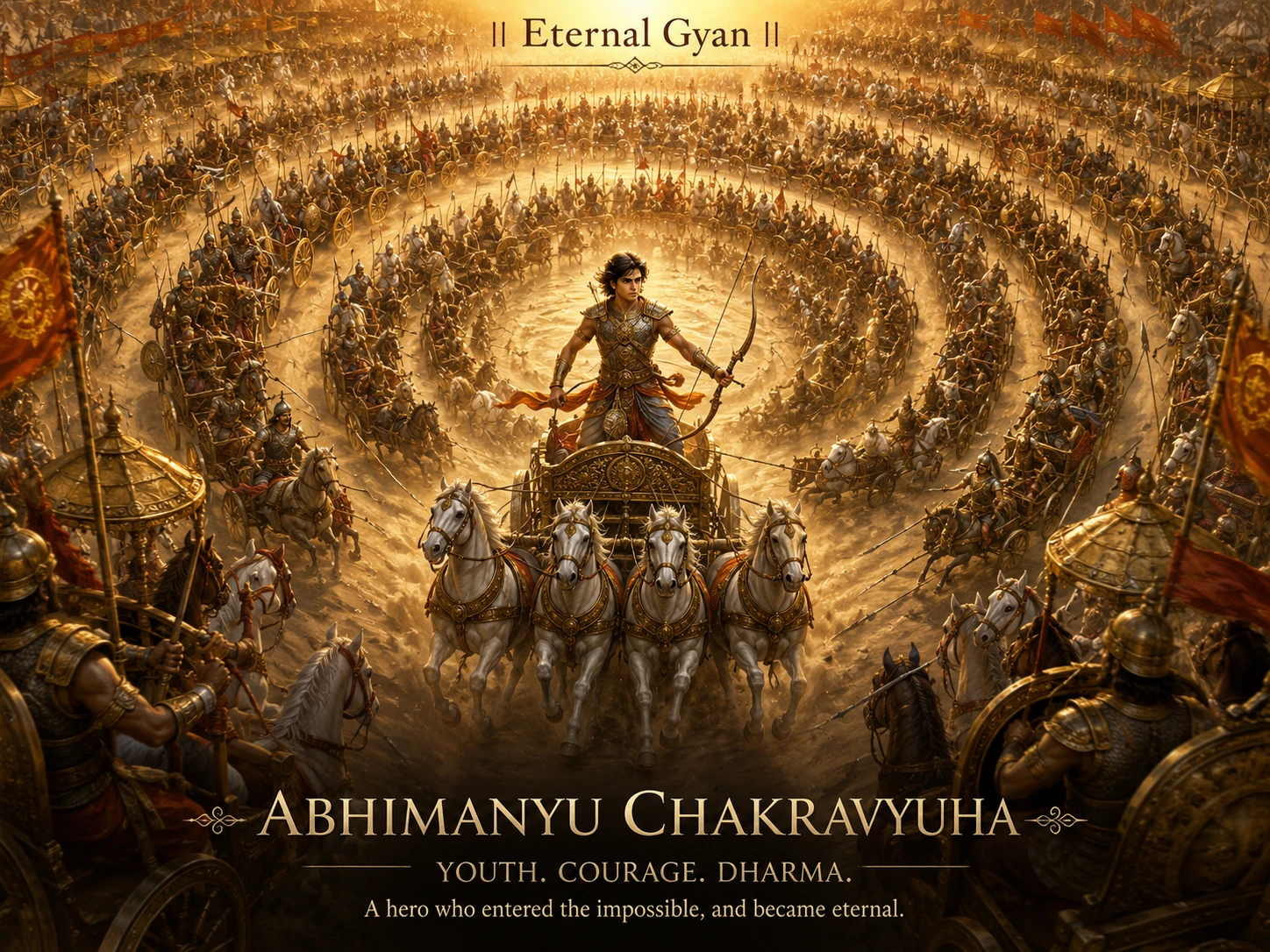
Abhimanyu and the Chakravyuha -- The Boy Who Knew How to Enter but Not How to Leave
14 min read
Adbhuta Ramayana -- The Ramayana Where Sita Becomes Kali
9 min read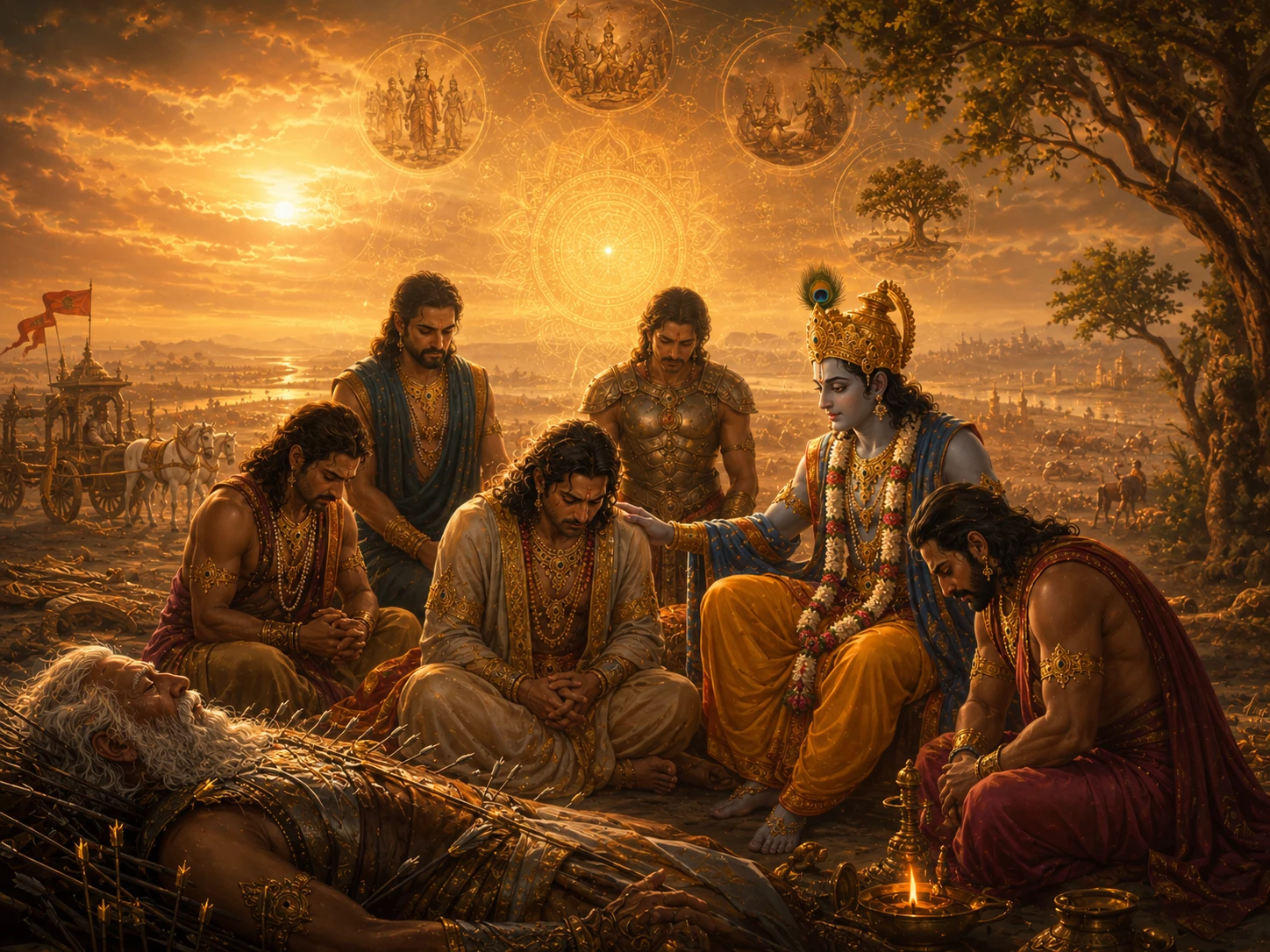
After Kurukshetra -- What Happened Next
14 min readThe same translation error that turned '33 Koti' into '33 crore' in Hinduism also happened in Buddhism. The Chinese translation of Buddhist texts rendered 'Sapta Koti Buddha' (7 Supreme Buddhas) as '7 Crore Buddhas.' The…
Deities AvatarsCommunity Reflections
🕉️
Be the first to share your reflection.