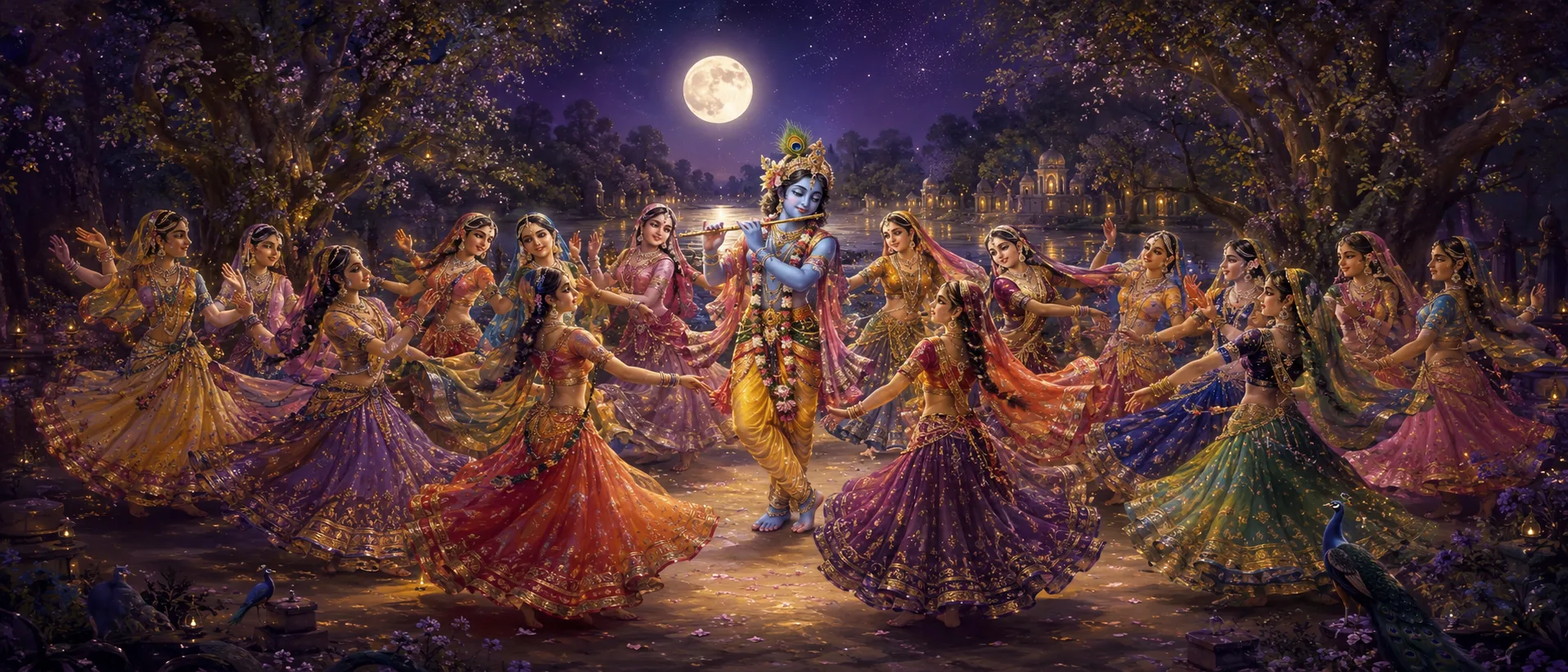
The fifth Amsa is the Vishnu Purana's Krishna-carita, its single longest sustained narrative. It opens with the earth herself, oppressed by Kamsa's tyranny, pleading with the gods for relief, and Vishnu's promise to descend. Krishna's birth in Devaki's prison-cell, his exchange for Yashoda's daughter, and his Vraja childhood follow in close narrative sequence — Putana, the overturned cart, the move to Vrindavana, the subduing of the serpent Kaliya, and, in the text's most celebrated passage, the lifting of Govardhana hill to shelter the cowherds from Indra's wrath, followed immediately by the Rasa dance with the gopis. The narrative then turns toward Mathura: Akrura's summons, Krishna's slaying of Kamsa, the restoration of Ugrasena, and Krishna's own guru-dakshina to Sandipani. In Dvaraka the story widens — Rukmini's rescue, the Syamantaka jewel dispute, Pradyumna's recovery from the demon Shambara, the theft and restoration of the Parijata tree, Usha and Aniruddha's romance and the war with Bana, and Balarama's confrontations with Dvivida and the Kauravas. The Amsa's final movement turns somber: the sages' curse that dooms the Yadava clan to mutual destruction, Balarama's yogic departure, and finally Krishna's own withdrawal from the world and the submersion of Dvaraka beneath the sea — the narrative's grief immediately answered by Vyasa's counsel to the grieving Pandavas and the closing account of Krishna's return to his eternal form.
Chapters
Why it matters today
This Amsa's account of Krishna's life predates and closely parallels the Bhagavata Purana's much more famous tenth skandha — reading them side by side shows how the same core narrative could be told in a compact, action-forward register here versus the Bhagavata's expansive, devotionally elaborated one, offering a useful window into how a shared story could be retold with different emphasis across Puranic literature.