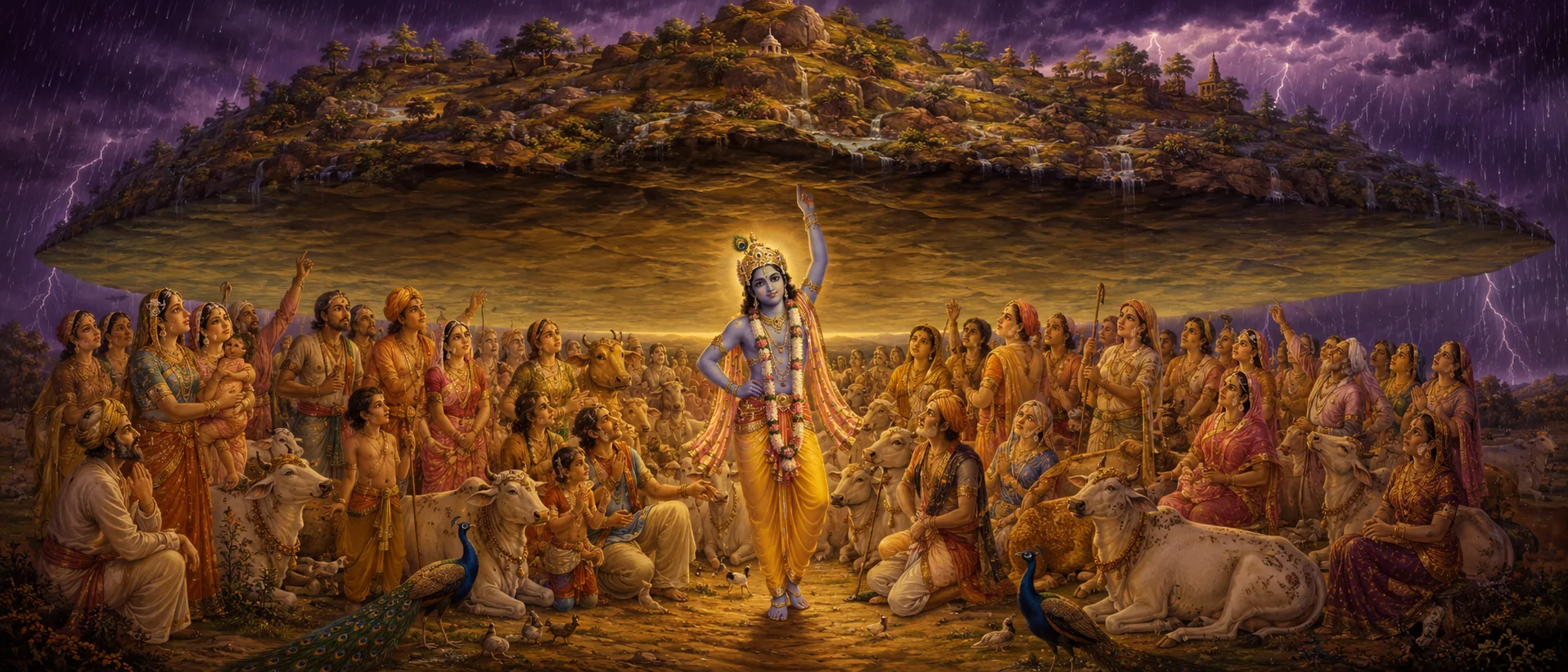
Skandha 10 is the heart of the Bhagavatam: the complete life of Krishna, told with a tenderness and narrative richness the rest of the Purana only gestures toward. It opens with a prison birth and a father's desperate midnight crossing of a river to save his newborn son, moves through a childhood so full of miracles that the miracles themselves become ordinary — a demoness's poisoned milk, a forest fire swallowed whole, a serpent subdued by dance, a mountain lifted on a fingertip — and arrives, in early youth, at the Rasa-lila, the dance with the gopis that Vaishnava tradition reads as the most complete image it has of the soul's longing for the divine. The skandha's second half turns outward: Krishna leaving Vrindavana forever to kill the tyrant Kamsa, founding Dvaraka as a city built for peace after a war he never wanted, marrying Rukmini and many others, and finally standing at the center of Yudhishthira's Rajasuya sacrifice as the figure whose presence alone completes it — even as Shishupala's persistent hatred becomes, in the end, just one more form of a mind fixed entirely on God.
Chapters
Why it matters today
Skandha 10 is why the Bhagavatam is a devotional text rather than merely a philosophical one — its central claim isn't argued but shown, in a childhood, a courtship, a friendship, a kingdom. The Rasa-lila in particular has generated centuries of theological commentary precisely because it refuses to resolve into either pure allegory or pure narrative; Vaishnava tradition insists it be read as both simultaneously.