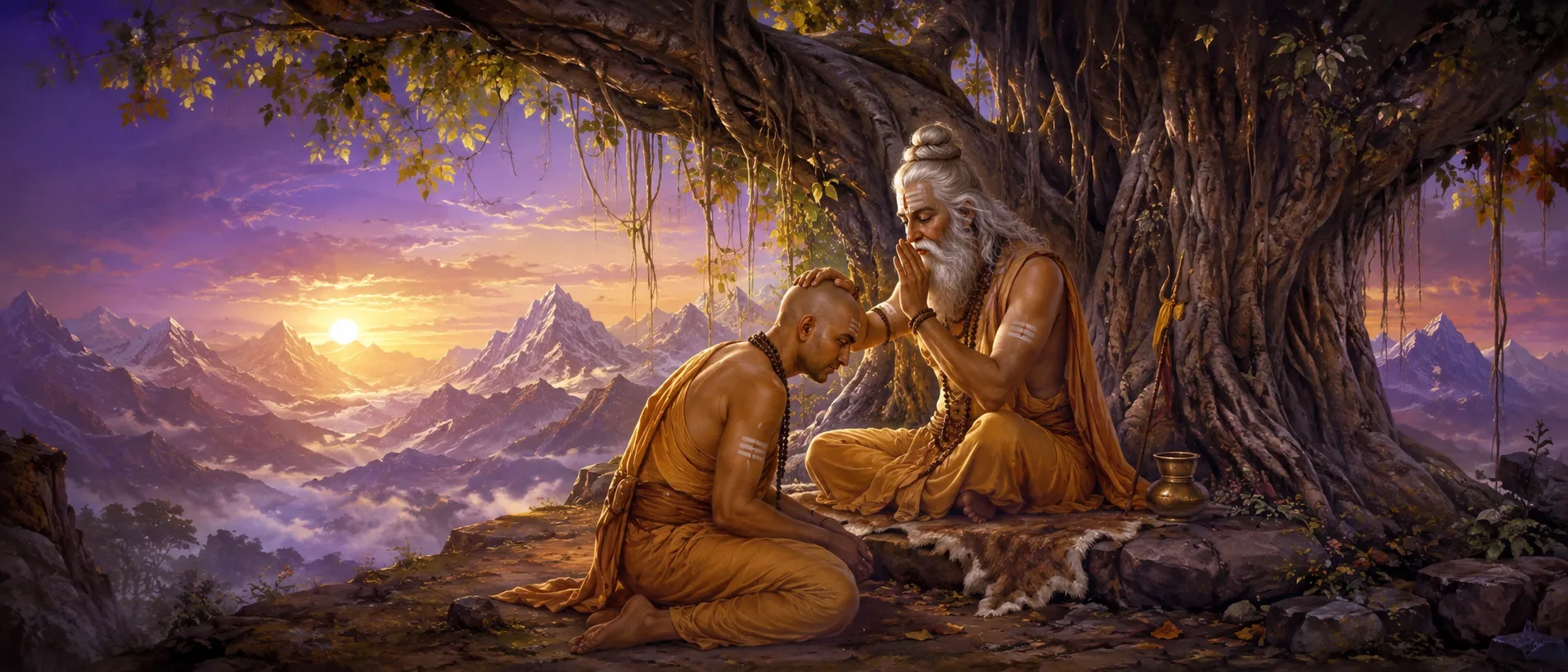
The Kailasa Samhita is the Shiva Purana's manual of renunciation. It begins with Shiva-Advaita teaching — the non-dual nature of the self, spoken as a narration of creation itself — before turning, with striking practicality, to exactly how a person becomes a sannyasin: the qualification and making of a disciple, the yoga-patta rite in which the guru transmits the twenty-two great Upanishadic sayings (mahavakyas) that declare the identity of the self and the absolute, and the tonsure and ritual bathing that mark the renunciant's new life. Its second half is unusual among these Samhitas for what it dwells on: the precise ritual sequence a renunciant's own community performs at his death, carried day by day through the tenth, eleventh, and twelfth days, ending in a discourse tracing the teaching lineages that descend from Vyasa and from Vamadeva. Where other Samhitas describe Shiva's play in the world, this one describes the discipline by which a person is meant to leave the world altogether.
Chapters
Why it matters today
The Kailasa Samhita's yoga-patta chapter — the transmission of the twenty-two mahavakyas — is one of the few places in the Puranic corpus where the Upanishads' core non-dual declarations are gathered into a single ritual sequence rather than scattered across separate texts, making it a compact entry point into Advaita teaching for a reader unfamiliar with the individual Upanishads.