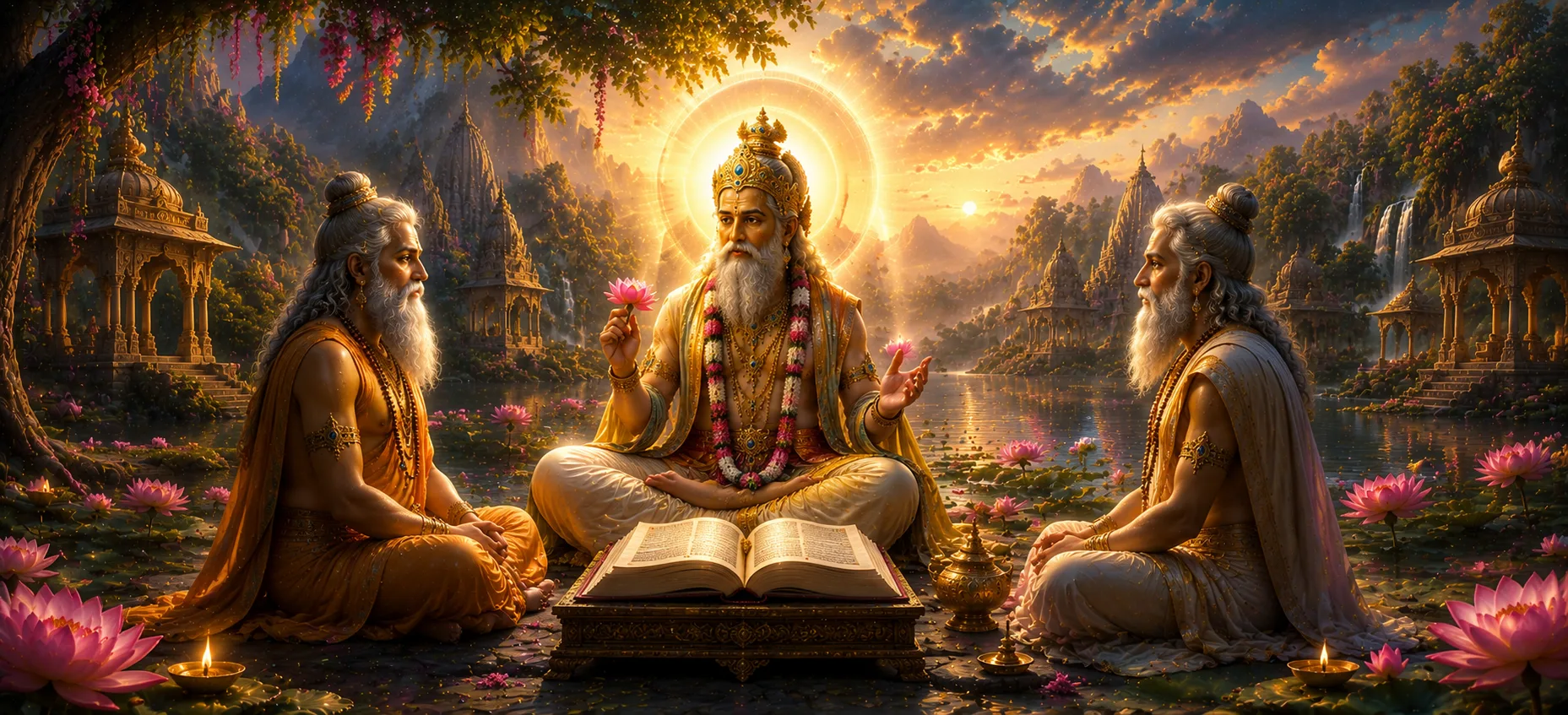
The Svarga Khanda closes this Purana's account of sacred fords with a sequence of tirtha-mahatmyas — the many crossing-points of the Narmada, the glory of Varanasi as Avimukta ('the never-forsaken'), the shrines Kapardishvara and Madhyameshvara, and an extended treatment of Gaya and Prayaga, the latter framed by King Dilipa's own story. From pilgrimage the text turns to formal dharma: the upanayana (sacred-thread investiture) and the snataka's graduation rite, the disciplined conduct expected of a Vedic student and of anyone approaching a guru, the practice of Gayatri japa, and a full accounting of what is required at each of life's four stages — student, householder, forest-dweller, renunciant — including rules of diet and the merit of giving (dana). The khanda closes with a hymn of devotion to Hari and a striking final chapter that reads the entire eighteen-Purana corpus as distributed across the limbs of Vishnu's own body — a closing gesture that gives this khanda's alternate name, the Adi Khanda, a kind of foundational, summarizing weight.
Chapters
Why it matters today
The closing chapter's mapping of all eighteen Puranas onto Vishnu's own body is a distinctive piece of Puranic self-reflection — rather than simply listing the eighteen texts as an external catalogue (as several other Puranas do), it embeds the entire genre inside the very deity most of them venerate, making the corpus itself a kind of extended body of god.