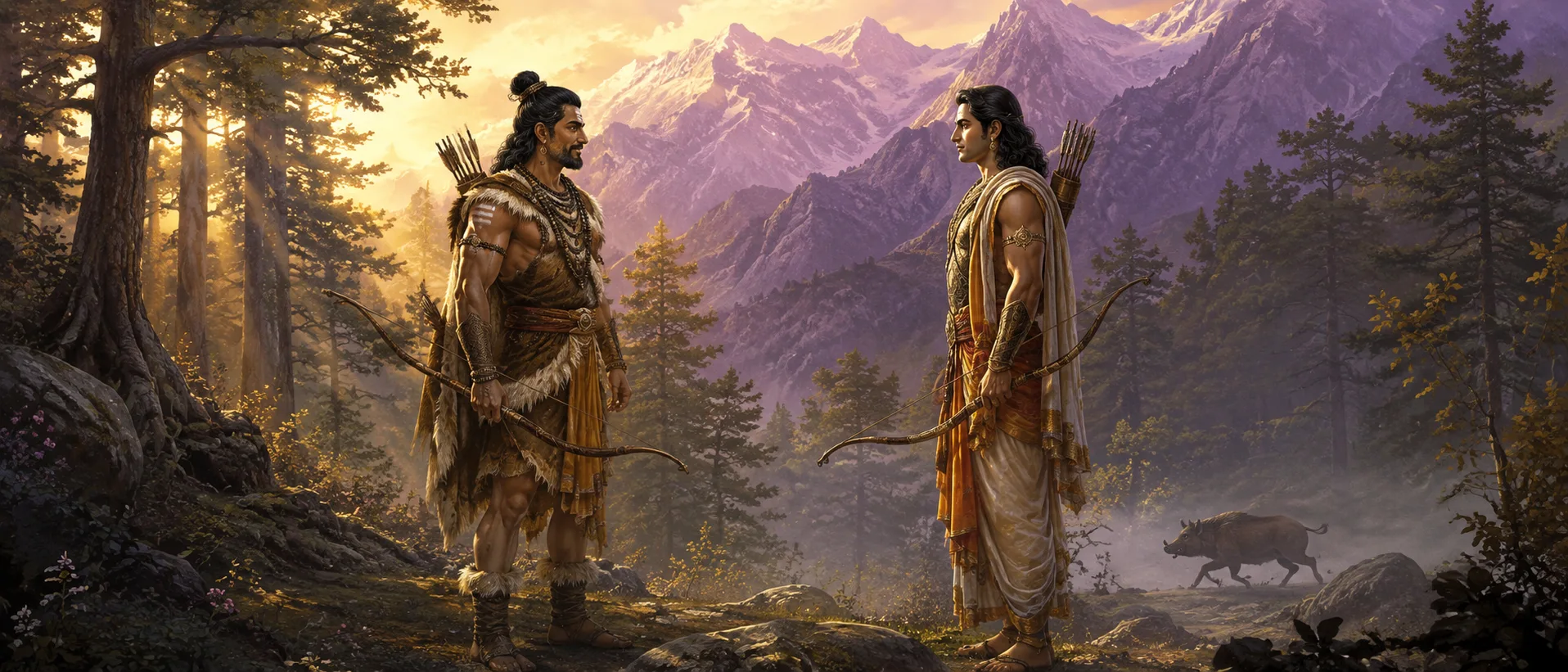
The Shatarudra Samhita answers a single question in exhaustive detail: what are Shiva's incarnations, and why did each one occur? Sanatkumara walks Nandishvara through Shiva's ten and then eleven-fold manifestations before slowing down to tell each incarnation's own story — Durvasa's fierce asceticism, Hanuman's devotion, a bull sent to correct Vishnu's own transgression, the sage Pippalada whose curse first shortened Shani's power over human life, and a sequence of avataras (Vaishyanatha, Dvijeshvara, Yatinatha, Avadhuteshvara, Bhikshuvarya, Sureshvara, Brahmachari, Sunartaka-Nata) each tied to a particular devotee's need or a particular cosmic correction, including the origin of Nala and Damayanti's story and of Jalandhara's birth. Ashvatthama's covert aid to Bhishma in battle appears as its own incarnation-story. The text's longest and most celebrated arc closes the Samhita: Arjuna's forest austerities, his dispute with a Bhilla hunter over a slain boar, and the hunter's revelation as Shiva himself — the Kirata avatara — culminating in single combat and the granting of the Pashupata weapon. A final chapter names all twelve Jyotirlinga-avataras as a set, closing the Samhita's own particular way of answering 'what is Shiva' with a list of everywhere and everyone he has personally been.
Chapters
Why it matters today
The Kirata episode closing this Samhita is one of the most widely retold Shiva stories outside the Puranic corpus itself — the basis of Bharavi's classical Sanskrit epic Kiratarjuniya — and its placement here, as the culmination of a whole samhita cataloguing incarnations, frames Arjuna's combat with Shiva not as an isolated legend but as one entry, deliberately the climactic one, in a complete taxonomy of how and why Shiva takes form.