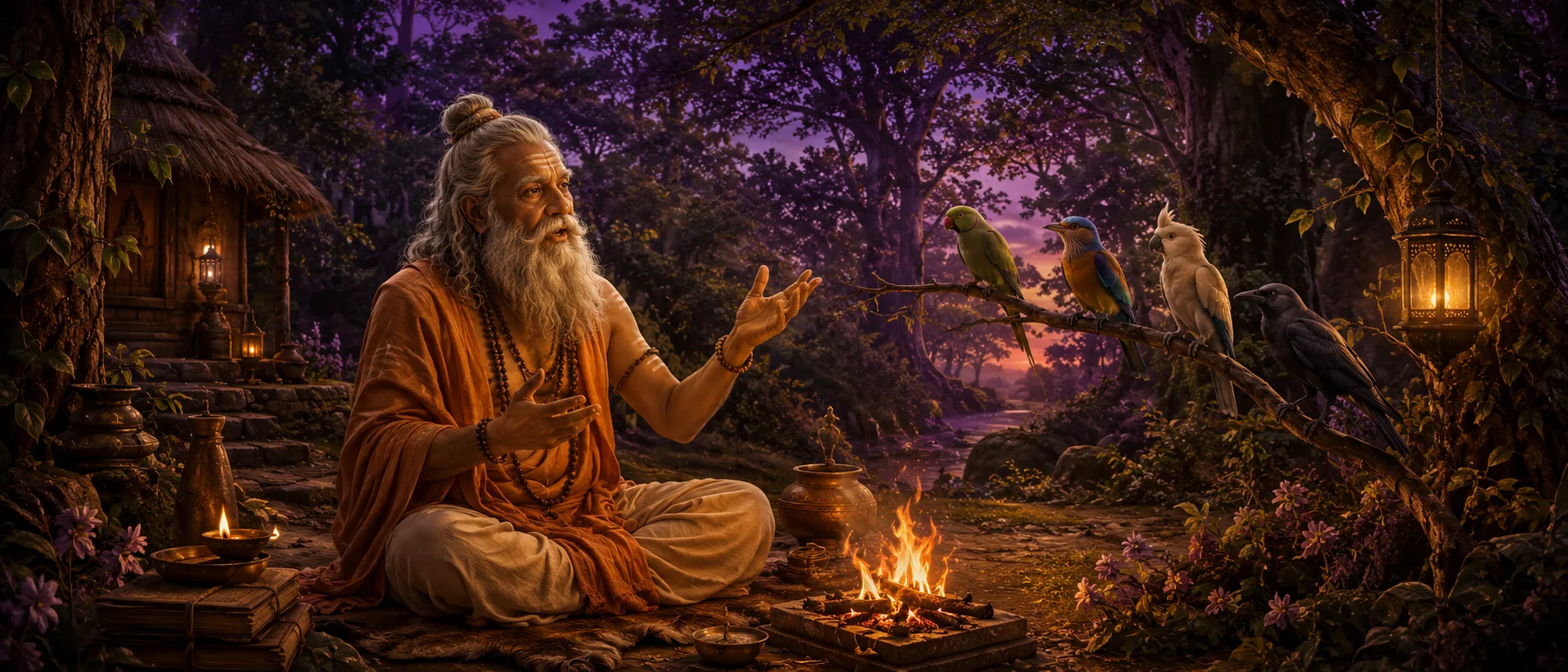
This build of the Markandeya Purana opens with sage Jaimini's puzzled questions about the Mahabharata and Markandeya's long answer, beginning with King Harishchandra's ordeal of truthfulness and moving through the Dattatreya-Alarka cycle on renunciation, kingship, and daily conduct. A long middle section maps the visible cosmos in careful geographic and astronomical detail — the seven island-continents, the rivers and mountains of Bharata-varsha, the sun's course, and the fourteen Manvantaras, past and future, each with its own Manu, gods, and sages, woven through with individual stories (Svarochi, the swan and the faithful stag, King Uttama and his lost queen) that keep the genealogy from ever feeling like a bare list. The text's final and most celebrated movement is the Devi Mahatmya: King Suratha and the merchant Samadhi, both stripped of everything they thought was theirs, meet the sage Medhas in the forest and hear the story of the Goddess — her manifestation from the combined radiance of all the gods, her battles with Madhu-Kaitabha, Mahishasura, and finally Shumbha and Nishumbha, and the hymns of praise that follow each victory — before Suratha and Samadhi receive, in turn, a restored kingdom and a state beyond kingdoms altogether.
Chapters
Why it matters today
The Devi Mahatmya's frame is easy to overlook but does real work: it insists that both a dispossessed king and a betrayed merchant — one who lost status, one who lost family — arrive at the same forest teacher with the same unresolved attachment, and receive the same answer. The text that follows is offered to both of them equally, which is part of why it has remained so widely recited across caste and class lines.
This story is also told in
Devi Mahatmya retold (Devi Bhagavatam, Skandha 5)
A near-full-length independent retelling within the Devi Bhagavatam's own frame.
Devi Mahatmya retold again (Devi Bhagavatam, Skandha 10)
A second, shorter retelling within the same Purana.
The Goddess's three avataras (Shiva Purana, Uma Samhita)
Compressed and recast theologically as Mahakali/Mahalakshmi/Sarasvati.
Harishchandra's ordeal (Devi Bhagavatam, Skandha 7, ch. 15-27)
The most extended, detailed version of the story.