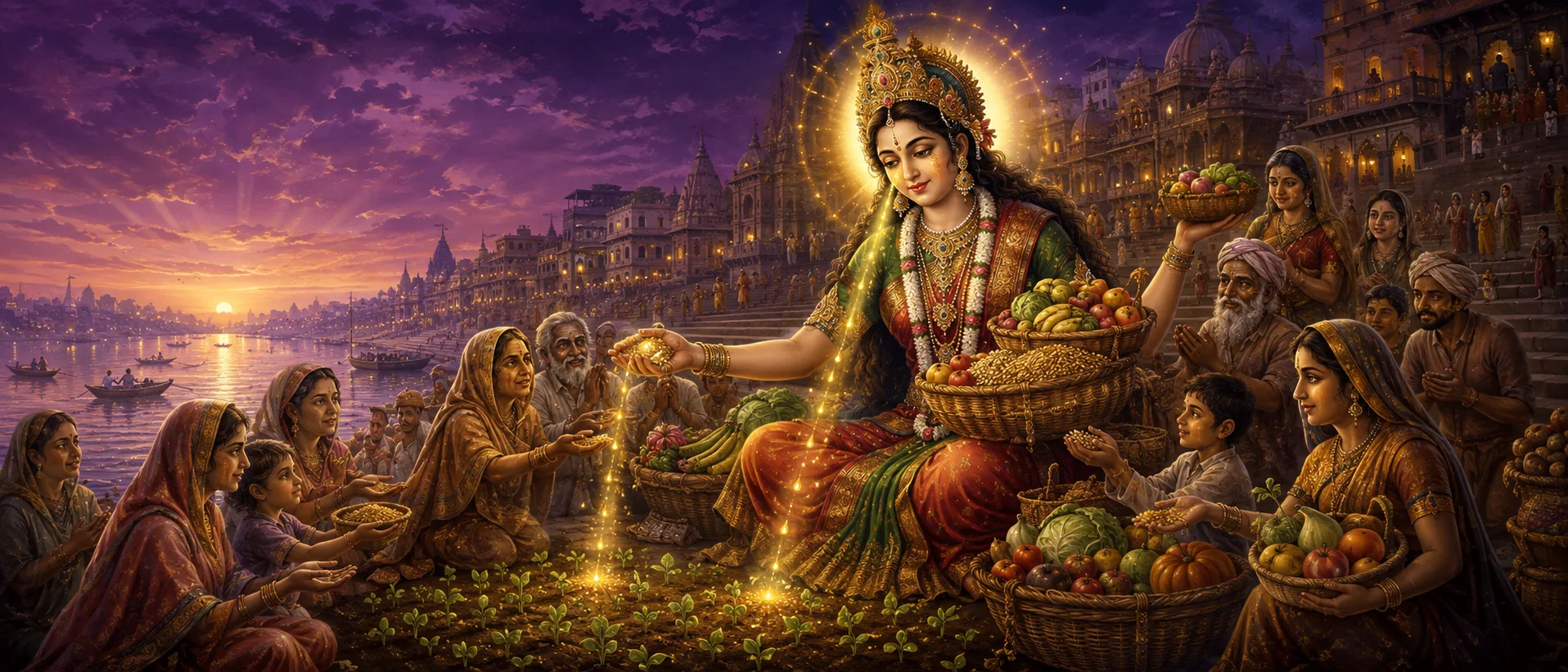
The Uma Samhita covers more ground than any other book of the Shiva Purana. It opens as a yoga manual — teaching on reading the signs of approaching death, on 'deceiving time' through pranayama and khecari-mudra, on the shadow-being and Kundalini — before shifting entirely into cosmology and genealogy: the primordial creation, Kashyapa's full progeny of gods and demons, the fourteen Manvantaras in careful sequence, the Ikshvaku dynasty's long descent through Harishchandra, Sagara, and Rama down to the kings who will reign as Kali Yuga arrives, and a discourse on the Pitrs. A quieter narrative thread follows: the story of seven hunters and their fate, then the birth of Vyasa from Parashara and Satyavati, his pilgrimage to Kashi, and his classification of all eighteen Puranas — inside which the text places its own retelling of the Devi Mahatmya, the Goddess's three great avataras as Mahakali (Madhu-Kaitabha), Mahalakshmi (Mahishasura), and Sarasvati (Shumbha-Nishumbha). Only in its last three chapters does the Samhita turn to what its title promises: Uma's own manifestation to humble the proud gods after a demon-war, the Shatakshi-Shakambhari famine narrative in which the weeping Goddess restores the Vedas and feeds a starving world, and a closing chapter of temple-building merit and the full annual festival calendar.
Chapters
Why it matters today
The Shakambhari/Shatakshi narrative closing this Samhita is one of the Puranic corpus's most direct statements of the Goddess as literally the source of food and sustenance — her weeping becomes the crops that end the famine — giving Devi worship an agricultural, provisioning dimension that sits alongside her more commonly emphasized roles as warrior and mother.
This story is also told in
Devi Mahatmya (Markandeya Purana, ch. 81-92)
The original, most-cited telling of the Devi Mahatmya.
Devi Mahatmya retold (Devi Bhagavatam, Skandha 5)
A near-full-length independent retelling within the Devi Bhagavatam's own frame.
Devi Mahatmya retold again (Devi Bhagavatam, Skandha 10)
A second, shorter retelling within the same Purana.