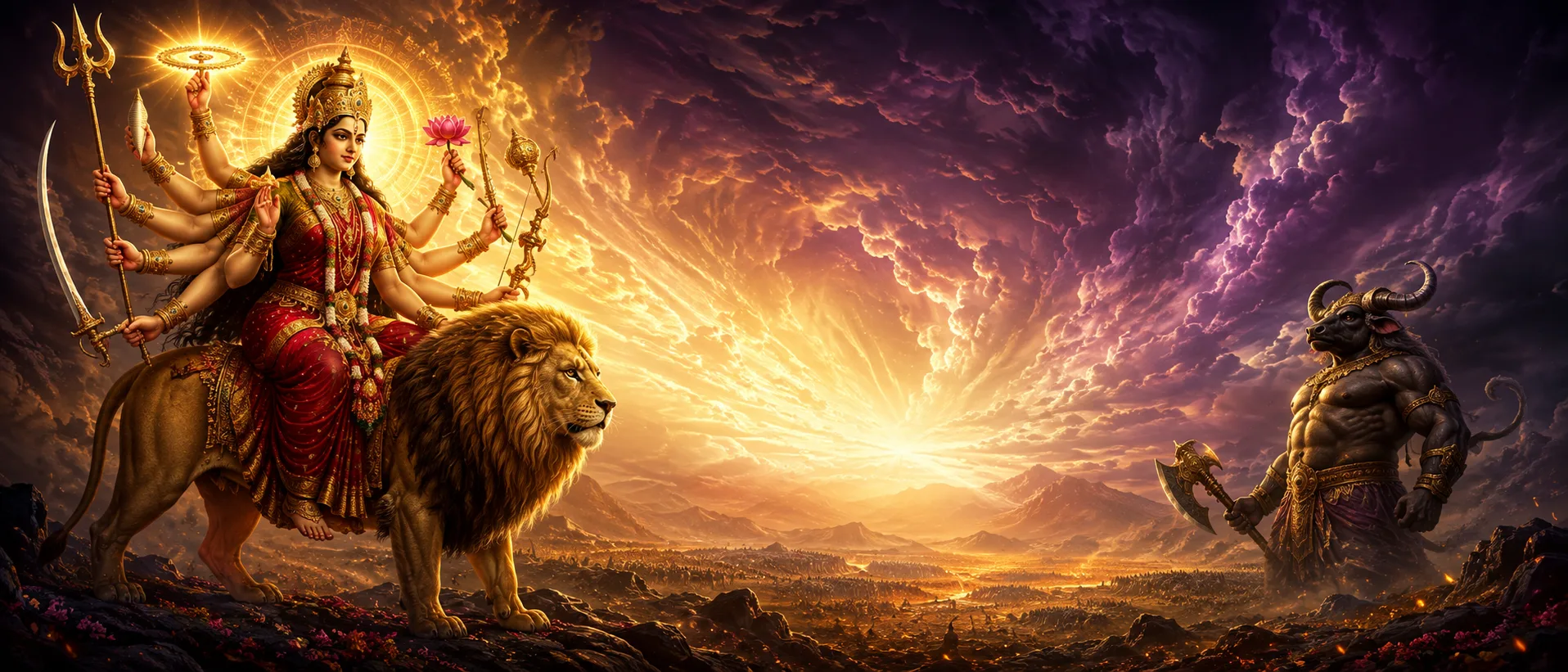
Skandha 5 is the Devi Bhagavatam's own version of the Devi Mahatmya, telling the war against Mahishasura and against Shumbha-Nishumbha in full narrative detail within this Purana's own frame. Mahishasura's ministers fall one by one to the Goddess before he himself, in a celebrated shapeshifting sequence — buffalo to man to lion to elephant to sharabha and back to buffalo — is finally beheaded by her discus, and the earth rejoices at his death. The narrative then turns to Shumbha and Nishumbha, whose conquest of heaven provokes the gods to worship the Goddess anew; her generals Chanda and Munda fall first, earning Kali the name Chamunda, then the blood-multiplying demon Raktabija is defeated only when Chamunda drinks every drop of his blood before it can touch the ground and spawn a new demon, and finally Nishumbha and then Shumbha himself are slain in the war's true climax. The skandha closes by returning to its frame: King Suratha and the merchant Samadhi, having heard this whole account from sage Sumedhas — including his teaching on Maya and the story of Brahma, Vishnu, and the Linga born of their dispute — receive the Navaratri worship procedure and, in the skandha's final chapter, the boons their devotion has earned.
Chapters
Why it matters today
Reading this skandha's Devi Mahatmya alongside the Markandeya Purana's more famous Durga Saptashati version shows how the same war-narrative could be extended with considerably more incident and dialogue when relocated into the Devi Bhagavatam's own longer, more expansive Purana structure.
This story is also told in
Devi Mahatmya (Markandeya Purana, ch. 81-92)
The original, most-cited telling of the Devi Mahatmya.
Devi Mahatmya retold again (Devi Bhagavatam, Skandha 10)
A second, shorter retelling within the same Purana.
The Goddess's three avataras (Shiva Purana, Uma Samhita)
Compressed and recast theologically as Mahakali/Mahalakshmi/Sarasvati.