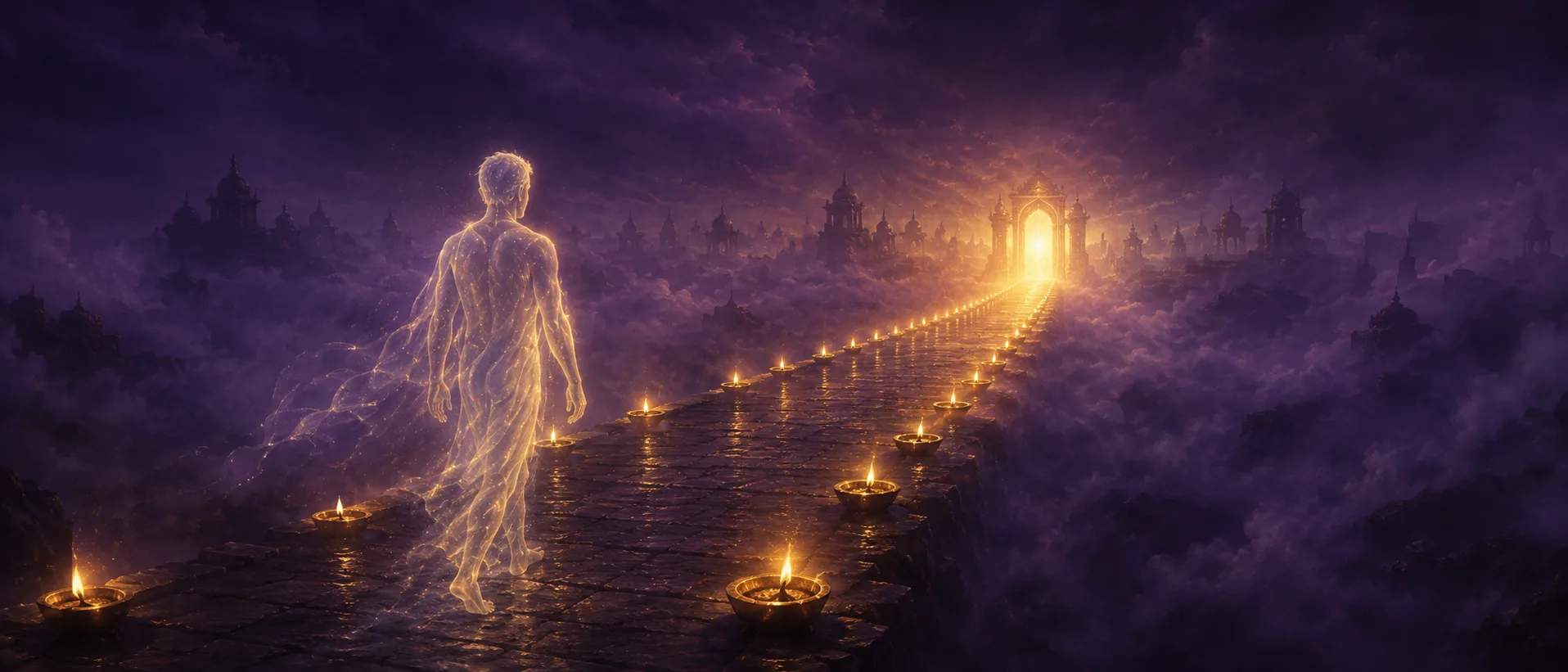
This khanda opens with Garuda's own questions to Vishnu about death and what follows it, and answers with the tradition's most detailed and widely-known account of the afterlife journey — the seven classical hells and their torments, the precise procedure for cremation and the sixteen shraddha rites owed to the departed, and the soul's arduous year-long passage through sixteen cities en route to Yama's own realm, its trials shaped by how a person lived and died, interwoven with narrative interludes like the story of King Vipracitti and the five pretas. Its second half, the Brahmakanda, turns from the individual soul's fate to cosmology at large: Krishna's extended teaching to Garuda on the structure of the cosmic egg (Brahmanda), the layered creation of gods and sages from Brahma's own body across successive spans of divine years, and a systematic gradation (taratamya) of every being in existence — from Lakshmi and Shesha down through the sages and the fiercest demons — ranked by nearness to Vishnu. The khanda closes with Brahma's own long hymn of praise and a final teaching distinguishing genuine wisdom about Hari from its counterfeits.
Chapters
Why it matters today
The Pretakalpa remains one of the most functionally alive portions of the entire Puranic corpus — it is still the specific text recited by priests during Hindu funeral rites across much of India today. The Brahmakanda's taratamya (gradation) doctrine, by contrast, is a distinctly Madhva-Vaishnava theological framework, of real historical and sectarian interest but not shared by Hindu tradition as a whole.