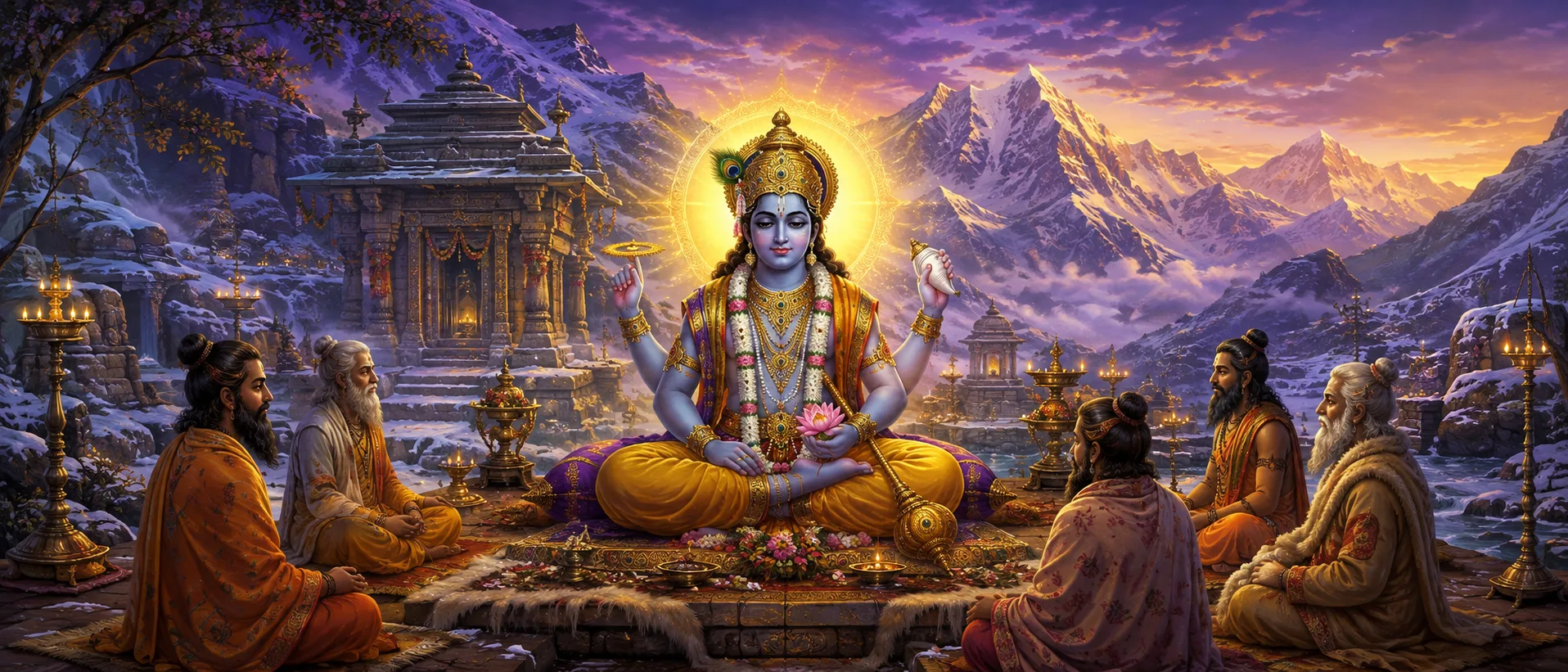
Vaishnava Khanda gathers nine mahatmyas glorifying Vishnu's sacred sites, the merit of specific months and observances, and the greatness of hearing the Purana itself. It opens at Venkatachala (Tirupati), tracing the mountain's cosmic origins and the tapas of Anjana that brings forth Hanuman, before moving to Puri, where the founding and sanctity of the Purushottama-Jagannatha kshetra unfolds at length. A visit to Badrinath's sacred fords follows, then an extended cycle on the vows and merit of the month of Kartika — bathing, lamp-offerings, Ekadashi, and the interwoven tale of Jalandhara, Vrinda, and the origin of Tulasi. The Margashirsha-masa Mahatmya turns to worship of the conch and tulasi and closes with the glory of Mathura, while a short but potent Bhagavata Mahatmya declares the supremacy of hearing that scripture above all austerities. The Vaishakha-masa Mahatmya carries a full retelling of Daksha's sacrifice, Sati's death, and the birth of Skanda, alongside King Kirtiman's confrontation with Yama himself. A pilgrimage through Ayodhya's own sacred fords follows, and the khanda closes with the Vasudeva Mahatmya — King Uparichara Vasu's fall and redemption, the churning of the ocean of milk, the celestial wedding of Lakshmi and Narayana, and instruction in the worship of Vasudeva — ending, fittingly, with the khanda's own colophon of completion.
Chapters
Why it matters today
Venkatachala/Tirupati and Puri's Jagannatha Temple remain, respectively, among the most-visited and most iconic pilgrimage sites in India today, giving this khanda's opening mahatmyas an unbroken devotional life; its Kartika-masa and Vaishakha-masa observances (lamp-offerings, Tulasi worship, Ekadashi vows) are still widely kept across Vaishnava households each year, making this one of the most directly lived-out khandas of the entire Skanda Purana.