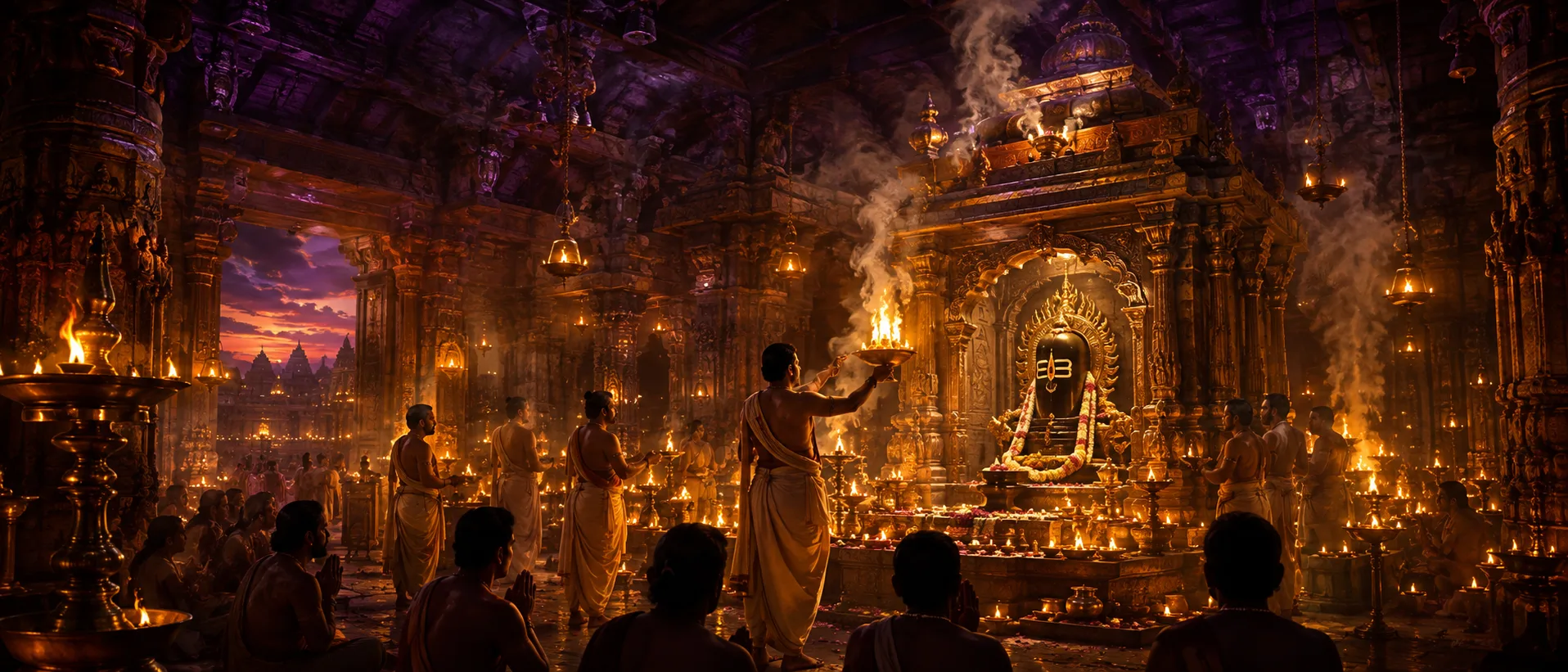
Avanti Khanda is the largest single khanda of the Skanda Purana, built around the sanctity of Ujjayini (Avanti) and the river Narmada. It opens with the Avanti-kshetra-mahatmya, an extended glorification of Ujjayini's own tirthas and the great Mahakaleshvara jyotirlinga, woven through with local legends — Brahma's severed head, the churning of the ocean, and the deeds of kings and sages who found liberation at its waters. The 84-Linga Mahatmya follows with a fixed cycle of eighty-four Shiva-lingas established in and around Mahakalavana, each chapter recounting the specific story — of a king, a sage, a repentant sinner, or a god — that gave that linga its name. The khanda's vast final movement, Reva Khanda, turns to the river Narmada herself: her birth from Shiva's own tapas-sweat, her many names and the kalpas in which she has never perished, and then an immense tirtha-by-tirtha pilgrimage along her banks — the churning of the ocean of poison, Parashurama's slaying of Kartavirya Arjuna, the founding of Bhrigukachchha (Bharuch), and Markandeya's own vision of cosmic dissolution — closing with a full roll-call of Reva Khanda's own tirthas and the merit of hearing this book. A short appended text, the Satyanarayana-vrata-katha, closes the khanda with the popular tale of the vow to Satyanarayana and its four generations of tested devotees.
Chapters
Why it matters today
Ujjain's Mahakaleshvara Temple remains one of the twelve jyotirlingas and one of India's most-visited Shiva pilgrimage sites (host to the Simhastha Kumbh Mela), while the Narmada parikrama — a circumambulation of the entire river praised at length in this khanda's Reva Khanda — remains among the most arduous and revered pilgrimages still undertaken in living Hindu practice today, giving this khanda's geography an unbroken devotional life outside the text itself.