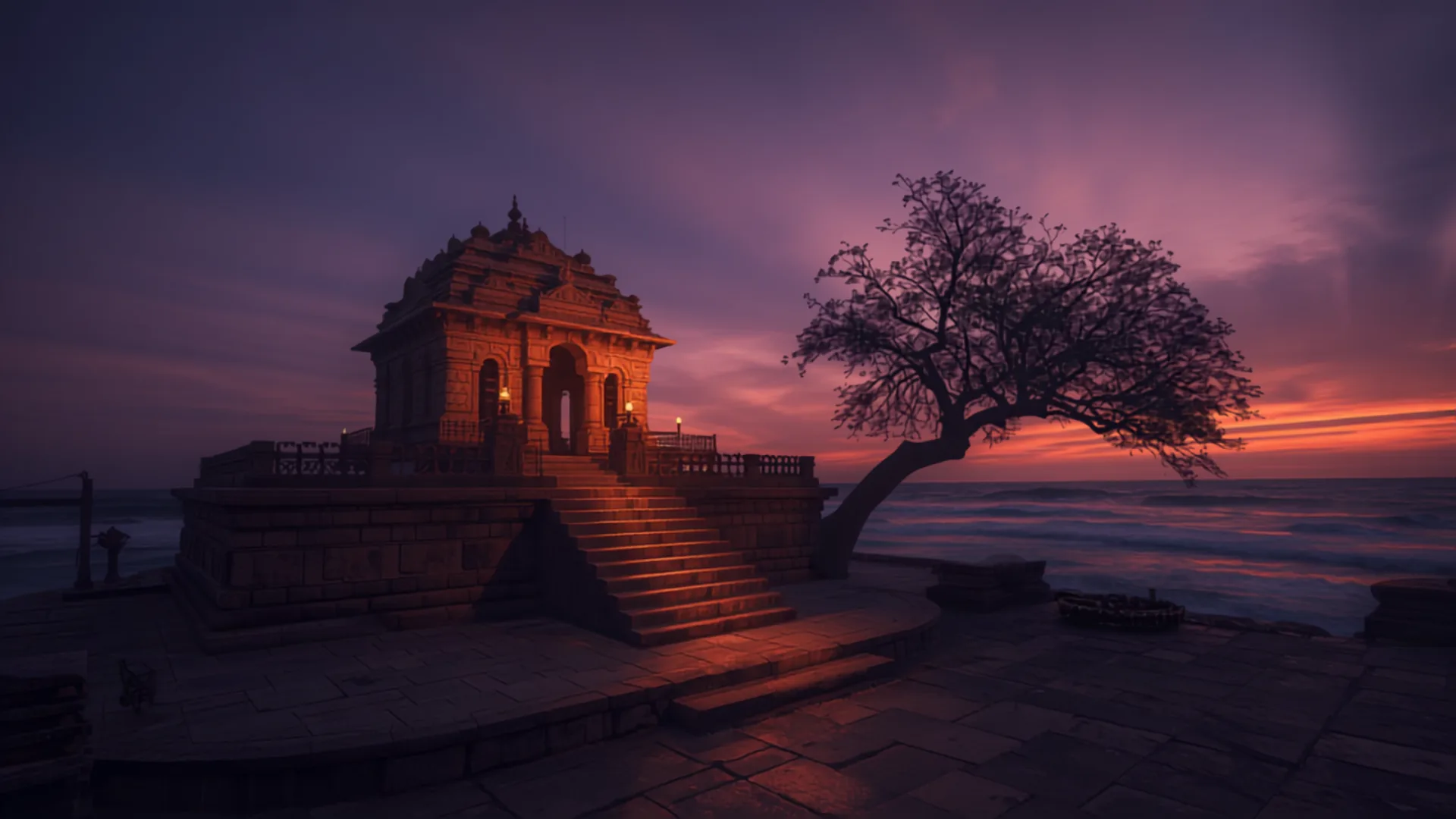
Prabhasa Khanda closes the Skanda Purana at the great tirtha of Prabhasa — the coastal Gujarat site of the Somnath jyotirlinga — where the epic itself brings the Krishna narrative to its own end. Its vast opening movement, the Prabhasa-kshetra-mahatmya, is the largest single sub-book of the entire Purana: it tells of the moon's curse and the origin of Somanatha, then unfolds tirtha by tirtha across the Prabhasa coastline — the Ekadasha-Rudra cycle, Daksha's sacrifice and Sati's death, the Savitri-Satyavan legend, Valmiki's own origin as a repentant thief, the Vena-Prithu cycle, and finally the Mausala destruction of the Yadava clan and Krishna's departure from the world at nearby Bhalka-tirtha. The Vastrapatha-kshetra-mahatmya follows with the glory of Damodara and the subjugation of King Bali, while Arbuda Khanda glorifies Mount Abu and the birth of Ganesha at its sacred fire. The khanda's closing movement, Dvaraka-mahatmya, turns to Krishna's own capital — Durvasa's curse and Rukmini's sorrow, the sanctity of the Gomati river, and the full pilgrimage rites of Dvaraka — ending, fittingly, with the completion not only of this khanda but of the entire eighteen-thousand-verse Skanda Purana itself.
Chapters
Why it matters today
The Somnath Temple at Prabhasa remains one of the twelve jyotirlingas and one of the most historically resonant Shiva pilgrimage sites in India (repeatedly destroyed and rebuilt across a millennium, most recently after 1947), while Dvarakadhish Temple in Dvaraka remains one of the Char Dham, giving this final khanda's two principal sites an unbroken devotional and cultural life that continues to draw millions of pilgrims each year.